As of 2026-05-10 UTC, Tencent's newest ai-china signal is easy to underread if you stop at Hy3 preview and call it another model release. The April 24 announcement does matter. Tencent says Hy3 preview was rebuilt for real-world usability, stronger agent behavior, and tighter integration with products such as Yuanbao, Tencent Docs, CodeBuddy, and WorkBuddy.[1] But the more revealing May signal sits one layer above the model: AI Gateway, a Tencent Cloud product positioned as the traffic entry point and governance hub for enterprises that need to access, route, observe, and secure multiple AI models at once.[2]
That shift matters because it changes the practical unit of competition. Instead of asking only which model won a benchmark week, Tencent is also asking who controls the ingress layer through which enterprise applications reach models, tools, and older internal systems. The public documentation describes a product that can front Hunyuan, open-source models, and third-party commercial models, while also converting between MCP/OpenAI/SSE protocols and older HTTP/gRPC services.[2] My inference from those documents is straightforward: Tencent wants its advantage to sit not only inside the model, but at the point where model traffic becomes governable production infrastructure.
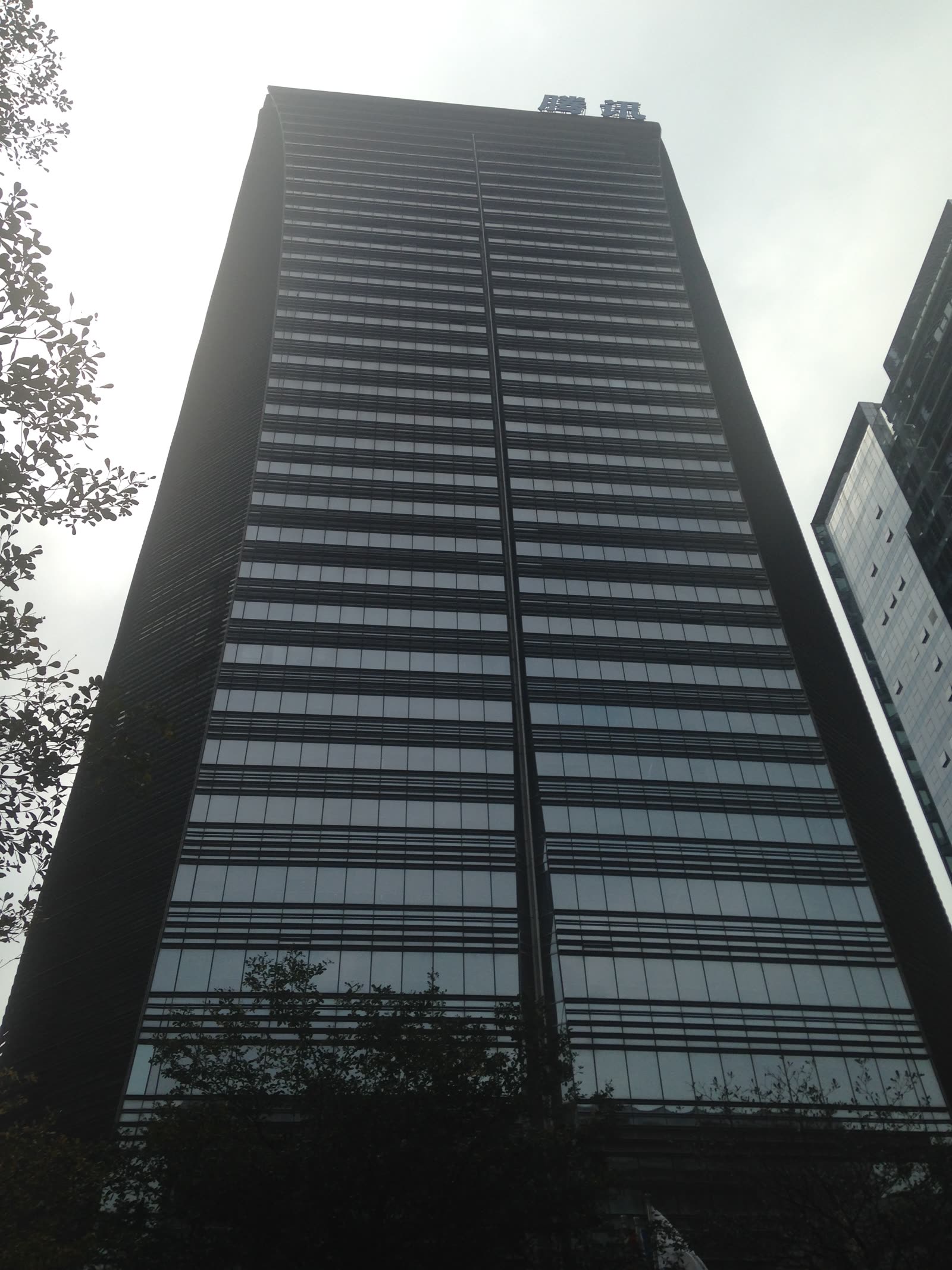
Image context: the cover uses a real Wikimedia Commons photograph of Tencent's Shenzhen headquarters. That is the right visual anchor here because the article is about company-scale architecture and control surfaces, not about a single benchmark chart or one demo prompt.[6]
The practical clue is the gateway, not only the model
Hy3 preview still matters as context. Tencent's April 24 article says the company rebuilt its pre-training and reinforcement-learning infrastructure from February 2026 onward to improve reasoning, instruction following, tool use, and practical agent performance.[1] Tencent also says Hy3 preview can support agent workflows of up to 495 steps, works with frameworks such as OpenClaw, and was integrated into internal product surfaces rather than left as an isolated research artifact.[1] Those details suggest Tencent wants Hunyuan to be read as a model that can survive real workflow complexity, not merely as a leaderboard entry.
The gateway documents make the next step legible. Tencent Cloud's AI Gateway overview says the product is built for enterprises facing a familiar problem: too many models, too many protocols, weak governance, and little cost control.[2] In that framing, the real operational headache is not "how do I call one model?" It is "how do I keep many model lanes and business APIs behind one stable, observable, permissioned front door?" Tencent's answer is to turn the gateway into a new architectural choke point.[2]
The use case is multi-model governance, not single-vendor lock-in
The strongest evidence for that reading appears in the product's own feature list. Tencent Cloud says AI Gateway supports unified access and intelligent scheduling across Hunyuan, open-source models, and third-party commercial models, with routing decisions shaped by factors such as content, performance, and cost.[2] The same page adds rate limiting, circuit breaking, degradation, security controls, token-cost observability, and consumer-group permissions.[2] This is not the language of a single-model showcase. It is the language of governed traffic.
The separate Model Services documentation sharpens the point. Tencent says AI Gateway can add model services from providers including Hunyuan, Google Gemini, DeepSeek, Qwen, and OpenAI.[3] It also gives operators two distinct policy shapes. In Specified Model mode, the gateway ignores the client's requested model and forces traffic through a chosen default model, with optional fallback rules for availability.[3] In Passthrough Request Model mode, the client keeps control, but the gateway can still validate requested model names against an allowlist and decide whether invalid requests should fail or degrade to a default lane.[3]
That policy split is more important than it first appears. It means Tencent is selling enterprises a way to keep client applications relatively stable while model choice changes above them. One team can lock a workflow to a controlled default for cost and uptime reasons; another can preserve flexible client-side selection while still enforcing guardrails.[3] The use case is therefore wider than "route to Hunyuan." It is "treat model selection as a governed policy surface."
Legacy-system conversion is the more surprising part of the pitch
The product becomes more interesting when it turns away from model-vs-model comparison and toward older business systems. Tencent Cloud says AI Gateway includes a protocol-conversion engine that can translate between AI-facing protocols and conventional business interfaces, and even package standard business APIs as MCP Tools for AI applications.[2] The documentation explicitly frames this as a way to give legacy systems a "zero-code" path into AI workflows.[2]
That matters because it places the gateway at the boundary between two very different worlds: agent frameworks on one side, old enterprise service estates on the other. Many AI product pages treat that boundary as an implementation detail left to customers. Tencent is making it part of the product story. In practice, that means the gateway is not only a model router. It is also a wrapper that can expose older business capability in a form agent systems can actually call.[2]
The Calling Hunyuan API Through AI Gateway guide reinforces that reading by showing the full operational sequence: create model keys, create a model service, create a model API, create consumers, group them for authorization, then invoke the route through the gateway address.[4] This is not abstract positioning copy. It is a concrete access pattern that separates upstream vendor credentials from downstream client identities and permissions.[4] For a real enterprise team, that separation is often where "we tried a model" ends and "we can operate this safely" begins.
Operations are part of the product, not a footnote
Tencent's AI Gateway story also carries a quieter signal about where ai-china competition is moving. The overview emphasizes end-to-end observability for latency, token usage, and model cost, plus intelligent diagnosis and alarms.[2] The product is therefore being pitched as a place where AI traffic can be measured in operational terms, not just experienced as a chat result.
The versioning document adds another layer. Tencent says AI Gateway versions follow a three-part scheme aligned with the first two digits of the Kong open-source version number, and each release receives up to 27 months of support across GA, EOM, and EOS phases.[5] That is a strong signal that Tencent expects customers to treat the gateway as durable infrastructure with upgrade planning, support windows, and expiration risk, rather than as an experimental console feature.[5]
This matters because it pushes the product away from demo culture. A model can look impressive in a product keynote and still be hard to operate across teams. A gateway, by contrast, only becomes valuable when permissions, routing policy, observability, fallback behavior, and version support all stay coherent over time. Tencent's public documentation is telling customers that this is the layer it wants to own.[2][3][4][5]
Why this matters in AI-China
Taken together, Hy3 preview and AI Gateway point to a narrower but more durable claim about Tencent's position in ai-china.[1][2][3][4][5] Tencent is still trying to improve the underlying model, and Hy3 preview gives evidence of that. But the more defensible commercial move may be to turn model access itself into a governed product surface where Hunyuan, rival models, and legacy APIs can all be brought under one operational policy.
The boundary should stay clear. These are mostly first-party sources, so they show product intent and operating model more clearly than they show independent customer adoption.[1][2][3][4][5] The right watchpoints are therefore concrete. Watch whether Tencent adds more customer examples around AI Gateway. Watch whether the multi-vendor lane expands in visible production references. And watch whether the gateway becomes the place where enterprises manage Hunyuan alongside DeepSeek, Qwen, OpenAI, and internal APIs, rather than one more optional wrapper around a single model.
For now, the use case is strong enough to name. Tencent's newest practical pitch is not simply that Hy3 is better. It is that multi-model sprawl can be turned into an ingress problem, and Tencent wants AI Gateway to be the layer where that problem is finally managed.[2][3][4][5]
Sources
- Tencent, "腾讯混元Hy3 preview发布:主打实用,Agent能力大幅提升" (April 24, 2026; Hy3 preview, practical agent capability framing, product integrations, OpenClaw support, and 495-step workflow claim).
- Tencent Cloud, "AI 网关概述" (updated April 28, 2026; AI Gateway positioning, multi-model governance, protocol conversion, MCP Tool packaging, observability, and permission model).
- Tencent Cloud, "Model Services" (updated May 7, 2026; supported vendors including Hunyuan, Gemini, DeepSeek, Qwen, and OpenAI; specified-model vs passthrough policy; fallback and allowlist behavior).
- Tencent Cloud, "通过 AI 网关调用混元 API" (updated 2026; model key, model service, model API, consumer, consumer-group, and invocation flow through the gateway).
- Tencent Cloud, "版本生命周期管理" (updated January 29, 2026; Kong-aligned version numbering and 27-month support window across GA, EOM, and EOS).
- Wikimedia Commons, "File:Headquarters of Tencent 20160307.jpg" (source page for the documentary headquarters photograph used as the article image).