As of 2026-06-26 UTC, the most useful way to read Unitree R1 is not as a cheap humanoid that can cartwheel. It is a test of whether AI-China can turn embodied AI into a developer surface: low enough in price to leave the demo stage, open enough in interfaces to attract builders, and constrained enough that serious users can tell the difference between movement, teleoperation, and useful autonomy.
That distinction matters because humanoid robotics has a bad habit of turning every video into a prediction. A robot runs, flips, punches, or waves; the internet immediately asks whether household labor has been solved. R1 should be read more narrowly and more seriously. Unitree's current product page lists the R1 line from $4,900, says shipments begin in June 2026, separates ordinary R1 variants from the R1 EDU customization path, and states that the base product does not support secondary development.[1] The headline is affordability. The operational detail is segmentation.
The price is the funnel
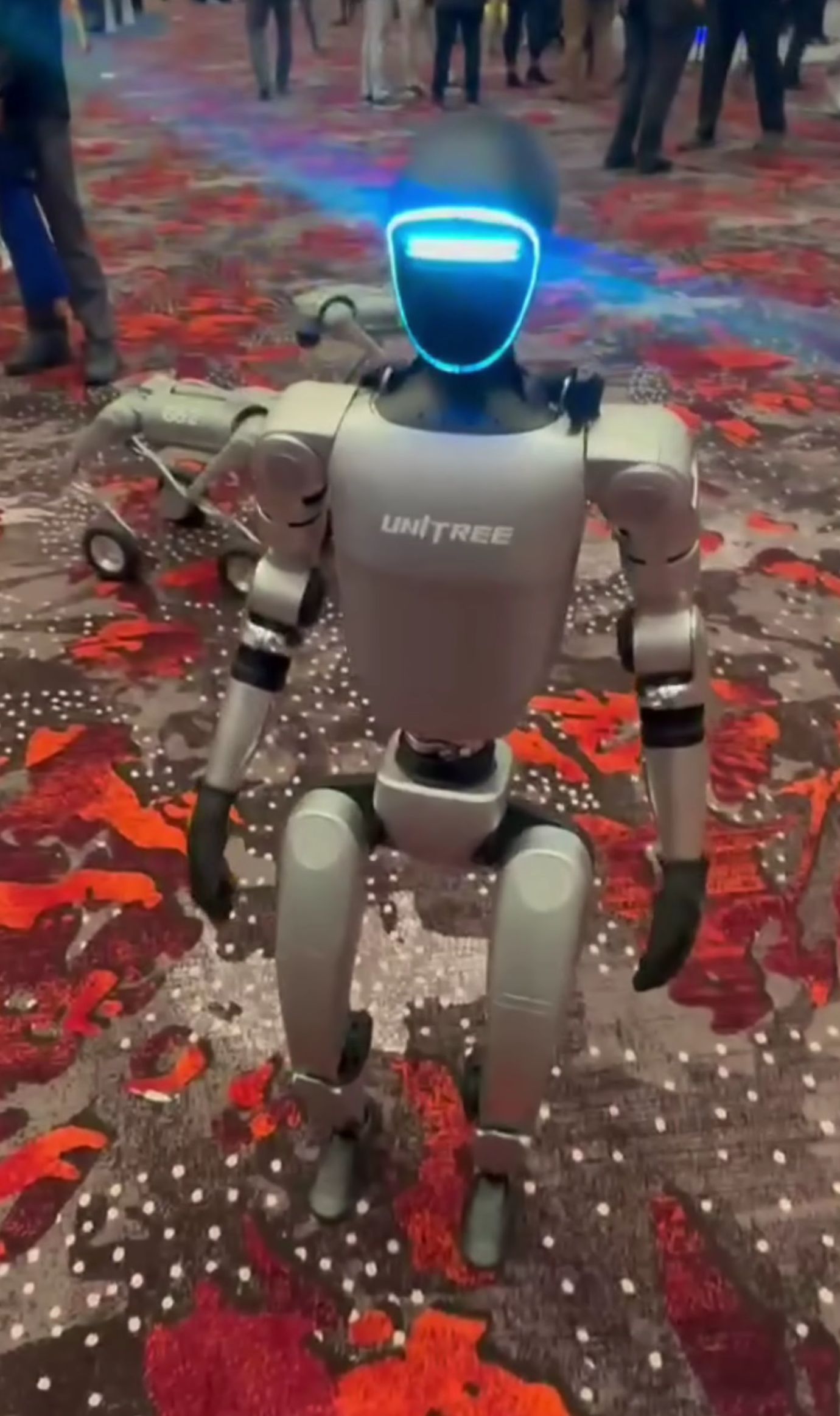
R1's low price is important because it changes who can experiment. A $90,000 humanoid belongs in a funded lab, a corporate pilot, or a theatrical demonstration. A sub-$5,000 to sub-$6,000 entry model starts to resemble a developer kit, even if it is still too dangerous, fragile, or limited to treat as a normal appliance. Unitree says the R1 is about 123 cm tall, weighs about 29 kg, and carries 20 to 26 degrees of freedom, depending on configuration.[1] Those are not household-worker numbers. They are bench-and-floor-test numbers.
The product split is the key. Unitree's store copy warns buyers that the base product does not support secondary development and points customization demand toward R1 EDU.[1] That is a useful boundary, not a disappointment. It says the cheap public model is not the same thing as an open research platform. For AI-China watchers, that split is the signal: consumer fascination, education, and research are being separated into different lanes rather than hidden under one "AI robot" label.
Notebookcheck's launch coverage captured the earlier public framing around a roughly $5,900 R1 with 26 movable joints, about 25 kg weight, an 8-core processor, microphones, speakers, Wi-Fi, Bluetooth, and multimodal speech-image interaction.[5] Unitree's live store now lists the R1 line from a lower starting price, so the exact public offer has shifted. The stable point is not the sticker number alone. It is the downward pressure on humanoid entry costs.
Interfaces matter more than acrobatics
The real question is what a builder can touch. Unitree's R1 page says the robot integrates speech and vision and, for the development lane, emphasizes open joint and sensor interfaces plus native simulation support.[1] That is where the product becomes more than spectacle. A humanoid that can only perform vendor-authored routines is a media object. A humanoid whose joints, sensors, robot description, SDK, and simulator can be worked against becomes infrastructure.
Unitree's public GitHub organization makes that infrastructure visible. It lists SDK, URDF, simulation, reinforcement-learning, teleoperation, LeRobot integration, app templates, and world-model/action repositories around the company's robot families.[2] The unitree_sdk2 repository describes a C++ SDK with Ubuntu 20.04, aarch64 and x86_64 support, CMake/GCC build paths, examples, and installation guidance.[3] The same organization also hosts unitree_model, a repository of robot model assets that includes humanoid families such as G1, H1, H2, and related USD/URDF-style model material.[4]
R1 should therefore be judged by whether it joins that workflow cleanly: model files for simulation, SDK access for control, repeatable examples, sane safety defaults, and enough hardware consistency that a classroom or robotics team can reproduce someone else's work. The AI layer is only one piece. Embodied AI fails when perception, control, latency, power, mechanical tolerance, and recovery behavior do not line up.
The AI-China signal is systems compression
This is where R1 fits the wider AI-China story. Chinese AI coverage often focuses on foundation-model releases, benchmark claims, token prices, or open weights. Unitree points to a different layer: systems compression. China has a manufacturing base that can push robot hardware prices down, cloud and model labs that can supply multimodal components, and a developer culture already used to SDK-first experimentation. R1 sits at the intersection of those layers.
But it should not be oversold. A low-cost humanoid does not prove general-purpose robot labor. A multimodal model inside a robot does not prove scene understanding under clutter, children, pets, reflective surfaces, loose cables, or an unexpected shove. A flip proves balance and control under a narrow routine. It does not prove that the same machine can load a dishwasher, sort laundry, or work safely beside a person for four hours.
The better use case is near-term and developer-shaped: robotics classes, embodied-AI research groups, app prototypes, teleoperation experiments, whole-body control practice, and simulation-to-real exercises. In that setting, R1's value is not that it replaces labor. Its value is that more teams can learn the constraints of physical autonomy earlier and cheaper.
What to watch next
Three things decide whether R1 becomes a real platform instead of a memorable product page.
First, the development lane has to stay explicit. If base R1 is locked down while R1 EDU exposes the relevant interfaces, buyers need clear SKU boundaries, documentation, and safety rules before purchase. Ambiguity will waste developer time.
Second, the software stack has to be boring in the right places. SDK installation, robot models, examples, simulation support, and version compatibility should feel ordinary. The less drama in the toolchain, the more useful the hardware becomes.
Third, Unitree has to avoid letting athletic demos define the category. The more impressive the stunt reel, the more important it becomes to state what the robot cannot do. Physical AI earns trust through recoverable failure, repeatability, logged behavior, and constrained deployment, not through one more viral clip.
That is why R1 is interesting. It brings the AI-China robotics story down from frontier rhetoric to a purchaseable object with SKU choices, interface boundaries, SDK expectations, and safety questions. The strongest claim is also the narrowest one: R1 does not make humanoid labor solved. It makes humanoid experimentation cheaper, more visible, and harder to keep inside elite labs.
Sources
- Unitree Robotics, "Unitree R1" official store page (current pricing, June 2026 shipment note, SKU split, dimensions, degrees of freedom, multimodal AI, interface and simulation claims).
- Unitree Robotics GitHub organization (public repository map for AGI, manipulation, SDK, robot models, simulation, ROS, app templates, and related developer infrastructure).
- Unitree Robotics,
unitree_sdk2GitHub repository (SDK description, build environment, CMake installation path, examples, and BSD-3-Clause license). - Unitree Robotics,
unitree_modelGitHub repository (robot model assets and humanoid/quadruped model folders). - Notebookcheck, "Humanoid robot for consumers: Unitree R1 launches starting at US $5,900" (July 2025 launch coverage and secondary summary of launch specs).
- Wikimedia Commons, "File:Unitree G1.jpg" (photograph of a Unitree G1 at UAV Expo 2024, used as the article image).