As of 2026-06-27T01:35:00Z UTC, the useful AI-China signal in OpenCSG's CSGHub is not that China has another place to list open models. The sharper signal is that model distribution is being pulled toward an enterprise artifact-registry problem: weights, datasets, Spaces, code, prompts, MCP repositories, fine-tunes, evaluations, storage acceleration, private deployment, and local inference all have to be governed as one supply chain.[1][2][3]
That distinction matters because Chinese open-weight AI has moved past the novelty phase. Stanford HAI's 2025 policy brief argues that Chinese open-weight language models have become unavoidable in the global competitive landscape, and that their diffusion changes real deployment and governance questions, not just benchmark narratives.[4] Once Qwen, DeepSeek, GLM, MiniCPM, Hunyuan, Kimi, ERNIE, and related model families are normal inputs to builders, the bottleneck shifts. The hard question becomes: where do teams store, verify, mirror, run, restrict, evaluate, and update the assets they depend on?
CSGHub's answer is unusually explicit. The repository describes it as an open-source platform for managing LLM assets such as model files, datasets, Spaces, and code; it supports upload, download, storage, verification, and distribution through web UI, git command line, a chatbot, and SDK paths.[1] The docs go further by comparing the role to GitLab for source code, OpenStack Glance for VM images, Harbor for container images, and Sonatype Nexus for artifacts.[2] That analogy is the whole story. CSGHub is trying to make model assets boring enough to be operated.
The registry is the control point
The AI-China race is often narrated at the model layer: who released the strongest checkpoint, who has the lowest token price, who can fit the most context, who ships the flashiest agent demo. CSGHub sits below that attention layer. It asks what happens after a company decides to use a model family and then has to live with that choice for months.
The public README frames CSGHub as an on-premise-friendly, Hugging Face-like platform with microservice submodules, standardized OpenAPIs, enterprise security, access control, high availability, and on-prem deployment.[1] That is not glamorous, but it is the grammar of adoption. A regulated enterprise cannot treat a 20GB or 200GB model as a link in a chat message. It needs ownership, visibility, permissions, storage policy, provenance, and a path for pulling the same asset into development, testing, fine-tuning, evaluation, and inference.
The docs make this asset-governance framing even sharper. CSGHub says it centrally manages model files, datasets, code repositories, and application Spaces, while also adding prompt repositories and MCP repositories.[2] The important point is not that every category is novel. The point is that the categories now belong to the same control surface. An agent workflow is not only a model. It may depend on a prompt library, tool protocol definitions, private code, evaluation data, a fine-tuned checkpoint, and a deployment Space. If those pieces live in different systems with different access rules, governance breaks where the pieces meet.
CSGHub's Model Tree and asset relationship graph are the most revealing feature names in the docs.[2] They imply that model lineage is becoming something operators need to inspect, not something left in a release blog. For enterprise AI teams, the question is not merely "which model performed well?" It is "which base model, which fine-tune, which dataset, which prompt repository, which inference runtime, and which public or private mirror produced this behavior?"
LLMOps is being folded into the hub
The bigger supply-chain move is that CSGHub does not stop at storage. Its docs place notebooks, one-click dataset mounting, fine-tuning through LLaMA-Factory and MS-SWIFT, evaluation through OpenCompass, EvalScope, and lm-evaluation-harness, and publication of fine-tuned models as APIs or inference services inside the same product story.[2] That turns the hub from a passive shelf into a workflow spine.
This is where CSGHub fits the broader China stack. Chinese model competition is fast enough that no enterprise wants to hand-wire a new pipeline for each model release. But enterprises also cannot accept a pure SaaS dependency for every sensitive workload. A useful domestic platform has to support public model discovery, private mirroring, offline operation, fine-grained access, local compute, evaluation, and enough framework compatibility that teams can switch between Qwen, DeepSeek, GLM, Llama, or other families without rebuilding every internal control.
The technical architecture section points directly at that portability problem. CSGHub says it integrates Git Server, Git LFS, object storage, and its XNet backend for large asset movement; supports Docker Compose and Kubernetes Helm deployment; and integrates inference frameworks including vLLM, SGLang, TGI, llama.cpp, KTransformers, and MindIE.[2] Treat those as directional platform claims rather than proof of frictionless deployment. Still, the list shows the intended operating layer: not one model, not one accelerator, not one runtime, but a governed hub that can sit above a changing inference landscape.
Data is part of the same argument. The docs describe DataFlow, large-file extraction and conversion, cleaning and deduplication, LLM-assisted operators, Label Studio integration, Apache Arrow and DuckDB preview paths, and Celery-backed distributed processing.[2] That matters because enterprise model governance fails quickly if datasets remain invisible. A fine-tune that cannot be tied back to data preparation, annotation, deduplication, and evaluation evidence is hard to approve and harder to debug.
The local runner closes the loop
CSGHub-Lite makes the strategy more concrete at the edge. Its repository describes a lightweight local runner powered by CSGHub models, with one-command model download and chat, llama.cpp local inference, an OpenAI-compatible REST API, resumable downloads, a web UI, marketplace browsing, and support for local datasets.[3] It also lists third-party providers including OpenAI, DeepSeek, Kimi, BigModel, Qianfan, MiniMax, OpenRouter, and generic OpenAI-compatible APIs.[3]
That combination is important. A private model registry without a local run path can become a storage system. A local runner without asset governance can become another unmanaged desktop tool. CSGHub-Lite ties the two together: a model can be found in the hub, downloaded or mirrored, run locally, exposed through a familiar API shape, and connected to developer tools or AI applications.[3]
For AI-China, that is a realistic adoption pattern. Many organizations will not centralize all model use through one public API. They will mix managed cloud models, private deployments, desktop experimentation, local inference for small models, and internal agent tools. CSGHub's stronger pitch is therefore not "replace every hub." It is "give organizations a place to govern the model assets and adjacent workflow pieces they already have to carry."
What would prove the layer is real
The first proof point is maintenance cadence. A model asset hub wins only if it keeps up with the model families, file formats, inference runtimes, and security expectations that teams actually use. CSGHub's GitHub page shows active public releases, but the more important watch item is whether private deployment, SDK compatibility, and runtime integrations continue to track the fast-moving Chinese model ecosystem.[1][2]
The second proof point is lineage discipline. If model trees, asset graphs, prompt repositories, MCP repositories, evaluations, and fine-tune outputs become ordinary parts of the workflow, CSGHub can turn model adoption into an auditable chain. If those features remain ornamental, the platform risks becoming a prettier catalog.
The third proof point is enterprise friction. The docs promise private deployment, offline operation, SSO integration, organization-based role control, asset visibility isolation, remote synchronization, and compute-resource monitoring.[2] Those are exactly the controls that security and platform teams ask for. The question is whether real deployments can use them without turning every upgrade into a consulting project.
The narrow conclusion is that CSGHub matters because it names a boring but durable layer in China's AI stack. Open-weight models create reach; registries create operational memory. A company that can govern model files, datasets, prompts, Spaces, code, fine-tunes, evaluations, and local runners in one place has a better chance of turning open-model abundance into repeatable systems. That is the supply-chain signal: CSGHub treats AI assets less like downloads and more like infrastructure that has to be owned, traced, and operated.[1][2][3][4]
Sources
- OpenCSG,
OpenCSGs/csghubGitHub repository README (LLM asset management scope, on-premise framing, web/git/chatbot/SDK access paths, key features, release status, and Apache-2.0 license). - OpenCSG documentation, "CSGHub Introduction" (private deployment, artifact-registry analogies, asset traceability, LLMOps, storage architecture, DataFlow, security, and runtime integration details).
- OpenCSG,
OpenCSGs/csghub-liteGitHub repository README (local runner, llama.cpp inference, OpenAI-compatible API, CSGHub model download, provider integrations, web UI, and dataset support). - Caroline Meinhardt, Sabina Nong, Graham Webster, Tatsunori Hashimoto, and Christopher Manning, "Beyond DeepSeek: China's Diverse Open-Weight AI Ecosystem and Its Policy Implications," Stanford HAI, December 16, 2025 (context on Chinese open-weight model diffusion and deployment-policy implications).
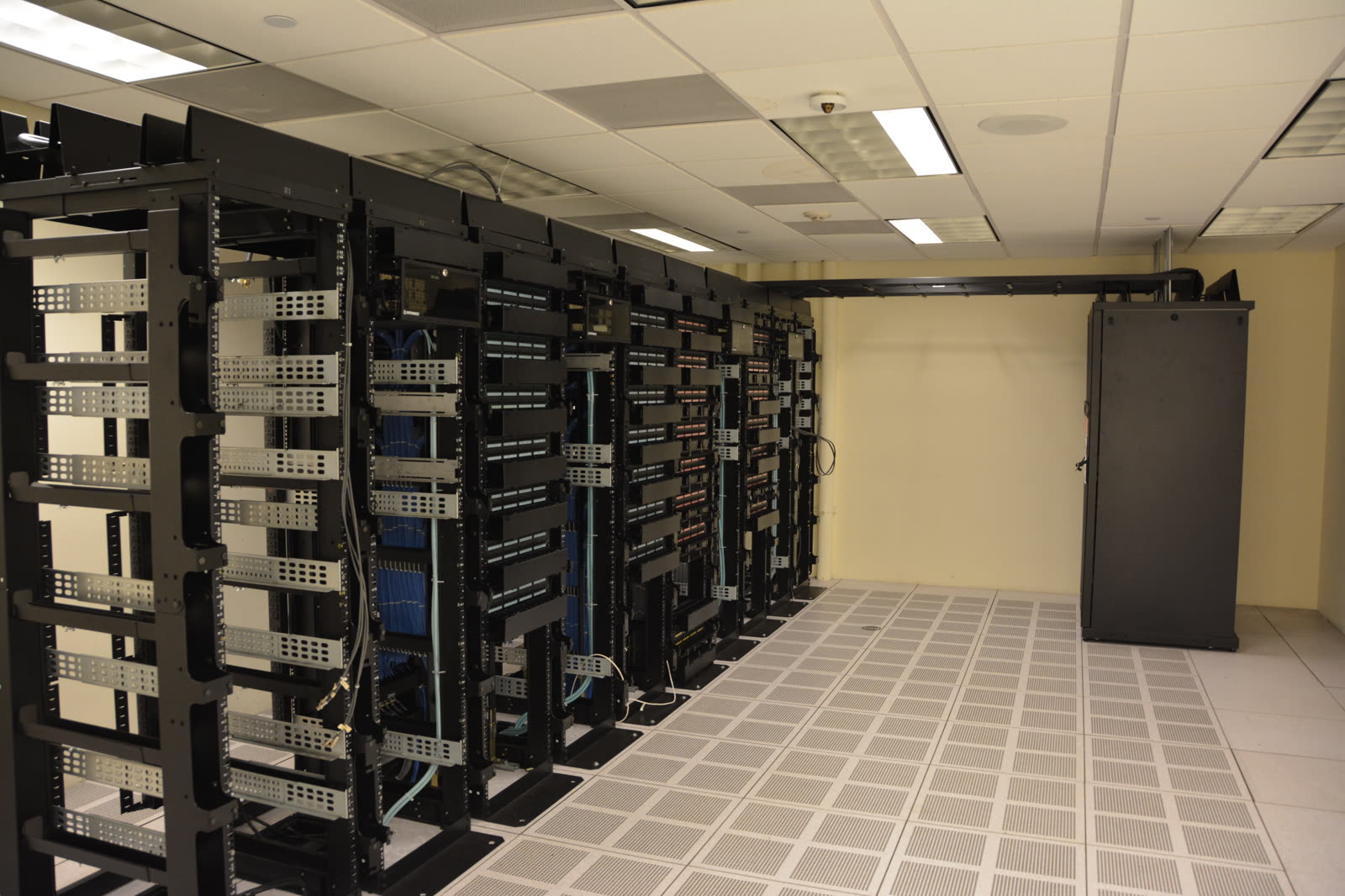
- Wikimedia Commons, "Datacenter Server Racks (22370909788).jpg" (real data-center rack photograph used as the article image source).