The cleanest number in Unisound's first full-year report as a public company is also the easiest to misread. Revenue that the Beijing AI company classified as large-model related rose from 51.87 million yuan in 2024 to 610 million yuan in 2025—more than tenfold and just over half of total revenue. This is genuine commercial acceleration, not another leaderboard claim.[1]
But it does not yet describe a Chinese version of a pure token-API business. Unisound still earns most of its money by carrying AI through the last, difficult handoffs: into a hospital record system, a metro service desk, a vehicle cockpit, or an edge device. Of its 1.211 billion yuan in 2025 revenue, 1.189 billion yuan was recognized at a point in time, generally when a product or solution reached delivery and customer acceptance. Only 22.6 million yuan was recognized over time. The annual report presents API calls, token billing, and subscriptions as systems the company intends to expand, not as the already dominant engine.[1]
As of July 17, 2026, that distinction defines the dossier. Unisound's model boom is real, yet its best-evidenced advantage is not a foundation model in isolation. It is the delivery organization built during the decade before foundation models became fashionable. The question is whether that organization can turn bespoke acceptance events into a repeatable, higher-margin service.
The Company Predates The Chatbot Cycle
Unisound was founded in 2012 around speech recognition. Its 2025 prospectus says the company proposed a cloud-plus-chip architecture in 2014, began building its Atlas AI infrastructure in 2016, and worked that year with both appliance maker Gree and Peking Union Medical College Hospital. It later placed model development, speech and vision components, knowledge graphs, deployment tooling, and edge SDKs inside a central platform called UniBrain.[2]
That chronology matters more than the usual “AI veteran” label. Speech software must survive accents, noise, latency, hardware limits, and customer systems. Medical software adds terminology, privacy, procurement, and clinical workflow. Those constraints gave Unisound distribution surfaces before it had a general-purpose generative model.
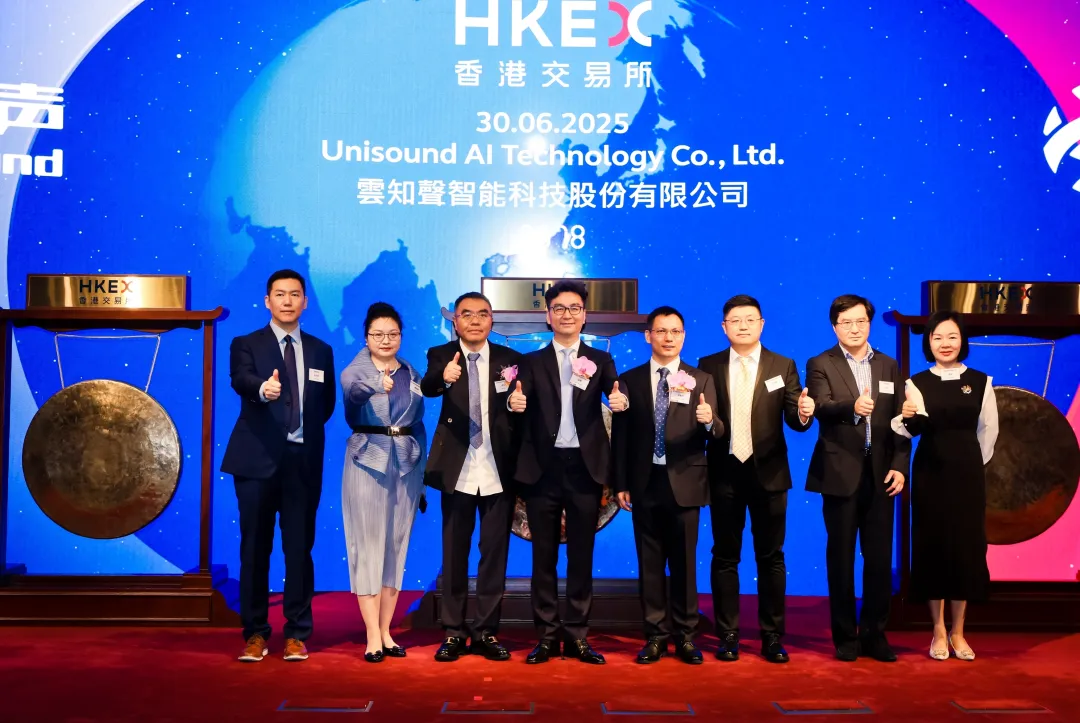
The model layer arrived later. The prospectus says a 60-billion-parameter UniGPT replaced UniCore at the center of UniBrain in May 2023; current company materials organize the same full-stack story around Atlas, UniBrain, and the Shanhai model family.[2][3] On June 30, 2025, founders Huang Wei and Liang Jia'en rang the Hong Kong exchange gong as Unisound listed under stock code 9678.[4][5] The listing did not create the stack. It made the economics of that stack visible.
The Revenue Jump Is A Delivery Signal
Total revenue increased 29.0%, from 939.0 million yuan in 2024 to 1.211 billion yuan in 2025. The 610-million-yuan large-model figure grew much faster, but it is a management-defined category in the annual report's discussion rather than a separately audited IFRS segment. It sits across Unisound's existing businesses. The company reports only one operating segment, then divides sales into 967.8 million yuan of “Daily Life” revenue and 243.6 million yuan of healthcare revenue. Within Daily Life, solutions supplied 846.0 million yuan and products 121.7 million yuan.[1]
That accounting boundary is important. “Large-model related” can include a model embedded in a customer solution, an agent platform, a transport deployment, or a healthcare workflow. It is not equivalent to 610 million yuan of metered inference. Independent coverage of the annual results confirms the magnitude and the more-than-tenfold increase, but the public disclosures still do not split that figure cleanly into tokens, licenses, implementation, hardware, and continuing service.[1][6]
The point-in-time revenue pattern offers a second clue. Roughly 98% of annual revenue was recognized at a moment rather than across a period. That does not prove every contract was custom or that recurring relationships are absent; accounting timing is not a product catalog. It does show that customer acceptance remains the financial event doing most of the work. A model may be reusable, while the revenue around it is still earned through a delivery project.
There is a strategic upside to that structure. A general model can be swapped; a supplier that understands the customer's microphones, data fields, approval process, edge hardware, integration partner, and failure escalation is harder to dislodge. There is also a ceiling. If each new installation requires substantial engineering, sales can rise without the economics acquiring software-like repeatability.
The Moat Lives At The Handoffs
Healthcare makes the delivery thesis clearest. Unisound says it had worked with nearly 450 hospitals by the end of 2025; about 85% of that year's hospital customers were tertiary institutions, and more than one-third had worked with it for at least three consecutive years. Its stack begins with noisy clinical speech, turns conversation into structured records, and then applies medical-language and quality-control systems inside hospital workflows.[1] These are company-reported operating figures, not an independent outcome audit, but they describe a distribution asset that a newly released model does not instantly reproduce.
The same pattern appears at the edge. The annual report says Unisound distilled an in-vehicle intent model to the 0.5-billion-parameter class for a 30-TOPS cockpit chip, with response latency as low as 350 milliseconds. It also reports more than 110 million cumulative shipments of its Swift and Hummingbird AI chips and modules.[1] The significance is not that either number proves model superiority. It is that Unisound can choose among cloud inference, a private deployment, an SDK, or constrained local hardware depending on the customer's environment.
Atlas is the connective tissue. The prospectus describes it as computing, storage, networking, scheduling, and management infrastructure begun in 2016, with UniBrain above it and applications above UniBrain.[2] That is a more coherent company shape than “old speech vendor adds chatbot.” Speech, models, chips, knowledge graphs, agents, and delivery teams are all ways of carrying the same capability into a bounded workflow.
Yet coherence is not proof of a moat. Hospital counts do not reveal utilization; a shipped chip does not reveal current active devices; latency in a stated cockpit configuration does not establish accuracy across vehicles; and a flagship deployment does not show average installation cost. The public record is strongest on the existence of the layers and the revenue they collectively produced. It is thinner on product-level unit economics and independently measured outcomes.
Growth Still Has Integration Economics
The financial statements show why the distinction matters. Sales and service costs rose 34.8% in 2025, faster than revenue. Gross profit increased, but gross margin fell from 38.8% to 36.1%. Unisound attributes part of that decline to the temporary cost of expanding integrated vertical-model and agent solutions. Research and development expense was 380.7 million yuan, while the IFRS net loss was 329.5 million yuan. The company's adjusted net loss, which excludes items including redemption-liability interest and listing expenses, was 126.5 million yuan.[1]
Cash tells the same story without the accounting adjustments. Operations used 212.8 million yuan of cash in 2025, improved from 319.0 million yuan in 2024 but still negative. Cash and equivalents rose to 341.2 million yuan because financing activities supplied 483.0 million yuan, mainly from the share offering and bank borrowing. Trade receivables reached 781.4 million yuan, up from 559.2 million yuan, and one customer generated 10.7% of annual revenue.[1]
None of those facts invalidates the model-revenue jump. They bound it. Unisound financed growth successfully, narrowed its losses, and converted existing customer channels into a much larger model-related sales line. It has not yet shown that this growth funds itself, raises gross margin, or reduces the amount of cash tied up between delivery and collection.
Three Tests For The Next Report
The first test is revenue quality. Unisound says it wants more API, token-billed, and subscription revenue.[1] The useful evidence will be a disclosed mix: how much model revenue is usage-based or recurring, how much arrives inside accepted solutions, and whether revenue recognized over time rises materially from its small 2025 base. A larger undifferentiated “large-model related” number would confirm demand without resolving repeatability.
The second test is delivery leverage. If the same model and agent components can move from one hospital, metro operator, or vehicle program to the next, revenue should begin to outrun service costs. Gross margin, implementation time, receivable days, operating cash flow, and renewal rates will reveal that transition more clearly than another claimed benchmark win.
The third test is outside validation. The strongest case would pair customer-level renewals with independently measured workflow outcomes: fewer record defects under a disclosed review protocol, lower response time without lower resolution quality, or reliable offline intent handling across a stated vehicle test set. Unisound's annual report supplies several flagship results, but vendor-selected cases should remain directional until customers or evaluators publish the setup and baseline.[1]
The narrow conclusion is more interesting than “speech company becomes LLM company.” Unisound is trying to convert years of unglamorous integration work into a foundation-model distribution system. Its 2025 results show that customers paid for that combination at meaningful scale. The next proof is not a larger model. It is evidence that the delivery desk can produce recurring revenue, better margins, and cash—without rebuilding the desk for every customer.
Sources
- Unisound AI Technology Co., Ltd., 2025 Annual Report (published April 29, 2026)—audited revenue, business mix, margin, losses, cash flow, revenue-recognition timing, customer concentration, operating metrics, and management's 2026 plans.
- Unisound AI Technology Co., Ltd., Global Offering Prospectus (June 20, 2025)—company chronology, Atlas and UniBrain architecture, UniGPT history, pre-listing financial baseline, customers, and delivery model.
- Unisound, “Company Profile”—official description of the Atlas infrastructure, UniBrain platform, Shanhai model, history, and current application stack.
- Qiming Venture Partners, “Portfolio Company Unisound Successfully Lists on the Hong Kong Stock Exchange” (June 30, 2025)—listing context and source of the real ceremony photograph.
- Beijing Municipal Science & Technology Commission and Zhongguancun Administrative Committee, “Beijing enterprise Unisound officially lists on the Hong Kong Stock Exchange” (July 1, 2025)—Chinese first-hand listing chronology, founders, and company-stack context.
- Economic Observer, “Unisound's 2025 revenue reaches 1.211 billion yuan; large-model business exceeds 600 million yuan” (March 28, 2026)—independent Chinese business-press coverage of the first annual results.