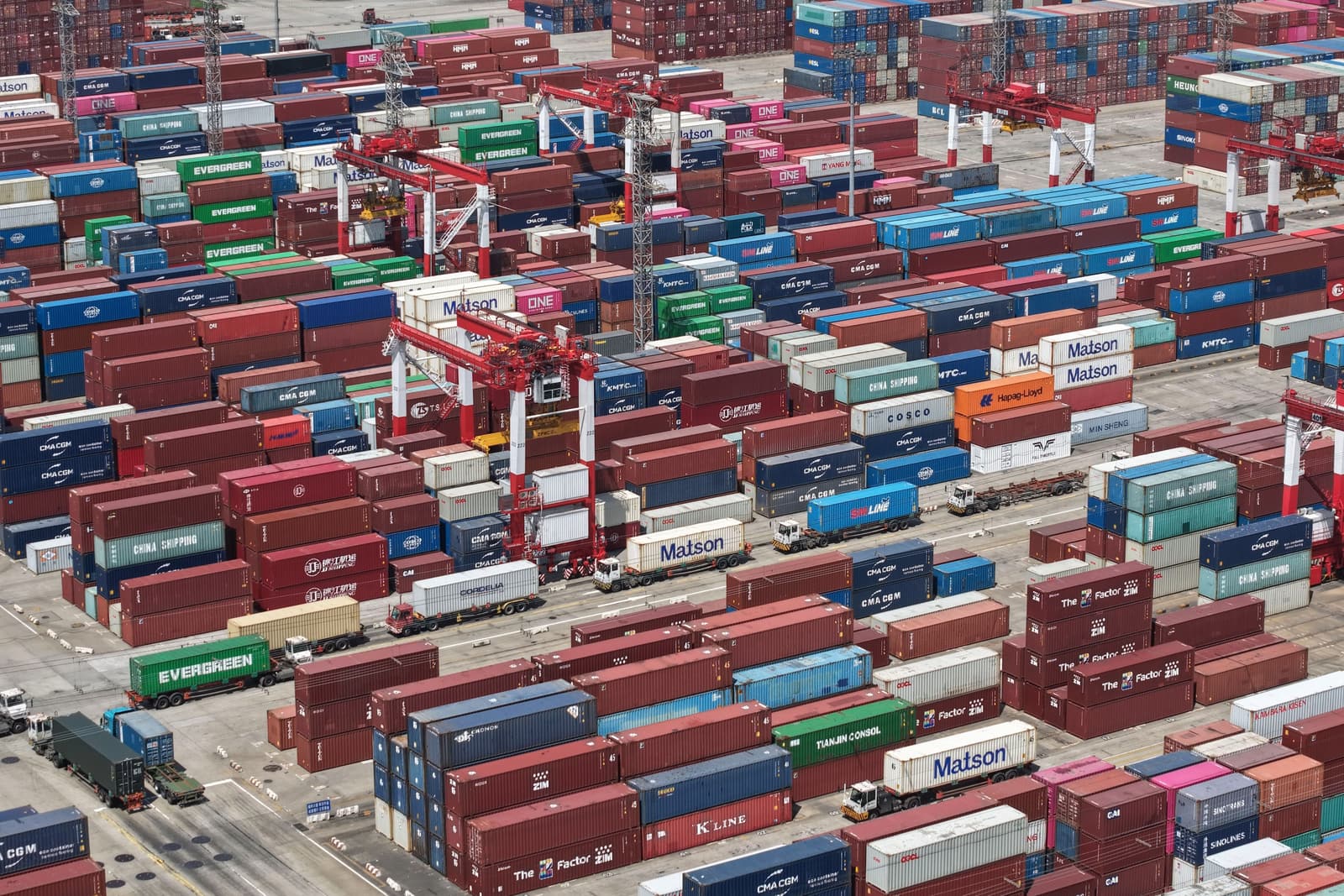
As of 2026-07-17 00:36 UTC, the most revealing Chinese AI release of the week is a customs ledger. The General Administration of Customs says China's combined imports and exports of computing hardware—including electronic components and computer parts—reached 5.13 trillion yuan in the first half of 2026, up 56.6% from a year earlier.[1] The headline is large enough to demand a careful denominator.
It is also an unusually easy number to misuse. The figure combines imports with exports, and it gathers broad hardware categories rather than isolating AI accelerators, servers, or data-center networking. It measures the intensity of a supply chain moving through China; it does not measure Chinese AI revenue, domestic chip self-sufficiency, or the amount of compute installed inside the country. The distinction is not a footnote. It is the key to reading what changed.
The AI cycle has become visible in the national ledger
China's total goods trade reached 25.47 trillion yuan in the first half, up 16.9% year over year. Exports rose 13.4% to 14.73 trillion yuan, while imports rose a faster 22.1% to 10.74 trillion yuan.[1] Against that base, the 56.6% growth in the computing-hardware category is exceptional. At face value, its 5.13 trillion yuan represented roughly one-fifth of all goods trade during the period, although the customs label is much wider than a clean list of AI products.[1]
The export mix reinforces the direction. High-technology product exports increased 39%, and mechanical and electrical product exports rose 20.1% to 9.36 trillion yuan.[1] A Chinese business-press breakdown, drawing on customs data and the China Chamber of Commerce for Import and Export of Machinery and Electronic Products, reports that first-half export values for integrated circuits and computer products increased 96.1% and 41.3%, respectively. Together, those two lines added 11.7 percentage points to the growth of mechanical and electrical exports.[3]
This is the first macro implication: China's place in the AI boom is no longer legible only through Qwen, DeepSeek, Hunyuan, or another model family. It is also visible in the movement of chips, boards, memory, optical links, computer parts, assembled systems, and the other physical layers that global compute spending requires. Chinese factories can participate in an overseas data-center cycle even when the frontier model running in that data center was trained elsewhere.
The headline blends demand, supply, and price
The first mechanism is overseas demand. Global investment in AI infrastructure pulls Chinese-made components and computer equipment outward. Customs officials linked the first-half surge to expanding demand for compute, data centers, and intelligent terminals; the same reporting notes that exports of electronic components and computer parts both grew at double-digit rates.[3] AP's account adds an important market caution: analysts attributed much of June's jump in trade value to a semiconductor price surge, even as foreign demand for Chinese goods remained firm.[4]
The second mechanism is unresolved in the headline: the inward flow. Overall imports grew 8.7 percentage points faster than exports in yuan terms, while imports of mechanical and electrical products rose 28%.[1] In an export-oriented manufacturing system, stronger output can require more imported upstream content; a domestic compute build can create additional demand. But the published 5.13 trillion yuan headline does not split computing-hardware imports from exports or identify which imported products were destined for AI workloads. It therefore leaves those mechanisms possible rather than proving either one.
The third mechanism is price. In June, China's integrated-circuit export volume slipped 0.2% year over year while its export value rose 121.9%, according to Jiemian's interviews and customs-data analysis.[3] A value series can therefore accelerate even when the number of units does not. Memory mix, product mix, and semiconductor prices can do much of the work. This does not make the customs signal unreal; revenue and trade balances are recorded in money. It does mean that 56.6% value growth cannot be translated into 56.6% more chips, servers, or usable AI compute.
Domestic scale is rising, but trade does not certify independence
Two domestic indicators add context beyond export pricing. The National Bureau of Statistics reports that industrial enterprises above designated size produced 279.8 billion integrated circuits in the first half, up 23.1% year over year.[2] Separately, a Study Times analysis republished by Digital China Summit put the country's intelligent-computing capacity at 1,882 EFLOPS (FP16) at the end of March 2026 and described a multi-level system organized around eight national computing hubs, key regions, and urban-edge capacity.[5] Domestic output is rising and installed capacity is large alongside the blended trade-value measure, but the indicators use different definitions and time windows.
But those measures answer different questions. Unit output does not reveal process node, memory type, die size, yield, or suitability for training frontier models. An EFLOPS estimate does not reveal utilization, interconnect quality, software compatibility, energy cost, or how much capacity is available to outside customers. Customs value does not reveal whether a component was designed by a Chinese firm, fabricated inside China, imported for assembly, or re-exported in a finished system. None of the three can stand in for the others.[1][2][5]
That boundary matters for the usual self-sufficiency argument. A large two-way hardware trade can coexist with stronger domestic manufacturing and continued dependence on particular foreign tools or components. It can also coexist with Chinese firms holding valuable positions in packaging, printed circuit boards, optical modules, server assembly, power equipment, and other layers that do not show up in a simple contest over the most advanced accelerator. The trade ledger is evidence of participation and scale, not a certificate of technological autonomy.
What the second half needs to confirm
The cleanest test is to separate value from physical activity. If semiconductor prices cool while export volumes and domestic chip output rise—and independent data show installed capacity is being used—the first-half jump will look like a durable expansion of the AI hardware system. If trade-value growth collapses as prices normalize and unit volumes remain flat, much of the apparent acceleration will have been a price cycle passing through customs.
A second test is direction. Import and export data need to be split by product, origin, destination, quantity, and price before anyone can say whether China is gaining domestic capability, serving overseas AI capex, importing more inputs for assembly, or doing all three. Company filings can then show whether hardware suppliers are converting trade growth into revenue and margin rather than merely carrying more expensive inventory.
For now, the disciplined conclusion is still substantial. AI has become large enough to reshape China's export composition.[1][3][4] Domestic chip output and capacity indicators place that export story beside a large internal buildout, without proving the direction of every customs flow.[2][5] The customs ledger confirms a boom in nominal hardware-trade value moving through China. It does not, without a directional product split, reveal how much of that boom is moving in versus out—or provide one clean score for who is winning AI.
Sources
- State Council of the People's Republic of China, "China's H1 foreign trade posts 16.9 pct growth with optimized structure" (July 14, 2026; official customs totals, computing-hardware trade, import/export growth, and product mix).
- National Bureau of Statistics of China, "Industrial value added above designated size grew 5.3% in June 2026" (July 15, 2026; official first-half integrated-circuit output table for enterprises above designated size and statistical scope note, in Chinese).
- Wang Zhen, "China Economic Half-Year Report: AI content rises sharply as AI reshapes the export structure." Jiemian News, July 14, 2026 (customs-category breakdown, electromechanical contribution, June chip volume/value divergence, and analyst context, in Chinese).
- Chan Ho-him, "China's June exports surge 27% from a year earlier as AI boom drives strong demand." Associated Press, July 14, 2026 (independent reporting, price-cycle context, and source of the Shanghai terminal photograph).
- Digital China Summit, "Future trends in computing-power development" (May 9, 2026; Study Times analysis republished with intelligent-computing capacity and national-hub context, in Chinese).