A passing cloud can change a rice plant's portrait without changing the plant. For a breeder comparing leaf color or canopy shape, that is a measurement problem: the camera records both the crop and the conditions under which it was photographed. A Chinese research team approached the problem by moving its imaging work into the night, when it could supply the light itself.[1][2]
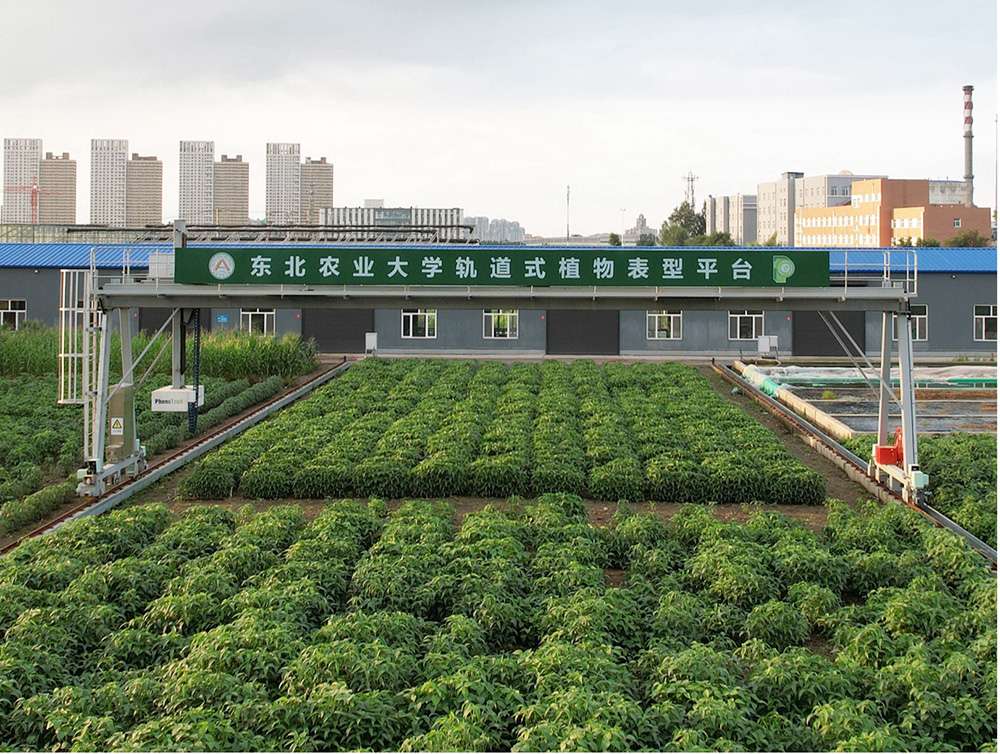
The result was a nighttime operating mode for TraitDiscover, a commercial platform that moves sensors over plants. Reported in April 2025 by the Chinese Academy of Sciences' Institute of Genetics and Developmental Biology, PhenoTrait, and Huazhong University of Science and Technology, the rice study joined controlled illumination to computer vision.[1] Its most useful idea is also its least spectacular: make the observation more consistent before asking AI to interpret it.
Give the camera a steadier subject
Phenotyping means measuring a plant's observable traits. The team added an array of lights to the rail-based platform. Its TraitNavigator web application handles sensor management, route planning, task scheduling, and analysis. These are consequential parts of the application: a plant image becomes useful experimental evidence only when it belongs to the right observation in the right sequence.[1]
Consider a hypothetical comparison between two rice lines. If one is photographed in bright sunlight and the other under a passing shadow, an apparent color difference may be difficult to interpret. Asking a model to compensate leaves that ambiguity inside the analysis. Controlling illumination addresses one cause of the ambiguity before the image exists. It does not make the field a laboratory; it gives the camera a more repeatable encounter with it.
This is a productive way to think about applied AI. Sometimes the decisive engineering choice sits beside the model: a lamp, a camera position, or a schedule. An impressive algorithm cannot recover an observation that was never made consistently.
Find the plant, then draw its boundary
The rice pipeline combines YOLOv8 object detection with K-Net segmentation.[2] Detection locates the subject; segmentation identifies the pixels belonging to it. That distinction matters when the next operation is measuring an area or describing a shape. A rectangular box around a plant also contains background. A useful outline must follow the plant more closely.
K-Net came from broader computer-vision research. Its 2021 paper describes a framework that learns to produce masks for objects or semantic categories, updating the learned kernels using information from the image.[3] The rice application puts that general capability to a specific experimental use. It is an example of adapting existing vision machinery to a carefully arranged observation task.
The boundary is a small decision with consequences downstream. Imagine including a patch of soil in a leaf-color measurement, or excluding a narrow leaf tip from an estimate of visible plant area. The arithmetic could be flawless while the biological description was wrong. Segmentation earns its place by improving what the calculation is allowed to count.
Read the result at the scale it measures
The researchers assembled a nighttime rice dataset with 360 carefully annotated plant masks. They report segmentation performance of up to 93.52% mask intersection over union, followed by extraction and validation of 28 parameters describing color, morphology, and texture. The reported average R² between inferred parameters and reference values was 0.95.[1][2]
Those figures belong to this rice imaging setup and its evaluation. Intersection over union measures the overlap between predicted and reference regions relative to their combined area. It is not the percentage of plants successfully bred, and an R² of 0.95 is not a promise that every individual measurement is within five percent of its true value.
The institutional abstract does not supply the full training and test split, inference hardware, or a matched daytime comparison protocol.[2] The results therefore support a bounded finding: this combination of acquisition and analysis worked well on the reported task. They do not establish that switching any crop camera to nighttime will reproduce the score. New sites, growth stages, overlapping canopies, and lighting arrangements would each deserve a fresh check.
What this could give a breeder
There is already a research destination for better measurements. In a separate study reported in June 2023, the CAS institute and Huazhong Agricultural University collected rice images across the whole growth period, derived traits from them, and connected those traits to genetic variation. Their analysis examined developmental patterns over time and across plant organs.[4] That history helps explain why a reliable image sequence can matter more than a single striking photograph.
The implication for TraitDiscover is practical. Repeated observations could help distinguish a plant that changes early under stress from one that changes later. To make that comparison credible, researchers need consistent measurements, matched experimental conditions, and a connection between the image-derived trait and the biological question. Cleaner segmentation contributes to that chain; it does not complete it.
The next convincing evidence would show that the useful differences persist across independent trials and help researchers select or explain a trait they care about. The harvest remains a separate outcome to measure. For now, the night shift offers something more immediate: a better chance that the difference in two plant portraits belongs to the plants.
Sources
- Institute of Genetics and Developmental Biology, Chinese Academy of Sciences, “Progress in field-based high-throughput phenotyping acquisition and analysis” (April 8, 2025; Chinese-language first-hand report, system software, and results).
- Binghui Xu et al., “Nighttime environment enables robust field-based high-throughput plant phenotyping: A system platform and a case study on rice,” Computers and Electronics in Agriculture (2025; institutional record reproducing the authors' abstract, dataset, methods, and results).
- Wenwei Zhang et al., “K-Net: Towards Unified Image Segmentation,” NeurIPS 2021 (camera-ready version; the segmentation framework's design).
- Institute of Genetics and Developmental Biology, Chinese Academy of Sciences, “Progress in rice phenotyping across the whole growth period” (June 16, 2023; Chinese-language report on a separate joint study with Huazhong Agricultural University).
- Specim, “Transformative Impact of Hyperspectral Imaging on Plant Phenotyping: Case PhenoTrait” (accessed October 10, 2026; supplier case study, photograph, and identification of the Northeast Agricultural University installation).