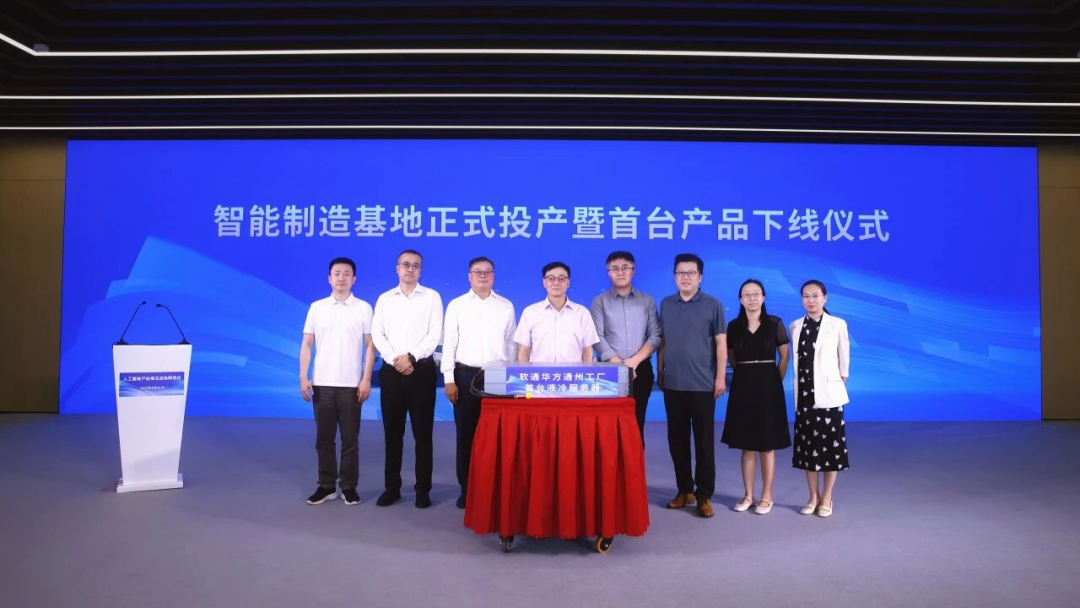
On August 28, 2026, China published a recommended, non-mandatory national general specification for cold-plate liquid-cooled data-center cabinets. Two days later, a covered liquid-cooled server sat on a red-draped cart in Tongzhou, Beijing, as officials and executives marked the opening of iSoftStone Huafang's smart manufacturing factory. The dates are adjacent, though the public record does not show that one event caused the other. Together they reveal the same change in the AI infrastructure stack: liquid cooling is moving from a facility-specific engineering project toward something manufacturers expect to build, test, and deliver as a repeatable rack-level product.[1][5]
The factory's first phase is described as having annual capacity for about 100,000 servers. Its operator says the 33,000-square-meter site can switch between air-cooled and liquid-cooled products on a flexible line, taking outside projects from prototype and pilot production through larger runs. Beijing's economic and information-technology bureau calls it the city's only specialist server factory with end-to-end production, validation, and delivery capability for liquid-cooled full racks and data-center products.[1][2]
Those are meaningful supply-chain signals, but they are not all the same kind of evidence. One server completed final inspection. A factory began operating. The larger figures describe rated capacity and a full-production scenario, not audited shipments. A second-phase expansion to 300,000 servers and planned validation and production work around Ascend 950-based supernode products are forward commitments, not products the ceremony proves are already in volume production.[1][2]
The important object is therefore not the ribbon or even the first server. It is the delivery boundary. In a dense AI cluster, liquid cooling makes that boundary expand from a dry compute box to a coupled rack of processors, cold plates, hoses, connectors, manifolds, coolant distribution, sensors, power, networking, controls, and service procedures. Tongzhou matters if its line can make those interfaces repeatable before the rack reaches a customer site.[3][9][11]
What changed: the rack entered the manufacturing line
An air-cooled server can arrive as a relatively self-contained appliance. It draws room air across internal heat sinks and fans, while the data center supplies conditioned air, electricity, and network connections around it. The two systems still interact, but their physical boundary is familiar.
Cold-plate cooling crosses that boundary with liquid. A plate attached to a high-heat component transfers energy into a secondary coolant loop. The coolant travels through server hoses and quick connections to a rack manifold, then toward a coolant distribution unit or another heat-exchange stage that separates the rack loop from facility water. Pumps, valves, seals, coolant chemistry, flow, pressure, temperature, and leak response become part of keeping the accelerator available. Residual components may still require air cooling, so “liquid-cooled” does not necessarily mean that every watt leaves through liquid.[9][11]
China's Ministry of Industry and Information Technology made this enlarged object explicit in a February 2025 challenge list. Its target was not merely a better cold plate. It called for a native cold-plate liquid-cooled full rack with blind-mate liquid lines, power and network buses, rack- and server-level leak detection, rack power and asset management, and at least 30 kW per intelligent-computing cabinet. The list set 100 percent liquid heat removal and cooling PUE below 1.15 as program targets for 2026, alongside deployment of at least 500 liquid-cooled nodes.[3]
These figures should not be mistaken for national fleet statistics or proof that the Tongzhou line has met them. They were goals offered to organizations entering a government challenge. Their value here is architectural: the official task defines the product as a rack in which wet connections, electrical delivery, network interconnects, monitoring, and maintainability must be designed together.[3]
That is why the factory's ability to handle a full rack is more consequential than its ability to fasten a cold plate onto one server. A line can control assembly sequence, connector torque, hose routing, cleanliness, pressure tests, firmware and sensor checks, and the record tying each unit to its components.[9][11] The public reports do not disclose Huafang's exact test protocol, yields, or traceability system. They establish a place where those jobs can be integrated; the quality of that integration remains the evidence to request.[1][2]
A liquid rack is a chain of wet and dry interfaces
The thermal path begins at the package but quickly becomes a compatibility chain. A cold plate has to match the component's mechanical envelope and heat flux. Its fittings have to match hoses that can be installed and serviced without stressing a board. Those hoses meet quick disconnects and a manifold; the manifold has to distribute adequate flow across branches; the coolant distribution unit has to move heat into the facility loop while maintaining the required temperature, pressure, cleanliness, and isolation.[9][11]
The dry interfaces do not disappear. Higher rack density raises the importance of busbars, power supplies, backup power, cabling, optical links, and management controllers. Shenzhen's 2026–2028 AI-server supply-chain plan is useful because it places these pieces beside one another: cold plates, cabinets, thermal-interface materials and coolant distribution units sit in the same industrial map as UPS and high-voltage direct-current power, high-speed connectors, printed circuit boards, storage, and 800G-to-3.2T optical modules. The plan is a policy agenda, not proof that every listed component is locally available at production quality. It nevertheless shows what local officials now understand an AI server supply chain to contain.[4]
Blind-mate connections capture the manufacturing challenge in miniature. They couple a server to rack infrastructure without an operator manually joining every line. That shifts serviceability and leak isolation into the rack interface; MIIT's challenge therefore pairs blind-mate maintenance with rack- and server-level leak detection. Passing one factory check is only the beginning: buyers still need evidence that the configured rack remains serviceable after delivery.[3]
Two vendor technical guides make the breadth of this system concrete. NVIDIA's DGX GB documentation treats compute trays, NVLink trays and backplane, power shelves, a busbar, liquid-cooling manifolds, management switches, and leak detection as parts of one rack-scale system; its cold plates cool the CPUs and GPUs while networking and storage remain air-cooled. Lenovo's rack and facility guide adds separate facility and secondary loops, cooling distribution units, water quality, wetted materials, temperature, pressure, redundancy, filtration, monitoring, and maintenance. These are vendor architectures, not Chinese regulations or evidence of Huafang compatibility. Their value is showing why “liquid-cooled rack” names a configured system, not a universal plumbing interface.[9][11]
Multi-level leak detection has the same logic. Finding moisture near a server can limit the affected zone; sensing at a rack or distribution unit can catch a different failure path. But a sensor only becomes protection when alarms map to an explicit response: which pump slows, which valve closes, which workload moves, which power domain shuts down, and how technicians identify the safe repair boundary. The factory can test the components and some sequences. A deployed site has to prove the operational choreography.[3][9][11]
Standards are moving from the box to acceptance
The standards timeline makes the widening boundary visible. Recommended telecom-industry standard YD/T 4024-2022, effective July 1, 2022, provides overall technical guidance for liquid-cooled server systems. Recommended industry standard YD/T 6049-2024, effective February 1, 2025, narrows in on the design, production, and testing of cold-plate liquid-cooled full-rack servers. Recommended YD/T 7105-2026, published July 15 and due to take effect November 1, describes equipment, acceptance, and operations-and-maintenance testing for cold-plate liquid-cooled data centers. Recommended national standard GB/T 48097-2026, published August 28 and due to take effect March 1, 2027, is a general specification for the cabinet itself.[5][6][7][10]
That sequence does not certify the new Tongzhou factory, and the public launch reports do not claim a named conformity result. It does something more basic: it separates testable layers. There is a recommended standard scope for producing and testing the rack, another for accepting and operating the data-center cooling system, and a recommended national product specification approaching implementation. Suppliers and buyers can increasingly ask whether a claim belongs to a component, a rack, an installed system, or its continuing operation.[5][6][7][10]
This matters for a shared factory serving prototypes and outside OEM or ODM orders. “Liquid-cooled” is too broad to function as a purchase specification. A useful factory-acceptance record has to freeze a configuration: accelerator and cold-plate design, coolant and wetted materials, connector and manifold, distribution unit, flow and temperature envelope, leak-detection zones, power and network layout, firmware, and the test load. Change one layer and some of the evidence may no longer travel.
Standardization can reduce needless variation, but it cannot make all racks interchangeable by declaration. The drafting organizations named across the Chinese standards include carriers, cloud platforms, server vendors, cooling specialists, universities, and data-center designers—a sign that compatibility spans organizational boundaries as well as parts.[5][6][7][10] The useful outcome is not one mandated architecture. It is a shared language for discovering exactly where two architectures fail to meet.
The facility still has the final veto
A rack leaving a factory has not yet encountered the building that must feed it. Guangzhou's July 2026 energy review for the planned Zhisheng computing center provides a rare view of that other side. The design specifies 12 liquid-cooled cabinets at 78 kW and 36 at 65 kW, with a 75:25 liquid-to-air cooling-load split. It also includes four 2,500 kVA dry transformers in paired redundancy, UPS capacity, backup generation, pumps, cooling towers, chillers, and air-handling equipment. The energy-review opinion lists a design PUE of 1.194 and an annual electricity ceiling of about 32.75 million kWh; the project was expected to enter operation in November 2026.[8]
These are design and approval values, not measured operating results. Their importance is topological. Forty-eight liquid-cooled racks still depend on a much larger electrical and thermal plant, while one quarter of the specified cooling load remains on air. Factory testing can verify the rack against declared inlet temperatures, flow, pressure, and power conditions. Site acceptance has to show that the actual building can sustain those conditions across changing compute loads, failures, maintenance, and seasons.[8]
The distinction also protects against an easy misuse of PUE. The MIIT challenge's “cooling PUE below 1.15” target and Guangzhou's 1.194 site-design PUE refer to different scopes, and one is a program target while the other is a pre-operation design value; they should not be ranked as though they were comparable measurements.[3][8] A rack-level thermal improvement can reduce facility cooling work, but whole-site PUE does not report model throughput, accelerator utilization, water consumption, or whether the installed compute completes useful work. A factory should therefore publish rack evidence as rack evidence. A data-center operator should publish site evidence after commissioning. Neither number substitutes for the other.
The next proof should follow one rack into service
Tongzhou has supplied the first three receipts: a physical factory, a flexible line, and a liquid-cooled server that reached final inspection. China's standards system has supplied another: increasingly explicit scopes for the cabinet, the full-rack server, and installed-system testing. The missing receipt is a versioned rack that can be followed from bill of materials through factory acceptance, site acceptance, and months of operation.[1][2][5][6][7]
That record should name the configuration and report more than peak cooling capacity. It should include pressure and flow margins, coolant and material compatibility, connector cycles, leak-test coverage, sensor and shutdown behavior, residual air load, pump energy, failure isolation, service time, and test results after transport. In the field, it should add inlet and return conditions, alarm and intervention logs, workload availability, and measured facility performance. If the line serves several accelerator families, results should be published per rack configuration rather than collapsed into a single “liquid-ready” label.
The near-term falsifier is straightforward. If every deployment still requires extensive one-off plumbing, private connector adaptations, site-specific firmware, and repeated debugging after delivery, then the rack has not yet become a stable factory product; assembly has merely moved earlier. If a frozen configuration repeatedly clears factory and site acceptance with predictable service behavior, the Tongzhou model has shifted real integration work out of the data hall.
China's AI hardware contest is often narrated at the chip or supernode level. The new factory points to a less glamorous constraint. An accelerator cannot remain useful if its heat path, power path, network path, and maintenance path are qualified by different teams only after installation. Liquid cooling makes those paths physically inseparable. The rack becomes the product when the factory can deliver not just assembled hardware, but a test record that the building can trust.
Sources
- Beijing Municipal Bureau of Economy and Information Technology, “iSoftStone Huafang smart shared factory begins production” (September 1, 2026; official account of the August 30 launch, first liquid-cooled server, stated capacity, end-to-end scope, expansion plans, and source photograph; in Chinese).
- Beijing Municipal Government / Beijing Daily, “Beijing's first shared smart factory for AI computing opens” (September 1, 2026; factory area, flexible line, staffing and capacity claims, OEM/ODM model, prototyping workflow, and planned Ascend 950 validation; in Chinese).
- Ministry of Industry and Information Technology, Computing Power Foundation Challenge Action Task List (February 2025; official targets for native cold-plate full racks, blind-mate liquid connections, power and network buses, leak detection, density, PUE, and deployment scale; copy attached to the Shanghai Municipal Commission of Economy and Informatization's implementation notice; in Chinese).
- Shenzhen Municipal Industry and Information Technology Bureau, Action Plan for High-Quality Development of the AI Server Industry Chain, 2026–2028 (March 2026; official component map spanning chips, storage, boards, power, optics, cooling, connectors, full systems, and services; in Chinese).
- National Public Service Platform for Standards Information, “GB/T 48097-2026: General specification for data center cold-plate liquid cooling cabinet” (recommended national standard published August 28, 2026; effective March 1, 2027; official record; in Chinese).
- National Public Service Platform for Standards Information, “YD/T 6049-2024: Technical requirements and test methods for cold-plate liquid-cooled full-rack servers” (recommended telecom-industry standard published October 24, 2024; effective February 1, 2025; official scope and drafting record; in Chinese).
- National Public Service Platform for Standards Information, “YD/T 7105-2026: Test methods for cold-plate liquid-cooled data centers” (recommended telecom-industry standard published July 15, 2026; effective November 1, 2026; official equipment, acceptance, and operations-testing scope; in Chinese).
- Guangzhou Municipal Development and Reform Commission, “Review opinion on the energy-saving report for the Guangzhou Zhisheng Computing Center project” (July 6, 2026; official rack densities, hybrid cooling design, electrical redundancy, projected energy use, PUE, and expected commissioning; in Chinese).
- NVIDIA, DGX GB Rack Scale Systems User Guide: Hardware (updated March 3, 2026; first-party description of the rack's compute, interconnect, power, cooling-manifold, air-cooling, management, and leak-detection subsystems).
- National Public Service Platform for Standards Information, “YD/T 4024-2022: Overall technical requirements and test methods for data-center liquid-cooled server systems” (published April 24, 2022; effective July 1, 2022; current recommended telecom-industry standard; in Chinese).
- Lenovo, Neptune Direct Water-Cooling Standards (September 13, 2024; first-party technical guide to rack and facility loop topology, coolant and wetted-material quality, temperatures, pressure, CDUs, monitoring, redundancy, and residual air cooling).