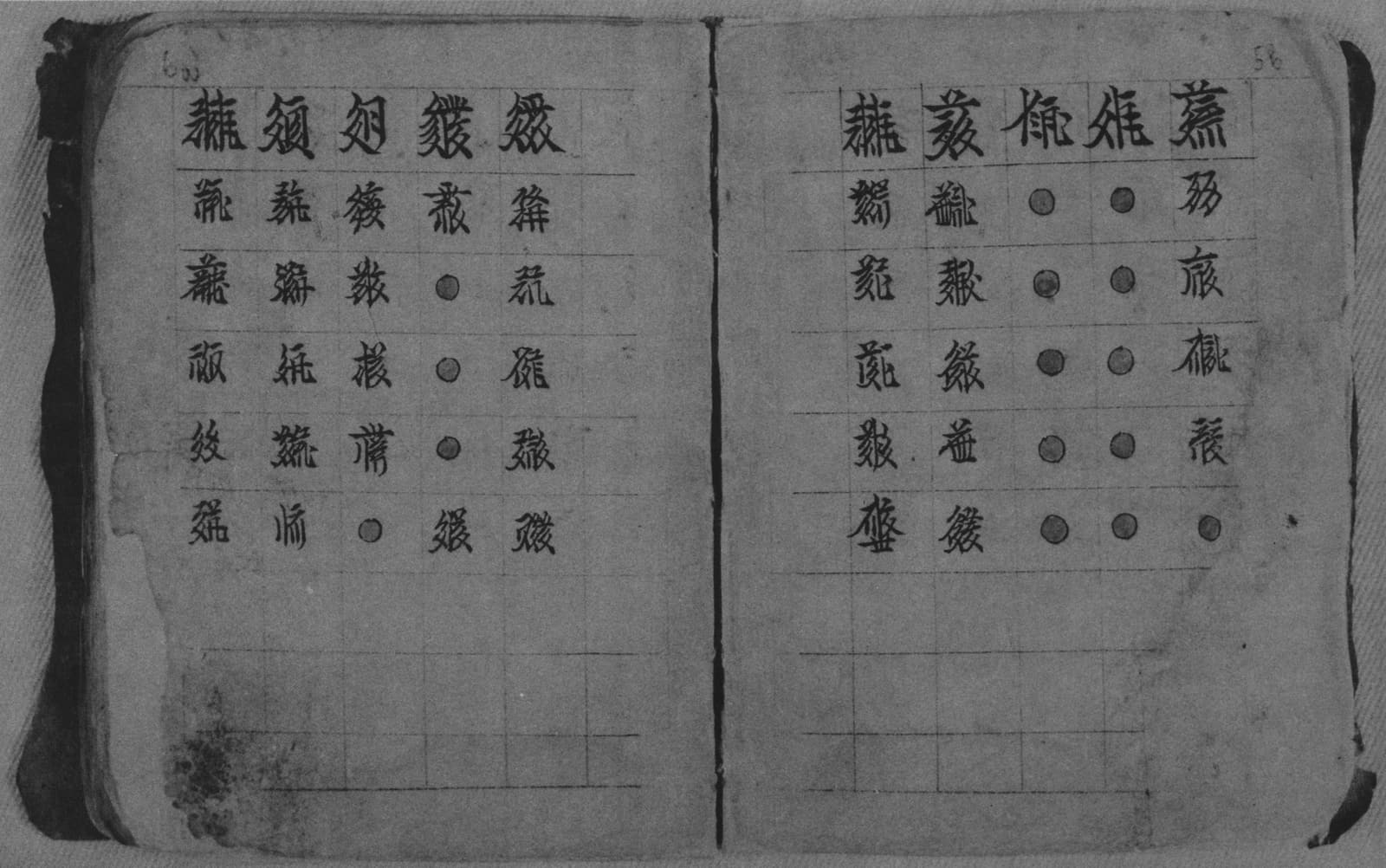
The photograph above is almost generous to a machine. The Tangut characters sit in orderly vertical columns. Their ink is dark, and most of the paper survives. Yet the two facing pages still contain the difficulties that make historical-script recognition different from reading modern print: tightly packed complex forms, similar-looking characters, uneven wear, and a physical layout that must be segmented before any glyph can be named. The manuscript, a twelfth-century work on Tangut phonology found at Khara-Khoto, is not merely an image of writing. It is the kind of object an OCR system must turn into an accountable scholarly draft.[7]
On August 24, 2026, China's Ministry of Education published its final list of 100 national cases in language-technology innovation. Six days later, Shaanxi Normal University's School of History and Civilization reported that its Zhijian Xixia project was among them, the latest institutional milestone in a research program that has spent nearly a decade on intelligent recognition and translation of Tangut texts.[1][2]
The useful story is not that AI has “decoded” a lost script. Specialists already read Tangut, and a recognition score does not interpret a document. The change is more practical: a script with thousands of complex characters now has a machine-assisted intake lane. The system can propose a transcription; a scholar or trained student can compare it with the page, correct it, and move the verified text toward search, collation, and translation. In this use case, correction is not the residue left after automation. It is the design.
What changed: recognition reached the scholar's desk
Shaanxi Normal University dates Zhang Guangwei's Ministry of Education research project on deep-learning-based Tangut recognition to 2017. By early 2018, the team had assembled a large labeled dataset and trained a dedicated recognizer. A September 2025 university feature described a human–machine platform on which the model supplies an initial recognition pass before researchers and students concentrate on collation and correction.[3]
That sequence matters more than a laboratory score alone. A classifier that returns a character label is a component. A usable transcription workflow must first find the text region, separate columns and glyphs, preserve the connection to the source image, express candidates in a standard encoding, and give a reviewer an efficient way to accept or repair the result. Only then does recognition remove work from the scholar's queue.
The August 2026 selection does not certify that each of those steps works at a particular accuracy or across every Tangut collection. The ministry's announcement records an expert-selected case after application, eligibility review, and public notice; it does not publish a technical audit of Zhijian Xixia.[1] What it does establish is a change in status. A university research lineage is now being presented as a national language-technology application, not only as a conference experiment.
The 94 percent headline has a narrow frame
Shaanxi Normal University's 2025 account says its dedicated model exceeded 94 percent recognition accuracy and places that model inside the initial-pass/correction workflow.[3] That is encouraging, but the page provides no test split, manuscript mix, segmentation protocol, unit of measurement, or correction-time distribution. It should therefore be read as a first-party performance claim, not as a portable guarantee that 94 percent of an unfamiliar page will emerge publication-ready.
The peer-reviewed record shows why the boundary matters. A 2022 IET Image Processing paper by a separate Tangut-recognition team describes Zhang and colleagues' earlier result as 94.00 percent validation accuracy on a 1,000-class character dataset drawn from the most frequent characters in Buddhist texts. The unit was a classified character image, not a complete manuscript page. Rare forms, unfamiliar hands, damaged characters, and mistakes introduced while cutting a page into glyphs sit outside that single number.[4]
Even a strong character score can produce a page that needs sustained review. A page contains many classification opportunities, and one wrong but graphically similar character may alter a word while still looking plausible to a nonspecialist. Page-level exact transcription, the proportion of pages requiring no edits, and the time an expert spends correcting a draft answer different questions from character-level top-1 accuracy.
This is not an argument against the reported result. It is an argument for putting it in the right place. Character accuracy tells a team whether a recognizer is useful enough to enter the workflow. The workflow must then measure whether it saves scholarly time without hiding uncertainty.
The long tail is the real document
The 2022 study made the recognition problem much larger. Its raw Tangut Character Database contained 124,624 labeled images across 6,077 character classes. But the distribution was sharply uneven: 94,459 images taken from ancient documents represented only 2,110 classes, while 30,165 images from modern printed editions supplied coverage across all 6,077. Of the raw classes, 4,088 had fewer than six examples, and the largest class had 565.[4]
To train across that long tail, the researchers created an enhanced dataset by adding 483,076 augmented images, bringing each class to 100 examples. Their five-layer TCRNet reached 97.96 percent on the enhanced test set under a 60/20/20 train, test, and validation split. A separate experiment using TCRNet trained on the raw database is more revealing: it reached 89.06 percent on the raw-data test, 85.04 percent on a 200-class similar-character set, 84.01 percent on a 604-class complex-background set, and 65.72 percent on 367 classes of incomplete or blurred characters. Those figures belong to a Northern Minzu University-led team, named models, curated character images, and specified datasets; they are not directly comparable with Shaanxi Normal University's later performance claim, and none is a result on unseen full pages. The paper also states that its research data were not shared, which prevents an outside team from rerunning the reported splits directly.[4]
The composition of the data explains the gap. Synthetic balancing can teach a model a class that appears only twice in the raw collection, but it cannot manufacture every way that ink flakes, paper folds, a hand varies, or two adjacent characters touch. The paper's own future-work list calls for more handwriting, movable-type printing, and inscriptions; better extraction of individual characters through text detection; and stronger handling of blurred and incomplete forms.[4]
Liu Peixin, writing for the Chinese Academy of Social Sciences in December 2025, describes the same constraint from the humanities side: Tangut documents are dispersed, their condition varies, the script has more than 6,000 characters and many handwritten variants, and genuinely labeled material is scarce. Synthetic data, transfer learning, and few-shot methods can reduce that scarcity, but they do not make the surviving object uniform.[5]
The operational lesson is simple. The common characters make the score. The rare, damaged, or context-sensitive character makes the edition.
Correction is the architecture, not the fallback
Human review already appears inside the training-data pipeline. The 2022 team used several models to propose likely labels for unclassified glyphs, gathered their highest-ranked candidates, and then had researchers check the result before adding it to the database. The paper reports that this multi-model, multi-prediction method cut labeling time by roughly a factor of 20 and increased the number of valid labels by a factor of 10 compared with its manual baseline. It also says uncertain labels were checked again by multiple people and against several model predictions.[4]
That loop is a better template for production OCR than a one-click “decipher” button. The machine narrows a search; the reviewer sees the evidence; the correction becomes new, provenance-bearing data. Shaanxi Normal University's reported workflow follows the same division of labor at the transcription stage: AI supplies the first pass, while people concentrate on collation and difficult readings.[3]
A mature interface should make that contract visible. Each output character should remain linked to its exact image crop and page coordinates. Low-confidence cases should expose ranked alternatives rather than silently forcing one answer. Corrections should retain the original proposal, reviewer, date, and source shelfmark. The system should distinguish an unreadable mark from a confident absence and a recognized-but-untranslated glyph. These are implications of the evidence, not features the public reports confirm are already present in Zhijian Xixia.
The most revealing deployment metrics would therefore be editorial: median correction time per page, untouched-character rate, error rate by material and period, recall on rare characters, disagreement between reviewers, and the number of verified pages released with stable identifiers. Those measures test the handoff. A higher crop-level accuracy without faster, more auditable correction would be a weaker advance.
Recognition opens the text; it does not finish the reading
There is another boundary after OCR. Tangut scholarship commonly presents a text in four aligned lines: the Tangut original, a phonetic reconstruction, a word-for-word Chinese rendering, and a fluent translation. OCR can propose the first line. A dictionary can help produce the second. The aligned and fluent renderings require lexical, grammatical, textual, and historical choices, and the low-resource parallel corpus needed to train those stages remains limited.[5]
Standard encoding made the first handoff possible. Unicode 9.0 encoded 6,125 Tangut ideographs and 755 components in 2016; subsequent work has added characters and corrected glyph representations.[6] Once a verified glyph has a code point, it can be searched, copied, compared across witnesses, and connected to a lexicon. Encoding is infrastructure, however, not interpretation. It gives a disputed character an address; it does not decide which address a stained stroke deserves.
The full research chain is therefore longer than “image in, translation out”:
page image → regions and columns → character candidates → reviewed Unicode text → lexical and textual collation → phonetic and Chinese renderings → historical argument.
Errors can enter at every arrow, and later fluency can conceal an earlier mistake. That is why a generated translation should never outrun its link to the image and corrected transcription. The safest system lets a reader travel backward from an elegant Chinese sentence to the word alignment, the selected Tangut characters, and the photographed page.
What would prove the use case at scale
Zhijian Xixia's national selection arrives at a credible midpoint. The technology is past the premise that Tangut recognition is possible, and the university describes a real human-in-the-loop transcription setting. Public evidence still stops short of showing how well the whole page-to-edition pipeline transfers across collections.[1][2][3]
Three releases would close much of that gap. First, a held-out, page-level evaluation should separate woodblock print, movable type, handwriting, inscriptions, damage, and unseen collections, reporting segmentation failures as well as character errors. Second, a workflow study should compare expert time and error patterns with and without the machine draft. Third, a versioned sample corpus should publish images, model proposals, corrections, and final four-line readings together, subject to collection rights, so another team can reproduce the handoff.
The project does not need autonomous decipherment to succeed. If it reliably turns hours of mechanical character entry into a shorter queue of visible, reviewable decisions, it changes what a small specialist community can attempt. More documents become searchable; repeated forms can be compared across collections; students can learn by correcting real evidence rather than retyping it; and experts can spend more time on the point at which recognition becomes history.
The page still belongs to the scholar. The useful machine is the one that returns it with the tedious work reduced and the uncertainty intact.
Sources
- Ministry of Education of the People's Republic of China, “Announcement of the 2025 national cases for language-technology innovation in key fields” (August 24, 2026; official selection process and final list; in Chinese).
- Shaanxi Normal University School of History and Civilization, “Our Zhijian Xixia project selected as a 2025 national language-technology innovation case” (August 30, 2026; official description of the named platform, selection, and research lineage; in Chinese).
- Shaanxi Normal University, “What happens when AI meets the Tangut script?” (September 23, 2025; first-hand project chronology, recognition claim, and human–machine transcription workflow; in Chinese).
- Jinlin Ma et al., “End-to-end Tangut character database building and recognition method,” IET Image Processing 16 (2022), DOI 10.1049/ipr2.12471 (datasets, splits, model results, labeling loop, and stated limits).
- Liu Peixin, “Artificial intelligence empowers Tangut studies,” Chinese Social Sciences Today / China Social Sciences Network (December 24, 2025; specialist account of OCR, four-line translation, corpus construction, and low-resource limits; in Chinese).
- Andrew West and Viacheslav Zaytsev, “Tangut Character Additions and Glyph Corrections,” Unicode Technical Note #42, version 2 (December 21, 2019; original Unicode 9.0 repertoire and later additions/corrections).
- Wikimedia Commons / Institute of Oriental Manuscripts, “Wuyin Qieyun A 05” (archival scan of two pages from the twelfth-century Tangut phonological manuscript Joined Rhymes of the Five Sounds, public domain).