As of 2026-04-06 UTC, the useful way to watch Tencent Global's 66-second video "Decoding Oracle Bones: With a Little Help from AI Agents" is to resist the most misleading reading available to it.[1] The misleading reading is that AI has finally "solved" oracle-bone inscriptions. Tencent's own companion essay says something much narrower and more defensible. Human expertise remains central; scholars still interpret the inscriptions; and the AI layer is there to search, compare, organize, and surface possible matches across a scattered archive.[1][2]
That distinction matters because oracle-bone research is exactly the kind of domain that invites bad AI storytelling. The artifacts are ancient, visually striking, and culturally important. A short video could easily claim that one multimodal model now reads the Shang past directly. Tencent does not quite do that. The video's sequence, especially when read beside Tencent's 2024 and 2026 essays and the new OBIMD dataset paper, points to a more interesting thesis: this is a retrieval-and-comparison workflow built around corpus infrastructure, image matching, and expert review rather than an autonomous decipherment engine.[2][3][4][5]
The surrounding numbers explain why that is the stronger claim. Tencent's 2026 article says researchers are working with more than 15,000 documented oracle-bone fragments, while the 2024 Tencent essay says around 150,000 oracle bones have been discovered overall and only about 4,500 unique characters have been identified, with fewer than half linked to modern counterparts.[2][3] The OBIMD paper adds a different layer of scale: 10,077 inscription images, 93,652 annotated characters, and an explicit multimodal structure built for retrieval, reconstruction, and contextual interpretation.[4] My inference from these materials is that Tencent wants the viewer to stop asking whether AI can replace oracle-bone scholarship and start asking whether AI can reduce the search and comparison burden that has slowed that scholarship for decades.[1][2][3][4]
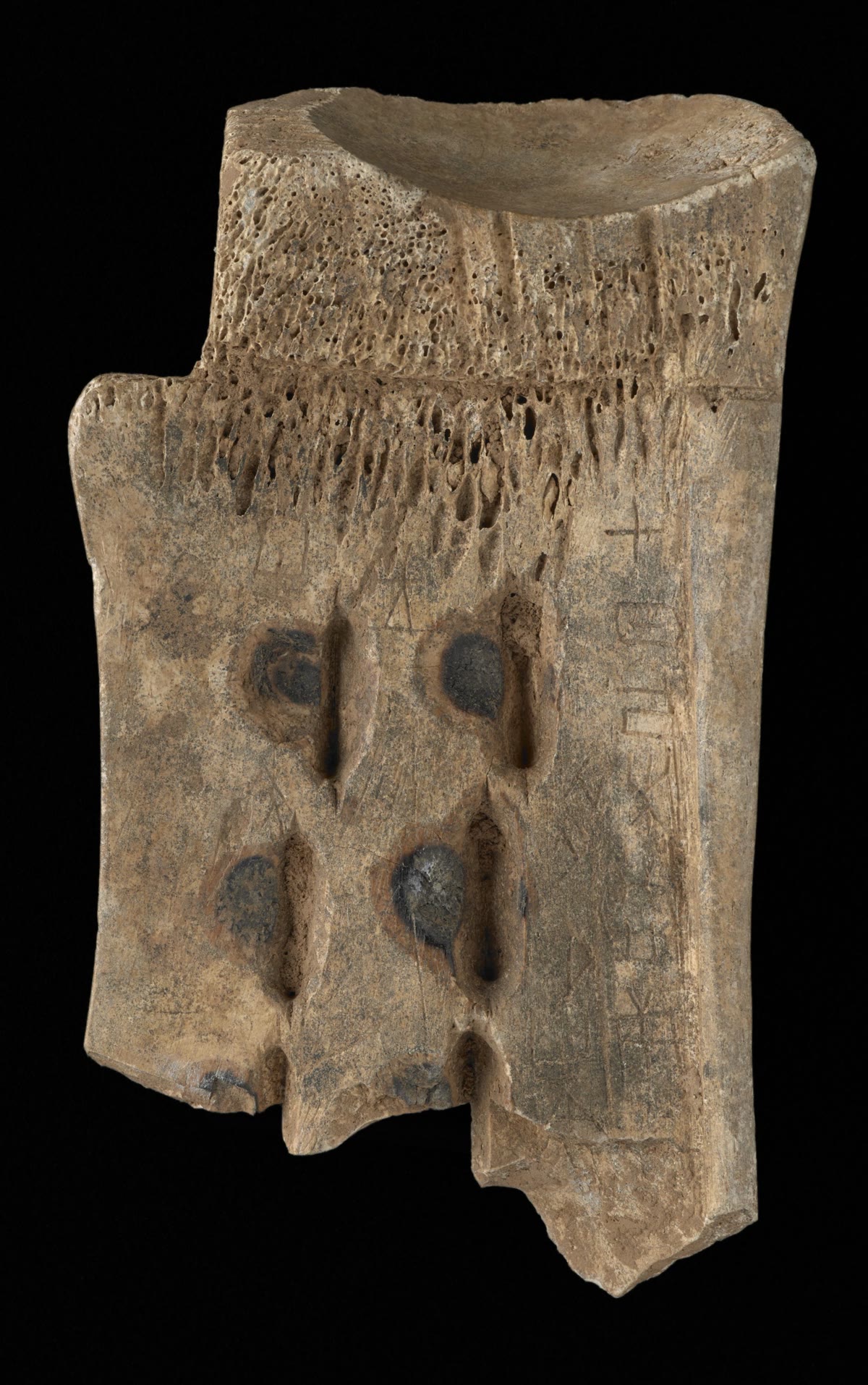
Image context: the cover uses a real Wikimedia Commons photograph of an oracle bone in the Couling-Chalfant collection. That is the right visual here because the video's real argument starts with material evidence. The AI system matters only because the carved object exists first, remains difficult to read, and has to be studied across photographs, rubbings, databases, and scholarly records.[6]
Around 0:00 to 0:12, the video starts on the artifact because physical evidence still sets the boundary
The opening frames dwell on the surface of an inscribed fragment before they show any interface.[1] That is a small editorial choice, but it matters. Tencent is telling the viewer that oracle-bone work begins with damaged, partial, material objects rather than with clean text strings. The 2024 Tencent essay makes the same point in prose by stressing the age of the fragments, their role in divination, and the very incomplete state of decipherment.[3]
This opening also puts a limit around what the AI claim can be. If the raw object is cracked, weathered, incomplete, and dispersed across collections, then an agent cannot simply "know" the answer the way a chatbot answers a generic trivia question. It has to begin from visual evidence, historical records, and comparative corpora. That is why the article should be read as an AI-China post rather than a generic heritage-tech vignette. The technical story is not magical translation. It is the use of Chinese AI infrastructure to make a difficult scholarly search problem more tractable.[1][2][3]
Around 0:18 to 0:30, the key move is not generation but candidate narrowing
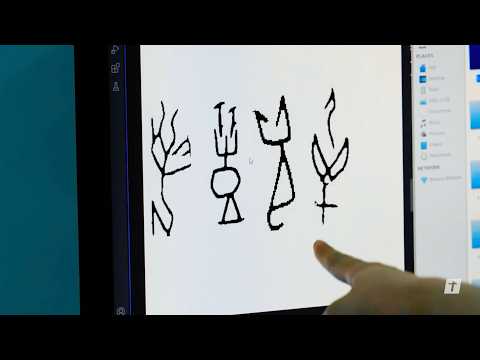
Once the video pivots to the database interface, the real product logic appears.[1] The viewer sees search, comparison, and glyph tables rather than a theatrical model speaking with false certainty. Tencent's 2026 article says the platform helps researchers search, compare, and identify similar oracle-bone characters, while the OBIMD paper describes a resource built around pixel-aligned rubbing and facsimile images, character-level annotations, and sentence-level transcriptions.[2][4] Put together, those sources make the system's value legible: it narrows the candidate set that a human scholar has to inspect.
That is a much stronger claim than "AI can read oracle bones." It is also more believable. In a domain with thousands of fragments and many visually similar but context-sensitive forms, the bottleneck is often not final interpretation but preliminary triage. Which fragments look related? Which stroke patterns recur? Which possible matches deserve a closer philological look? The AI layer earns its place if it makes those first passes faster and less repetitive.[2][4]
This is where the video's brevity helps it. A 66-second runtime leaves no space for benchmark theater, so Tencent uses screen time to show the workflow boundary instead. The artifact becomes image data, the image data becomes searchable candidates, and the searchable candidates return to human review. That is the expert loop.
Around 0:36 to 0:42, the public-facing tablet matters because the corpus is also an interface problem
The next useful transition is from research-style interfaces to a tablet and a chat-oriented surface.[1] Tencent's 2026 article says the same AI foundation supports a conversational learning experience through a web interface and Weixin Mini Program, allowing both specialists and the public to ask questions, inspect visual similarities, and learn historical usage and meaning through dialogue.[2] The 2024 Tencent essay makes this even more explicit by describing the public-facing Amazing Oracle Bones mini program and the broader Oracle Bone Corpus platform.[3][5]
That shift is important because it reveals a second ambition beyond scholar productivity. Tencent is not only building a back-office retrieval system. It is also building a public interface layer that can lower the intimidation barrier around oracle-bone studies. In AI-China terms, that matters because many Chinese AI deployments are strongest when they do not ask users to admire a model in the abstract. They ask users to enter a domain through a better interface. Here the interface is educational as much as scholarly.[2][3][5]
The risk, of course, is that public chat can blur confidence boundaries. Tencent's own wording partly avoids that trap by insisting that interpretation and cultural meaning remain in human hands.[2] That is the correct boundary to keep. The chat layer should be read as guided access to a corpus, not as an oracle-bone authority that eliminates the need for specialists.
Around 0:48 to the end, "helping history speak more clearly" is really a digital-reunification argument
The final artifact shot and closing line push the article toward its most durable idea.[1] Tencent's 2026 essay argues that shared digital foundations let scholars work across collections, institutions, and borders, and it explicitly frames one outcome as digital reunification.[2] That phrase is the real center of gravity. Oracle bones are historically dispersed. Physical reunification is limited. Digital reunification offers a way to study the material as a connected field even when the objects remain physically apart.
That goal also explains why corpus quality matters as much as model quality. Tencent's 2024 essay emphasizes multiple viewing modes, archival images, digital rubbings, and character-database functions inside the corpus.[3] The OBIMD paper emphasizes multimodal structure and open availability for retrieval and reconstruction tasks.[4] The AI agent, on this reading, is not the whole product. It is the conversational and comparative layer that sits on top of a longer digitization and annotation project.
That is why this video is worth embedding now. Its strongest claim is modest on the surface and ambitious underneath. Modest, because Tencent is careful not to present AI as the final interpreter of Shang writing. Ambitious, because it is trying to turn a hard scholarly archive into a searchable, teachable, partially reunified research environment. The video's best lesson is that good AI-China work in 2026 often looks less like autonomous genius and more like expert-centered infrastructure: image enhancement, visual retrieval, corpus organization, and public access, all arranged so specialists can spend more time interpreting and less time hunting.
Sources
- Tencent Global, "Decoding Oracle Bones: With a Little Help from AI Agents," official YouTube video, published March 10, 2026.
- Tencent, "Decoding Oracle Bones – With a Little Help from AI Agents" (March 10, 2026; expert-in-the-loop framing, 15,000 documented fragments, and the public chat interface).
- Tencent, "Oracle Bones: How Tencent Is Unlocking Excitement for the Earliest Writing" (December 19, 2024; corpus features, public mini program, and the scale of overall discovery and decipherment).
- Li, Yang et al., "OBIMD: A Multi-modal Dataset for Contextual Interpretation of Oracle Bone Inscriptions," Scientific Data (2026; dataset structure, annotation counts, and retrieval-oriented tasks).
- 甲骨文AI协同平台, official home page of the Oracle Bone AI Collaborative Platform referenced by Tencent's articles.
- Wikimedia Commons, "File:Oracle bone from the Couling-Chalfant collection.jpg" (source page for the museum photograph used as the article image).