As of 2026-04-06 UTC, Tencent's most revealing AI-China move is no longer one more model release. The stronger signal sits one layer above the model. Tencent Cloud now presents ADP as an enterprise agent-building platform with LLM+RAG, Workflow, and Multi-Agent modes; it has shifted that platform into a subscription package regime in 2026; it lets teams bring tools in through a plugin square that includes API, MCP, code, and application plugin types; it provides a publish path from test configuration to production access; and it is pairing that stack with a new AI Agent Security Gateway and a separate Agent Runtime infrastructure layer.[1][2][3][4][5][6][7]
Read together, those pages point to a coherent company thesis. Tencent does not only want to provide model capability through Hunyuan or adjacent AI services. It wants to own the chain by which agent work is assembled, governed, executed, and observed inside enterprise environments.[1][2][3][4][5][6][7] My inference from these primary sources is that Tencent is trying to turn "agent" from a demo category into a managed operating surface with explicit control points.
Tencent's own historical framing helps. In September 2025, the company said it was launching AI Agent Development Platform 3.0 internationally through Tencent Cloud as part of a broader rollout of scenario-based AI capabilities.[8] The current 2026 product and documentation trail makes that line much more concrete. What looked like a platform announcement now reads like the front end of a fuller execution stack.[1][2][8]
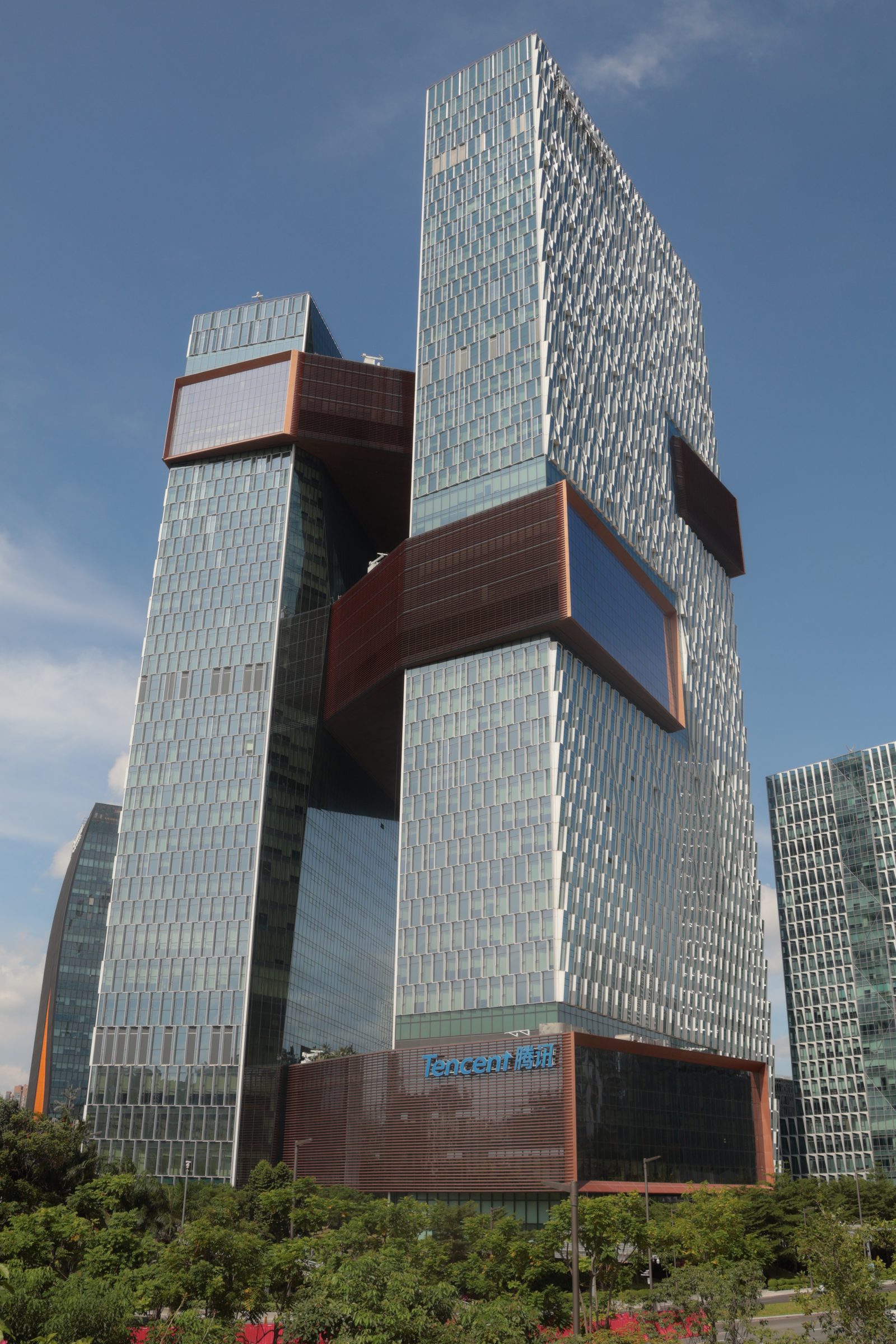
Image context: the cover uses a real Wikimedia Commons photograph of Tencent Binhai Mansion in Shenzhen. It works here because the article is about Tencent's company-level effort to package agent development, control, and execution into a stable business stack rather than about a single benchmark or model screenshot.[9]
The account unit has moved from experiments to packages
The first sign of that shift is commercial rather than architectural. Tencent Cloud's ADP product page currently pushes a newly upgraded package system, a 0-yuan trial tier, and one-click deployment flows such as ClawPro directly on the front page.[1] The product overview then describes ADP as a production-oriented enterprise platform, not a sandbox for prompt play: agents can be published through multiple channels, exposed through standard API / SDK pathways, and connected into existing work systems.[2]
The billing documents show the next step. Tencent's service change rules for package subscriptions say the current charging plan was rolled out in batches from January 9, 2026 through January 15, 2026, and the page explicitly discusses package upgrades, prorated pricing, and proportional issuance of PU resources and knowledge-base capacity.[3] That is an important change in emphasis. Once agent building is sold in subscription packages with bundled resources, the platform is no longer presenting itself as a thin wrapper over raw inference. It is selling a governed work surface with its own quotas, entitlements, and upgrade logic.[1][2][3]
In AI-China terms, that matters because it moves Tencent closer to the layer where enterprise stickiness usually forms. Model choice can change. Package logic, quotas, publish rights, and operational habits tend to persist longer.
Tools are being turned into catalog objects
The second signal is the plugin system. Tencent's plugin documentation says ADP can extend an application through a plugin square, and it defines four plugin types: API, MCP, code, and application plugins.[4] It also divides plugin sources into official, third-party, and custom classes.[4] That sounds like a documentation detail until you place it next to the platform's Multi-Agent and workflow language. The result is a controlled distribution format for tools, not just a generic invitation to call outside services.
That format becomes more operational in the MCP guide. Tencent's MCP-plugin walkthrough uses a Multi-Agent application flow, asks the builder to add the required MCP tool, test the dialogue result, and then publish the application into production.[5] After publication, the user can open publish management to obtain an experience link, a shareable link or QR code, and an API key for business integration.[5] The important point is not the route-planning example itself. The important point is that Tencent is teaching users to think in one chain: build the agent, attach tools, validate behavior, publish, then connect the result to a production scenario.[5]
That is a meaningfully different posture from a platform that stops at model access plus documentation. Tencent is productizing the transition from prototype to deployment inside the same interface vocabulary.
Governance now sits between the agent and the tool
The third signal is the emergence of a distinct security-control layer. Tencent's AI Agent Security Gateway documentation, updated on 2026-03-20, says the gateway supports grouping API and MCP resources by application, adding and managing MCP servers, maintaining security logs and access logs, and applying multiple rule classes such as injection detection, MCP poisoning detection, sensitive-data checks, desensitization, and content-safety review.[6]
This is where Tencent's agent story becomes more than a builder surface. An enterprise agent stack is not durable if it only makes tool connection easier. It also has to make tool connection governable. The gateway page makes that ambition explicit. Tencent is placing inspection, filtering, logging, and policy between the agent and the external capability surface.[6]
That matters because MCP-style openness creates a familiar tradeoff. It lowers the cost of adding tools, but it also expands the attack and data-leak surface. Tencent's public answer is not to narrow the tool model back down. It is to insert a policy layer that can watch, classify, and sanitize what crosses that boundary.[6] The deeper commercial implication is that governance becomes part of the product, not only part of the customer's own middleware.
Agent Runtime says Tencent wants the execution layer too
The fourth signal sits even lower in the stack. Tencent Cloud's Agent Runtime product page describes a new infrastructure platform built around agent-native execution patterns, explicitly contrasting them with the traditional request-response model.[7] The page says agents bring four execution characteristics together: goal orientation, autonomous decision-making, multi-step execution, and tool calling.[7] Tencent then presents Agent Runtime as the infrastructure that supplies the missing determinism around those behaviors: runtime, sandbox, gateway, memory, and observability.[7]
That vocabulary is revealing. Tencent is no longer only describing how to design an agent. It is describing how to host one. The product page emphasizes VM-level isolation, zero-trust and zero-credential access, hundreds of thousands of instances per minute, 100-millisecond startup, support for both short-lived and long-running jobs, and production-grade auditability and recovery.[7] In other words, the company is publicizing a runtime substrate for agent work, not merely a console for composing prompts and tools.
Once Agent Runtime is placed beside ADP and the security gateway, a fuller architecture appears. ADP is the application-building and publication surface.[1][2][4][5] The security gateway is the inspection and protection layer around APIs and MCP servers.[6] Agent Runtime is the execution substrate that tries to make long-lived, tool-using agents operationally safe and scalable.[7] The stack is not fully described on one single page, but the public pieces align closely enough to support one conclusion: Tencent wants the center of gravity to move from model access toward governed agent execution.
What this changes about Tencent's AI-China position
This does not prove Tencent has already won the agent platform market. Public documentation cannot establish adoption depth on its own. It also does not erase the importance of Hunyuan model quality, pricing, or broader cloud competition. Those boundaries still matter.
But the public evidence does support a narrower claim. Tencent's most durable AI move right now is to make enterprise agents legible as a full stack with explicit control points: package subscription, tool catalog, production publish flow, security mediation, and runtime infrastructure.[1][2][3][4][5][6][7] That is a stronger position than "we have another capable model," because it gives Tencent more ways to hold the surrounding workflow even when model preferences keep moving.
For AI-China watchers, that is the field signal worth keeping. Tencent is trying to ensure that once an enterprise starts building agents on its platform, the hard part is no longer choosing a model. The hard part becomes leaving the governance and execution chain wrapped around that model.
Sources
- Tencent Cloud, "腾讯云智能体开发平台 ADP" product page (current platform framing, LLM+RAG/Workflow/Multi-Agent, package-system upgrade, free trial, Widget, and one-click ClawPro deployment references).
- Tencent Cloud Docs, "产品概述" for Tencent Cloud Agent Development Platform (enterprise AI application platform framing, standard mode, Multi-Agent mode, Workflow mode, and API/SDK/publish-channel integration).
- Tencent Cloud Docs, "服务变更规则说明(套餐订阅)" (updated February 9, 2026; subscription rollout from January 9-15, 2026, package upgrades, and proportional PU-resource issuance).
- Tencent Cloud Docs, "插件介绍" (updated November 19, 2025; plugin square, four plugin types, and official/third-party/custom source classes).
- Tencent Cloud Docs, "使用 MCP 插件" (updated December 4, 2025; Multi-Agent example, add-plugin flow, publish-to-production step, and post-publish API-key access).
- Tencent Cloud Docs, "AI Agent 安全网关 功能列表" (updated March 20, 2026; application grouping, MCP server management, security and access logs, injection and MCP-poisoning detection, sensitive-data checks, and content-safety rules).
- Tencent Cloud, "Agent Runtime" product page (agent-native execution framing, sandbox/gateway/memory/observability stack, VM-level isolation, zero-credential access, and high-concurrency runtime claims).
- Tencent, "Tencent Announces Global Rollout of Scenario-Based AI Capabilities to Accelerate Industrial Efficiency" (September 16, 2025; launch of AI Agent Development Platform 3.0 internationally via Tencent Cloud).
- Wikimedia Commons, "File:TencentBinhaiMansion.jpg" (source page for the cover photograph used in this article).