
As of 2026-03-28 UTC, the useful way to watch Tencent Cloud's two-minute MWC26 reel is to treat it as a deployment argument rather than as a product sizzle video.[1][2] The clip does contain AI language, but its sequencing keeps pushing the viewer toward a narrower conclusion: Tencent wants overseas customers to picture AI adoption as a package made of regional capacity, workflow tools, and local partner trust.
That distinction matters for AI-China coverage because many Chinese AI videos still ask to be read at the model layer first. They open on benchmark language, reasoning claims, or one heroic demo. Tencent Cloud's MWC26 montage takes a different route. The camera stays on customers, booth traffic, and field conversations; the narration emphasizes multicloud resilience, European deployment, and creator pipelines; and the named AI surface is HY 3D, a production tool family aimed at 3D asset generation rather than a general chatbot spectacle.[1][2][3]
My inference from Tencent's sequencing is that the company wants overseas buyers to see Chinese AI capability as something that arrives already wrapped in service structure. The Frankfurt availability-zone expansion supplies locality, HY 3D supplies a creator-facing workload, and partner quotes supply social proof that Tencent Cloud can support always-on businesses in Europe.[1][2][4][5] That is the frame worth holding before pressing play.
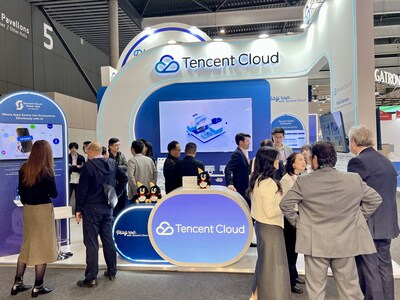
Image context: the cover uses Tencent's own MWC26 booth photo from the PR release about its Europe expansion. A real event photograph is the right visual here because the article is about how Tencent packages AI in a trade-show setting through people, booths, and partner meetings, not through synthetic renders of model internals.[2]
Around 0:07, the opening testimonial sells trust before it sells AI
The first spoken lines come from a payments customer describing online payments as a 24/7 business and explaining why a long-term partnership matters.[1] That is a revealing editorial choice. Tencent could have opened with Hunyuan model branding or a generic statement about innovation. Instead it opens with uptime, support, and whether a cloud partner understands the customer's business.
That emphasis lines up with the written MWC26 announcement, which highlights Turkish fintech iyzico launching its first European cloud-based production platform on Tencent Cloud.[2] Read together, the video and the release suggest that Tencent wants the first emotional association to be operational reliability. The AI layer is present, but it is introduced inside a business continuity story. For an international cloud pitch, that is a stronger trust signal than a detached model demo would be.
The opening also helps explain why this belongs in AI-China rather than in a generic telecom-events bucket. Tencent is carrying Chinese AI capability into foreign markets through an enterprise-cloud relationship vocabulary: continuity, support, platform fit, and regional delivery. The clip's first ten seconds quietly tell you what kind of exporter Tencent wants to be.
Around 0:22, Europe is framed as a deployment market, so Frankfurt matters more than a benchmark slide
The narrator enters around 0:22 with the video's clearest line: Europe is entering a critical phase in its AI journey, with companies moving from experimentation into deployment.[1] That sentence is the hinge for everything that follows. Once the market is described as a deployment market, infrastructure details become headline material. The montage then moves directly into Tencent Cloud's third availability zone in Frankfurt, presented as the local backbone for platform and AI services in real-world use.[1][2]
This is where the video becomes more strategic than it first appears. Tencent's official infrastructure pages already position Frankfurt as its European node, and the MWC26 release adds the new capacity as an explicit sign of commitment to local workloads.[2][5] In other words, Tencent is not asking European buyers to think about Chinese AI as something that must be remotely imported from a distant model endpoint. It is asking them to think about AI as a service that should sit closer to deployment, latency, resilience, and compliance needs.
That reading also fits Tencent's broader 2025 international messaging. At the Global Digital Ecosystem Summit, Tencent said its overseas client base had doubled year over year and described international growth through three layers: infrastructure, technology products, and service capabilities.[4] The MWC26 clip compresses those three layers into a ninety-second proof-of-concept. Frankfurt is the infrastructure layer made visible.
Around 0:52, HY 3D is positioned as pipeline infrastructure for creators
The middle stretch of the video shifts from regional cloud capacity to creator workflow. A partner explains that a 3D artist used to spend hours or even days producing a model, then says Tencent allows its products to sit inside the production pipeline so output can be sold to millions of users with reliability and stability.[1] A few seconds later, the speaker describes HY as AI infrastructure for creating and optimizing 3D models.[1]
That wording matters. HY 3D is not framed here as a moonshot research demo. It is framed as pipeline equipment. Tencent's November 2025 Hunyuan 3D announcement uses the same logic in writing: a world model, image-to-3D tools, text-to-3D tools, and open-source releases are presented as creator instruments for game, film, and e-commerce production rather than as laboratory curiosities.[3] The later 2025 ecosystem-summit release reinforces the point by grouping Hunyuan 3D 3.0, Hunyuan 3D AI, and Hunyuan 3D Studio under scenario-based AI capabilities for creators and developers.[4]
That combination is useful because it shows Tencent choosing an exportable AI workload with clear commercial edges. Generative 3D has a visible customer set, a recognizable time-saved story, and a direct connection to media, gaming, and marketplace pipelines. For a company trying to internationalize Chinese AI without depending on one frontier-model narrative, this is a pragmatic showcase.
Around 1:28, the Maxon segment explains the real export logic
The Maxon quote is the cleanest distillation of the whole reel. The speaker says the partnership will let artists do more, faster, improve UV unwrapping, and enable 3D creation when needed.[1] The language stays grounded in concrete workflow steps. Nobody claims that artists are being replaced or that general intelligence has arrived. The value proposition sits at the level where adoption decisions are actually made: speed, fit, and integration into tools creative teams already use.
That is why the montage ends up saying more about Tencent's go-to-market posture than about any single model family. The company is presenting HY 3D through named customers such as 3D AI Studio, CGTrader, and Maxon, while packaging the whole story inside a European-cloud expansion and partner-event setting.[2] My inference from the video and the supporting releases is that Tencent sees international AI uptake as a channel problem first and a model-brand problem second.[2][3][4]
The contrast with many shorter AI launch clips is sharp. Instead of asking the viewer to admire an isolated capability, Tencent asks the viewer to picture a supply chain: local region, cloud account team, creator tool, partner case study, then production workload. That is a distinctly enterprise version of AI-China export logic.
What to watch for if you replay it now
Replay the reel and notice how rarely Tencent names a single master model. The opening gives you uptime and relationship language. The Europe section gives you deployment and Frankfurt. The middle gives you HY 3D as creator infrastructure. The closing gives you a software partner translating that AI layer into daily workflow language.[1][2][3][4][5] The video works because each piece answers a different buyer question.
That is what makes it worth annotating. Tencent Cloud is using a trade-show highlight reel to argue that Chinese AI can travel internationally when it is bundled with regional capacity, partner confidence, and a workload that already looks commercially legible. The claim may sound modest next to frontier-model theater. It is also much closer to how enterprise adoption usually happens.
Sources
- Tencent Global, "AI, Infrastructure and New Partnerships | Tencent Cloud at #MWC26," official YouTube video, published March 16, 2026.
- Tencent Cloud, "Tencent Cloud Launches New Availability Zone and Services in Europe to Power AI Growth" (PR Newswire, March 16, 2026).
- Tencent, "Tencent Announces Global Launch of Hunyuan 3D Engine to Empower Creators with Advanced Creation Tools" (November 20, 2025).
- Tencent, "Tencent Announces Global Rollout of Scenario-Based AI Capabilities to Accelerate Industrial Efficiency" (September 16, 2025).
- Tencent Cloud, "Tencent Cloud Global Infrastructure" (Frankfurt listed under Central Europe).