As of 2026-03-27 UTC, the easiest way to misread Moonshot's recent Kimi cycle is to treat it as one more frontier-model refresh. The public product pages point somewhere more operational. The Kimi K2.5 release, the technical blog around it, the Kimi Code launch materials, and the CLI documentation all describe the same shift: Moonshot is trying to turn one model family into an execution ladder that starts with chat, climbs into structured work products, and then lands inside a terminal-and-IDE coding agent.[1][2][3][4][5]
That matters because the unit of competition changes when the product stops selling "answers" and starts selling completed work. Moonshot's own K2.5 page is explicit that the line now spans Instant, Thinking, Agent, and Agent Swarm, with the higher modes aimed at producing documents, slides, spreadsheets, websites, and research outputs rather than just a better paragraph in a chat window.[1] The same page also says K2.5 is accessible through the web, app, API, and Kimi Code.[1] That distribution pattern is the real release-note signal.
The front-end split is no longer chat versus no chat
The K2.5 page describes a meaningful hierarchy, not a decorative mode picker. Instant is framed for quick questions. Thinking is framed for deeper reasoning. Agent is framed for research and content creation that ends in structured outputs. Agent Swarm is framed for large, multi-step projects where sub-agents can run in parallel.[1]
This is a more important product choice than it first looks. It means Moonshot is trying to normalize a different user expectation. Instead of asking whether the model writes better text than last quarter, the company wants users to ask which level of orchestration the task deserves. A simple answer sits at the bottom. A multi-file or multi-document workload sits higher up. In that sense, the K2.5 release is a packaging decision as much as a model decision.[1]
The company's own wording reinforces that read. K2.5 is described as "designed for real-world execution," and its multimodal story is tied directly to visual-to-code workflows and long-horizon task handling rather than only to benchmark prestige.[1] That wording is hard to ignore because it matches the rest of the release stack.
The technical blog explains why Moonshot wants the product to be read this way
Moonshot's K2.5 technical blog gives the model side of the same argument. It describes K2.5 as Visual Agentic Intelligence, says it was trained on 15T tokens, and frames the release around two specific capabilities: strong visual coding and autonomous agent swarm behavior.[2] Even the evaluation notes are revealing. The post does not only talk about classic reasoning or language benchmarks. It also calls out coding and agent-oriented evaluations such as Terminal-Bench 2.0, the SWE-Bench family, and swarm-mode settings for BrowseComp and WideSearch.[2]
The deeper point is not that Moonshot published one more impressive table. It is that the company is choosing to prove K2.5 in environments that resemble execution: tool use, long context, coding loops, browser-style retrieval, and coordinated sub-agents. When a lab changes its public benchmark vocabulary, it is often signaling how it wants the market to value the product. Here the signal is clear: Moonshot wants K2.5 to be read as a system for doing work across surfaces, not merely for winning abstract scoreboards.[2]
Kimi Code is the second half of the release, not a sidecar
The clearest evidence sits in the Kimi Code materials. Moonshot's own resource page describes Kimi Code as a terminal-first AI agent powered by K2.5, with a 256K context window, 100 tokens per second output, MCP support for external tools, advanced session management, and support for VS Code, Zed, and JetBrains via ACP.[3] That is not the language of a lightweight autocomplete feature. It is the language of a workflow surface.
The same page is even more explicit about behavior. It says Kimi Code is designed for terminal-first development workflows and, unlike traditional assistants that mostly suggest snippets, it can analyze repositories, plan multi-step tasks, execute commands, and iterate autonomously.[3] That is the moment the K2.5 release starts looking less like one model page plus one add-on product. Kimi Code is the place where Moonshot cashes out the execution rhetoric.
The CLI docs push the point further. The documentation tree is organized around agents and subagents, sessions and context, MCP, plugins, IDE integration, and a set of operational subcommands rather than a narrow prompt box metaphor.[4][5] The Kimi Code introduction page also describes slash commands such as /login, /sessions, /compact, and MCP flows that let the agent work against external tools while preserving an approval mechanism.[3] The design logic is visible: long-context reasoning is being wrapped inside an operating surface where persistence, resumption, tool access, and session control matter as much as raw model output.
That is why the right read on this release cycle is "execution ladder." K2.5 handles the model and consumer modes. Kimi Code handles the heavy developer workflow surface. The CLI docs provide the controls that make that surface durable instead of theatrical.[1][3][4][5]
The distribution clue is developer-facing, not only consumer-facing
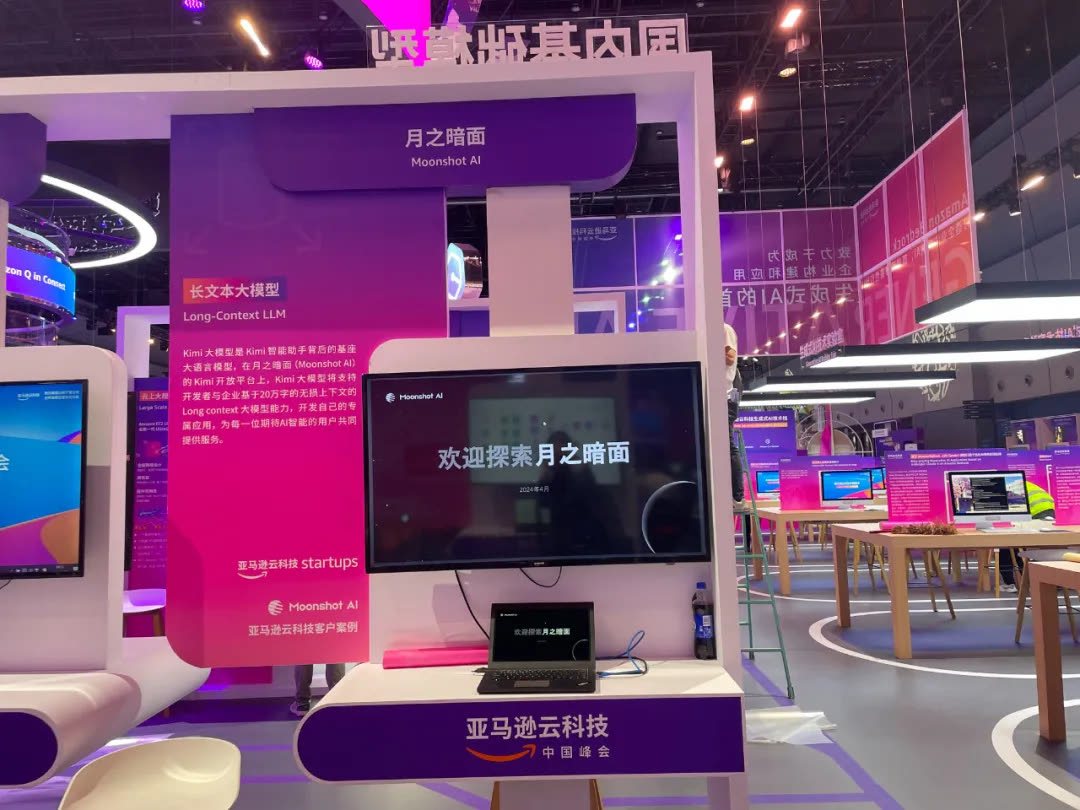
One additional signal comes from Moonshot's own open-platform blog. In its post about API updates and the 2025 AWS China Summit, the company shows itself bringing Kimi platform updates to a developer exhibition context rather than keeping the story inside a consumer chatbot frame.[6] That does not prove Kimi Code has already become a standard tool in serious engineering teams. It does show where Moonshot is trying to meet demand: not only on the homepage, but in the places where APIs, tooling, and enterprise evaluation happen.[6]
That matters because many China AI launches still blur research prestige and product readiness. Moonshot's recent stack is more deliberate. The company is exposing a consumer hierarchy, a technical benchmark story tied to action-heavy tasks, and a coding product with explicit operational controls. Those pieces reinforce each other.
Boundary and watchlist
There is still a hard boundary on this read. Moonshot's sources show intention and surface design more clearly than they show durable usage. A clean ladder from K2.5 to Kimi Code is not the same thing as proven daily habit. The company still has to show that Agent and Agent Swarm outputs become repeated workflows, that Kimi Code stays reliable on long-running repository work, and that the terminal-and-IDE surface can convert model capability into sticky developer behavior.
Three things are worth watching next:
- Whether Moonshot publishes more public evidence that Agent and Agent Swarm outputs are turning into repeated work-product habits rather than novelty demos.[1]
- Whether Kimi Code's operational controls around sessions, MCP, and approvals keep expanding, which would signal that the coding surface is being treated as a real workstation layer.[3][4][5]
- Whether Moonshot keeps pushing developer distribution channels, not only consumer branding, because that is where an execution-first model line becomes harder to dislodge.[6]
The useful conclusion is therefore narrower than "Moonshot shipped another strong model" and more valuable than that label. The Kimi K2.5 cycle is trying to reorganize Moonshot around a ladder: quick chat at the bottom, structured outputs in the middle, and terminal-and-IDE execution at the top.[1][2][3][4][5]
Sources
- Kimi, "Kimi K2.5 | Open Visual Agentic Model for Real Work" (mode split, work-product outputs, access surfaces, and release date).
- Kimi, "Kimi K2.5 Tech Blog: Visual Agentic Intelligence" (15T-token framing, visual coding, agent swarm, and benchmark notes).
- Kimi, "Kimi Code: Next-Gen AI Code Agent for Terminal & IDE" (256K context, 100 tokens/s, MCP, session management, and IDE support).
- MoonshotAI, "Agents and Subagents" in Kimi Code CLI Docs.
- MoonshotAI, "Sessions and Context" in Kimi Code CLI Docs.
- Moonshot AI Open Platform Blog, "Kimi 大模型 API 更新了,也期待在『亚马逊云科技中国峰会』见到大家 | 开发者速递" (developer-event and platform-distribution context).