As of 2026-05-06 UTC, the useful way to read Tencent Cloud ADP is no longer as a plain enterprise prompt builder that happens to sit on top of large models. The stronger ai-china signal is that Tencent is assembling a managed control plane where model choice, workflow shape, plugin access, cost accounting, and internal distribution live on the same surface.[1][2][3][4][5] The product page now advertises an "intelligent workspace" for employees, while the documentation describes ADP as a platform for building controllable production AI applications rather than one-off demos.[1][2] My reading is that Tencent wants ADP to occupy the layer between model supply and enterprise operations.
That distinction matters because a lot of enterprise AI platforms still stop at orchestration theater. They promise agents, then leave teams to stitch together model routing, plugin policy, workflow logic, usage governance, and publishing paths by hand. Tencent's current ADP materials point to a different ambition. The company is trying to keep those pieces inside one managed product boundary.[1][2][3]
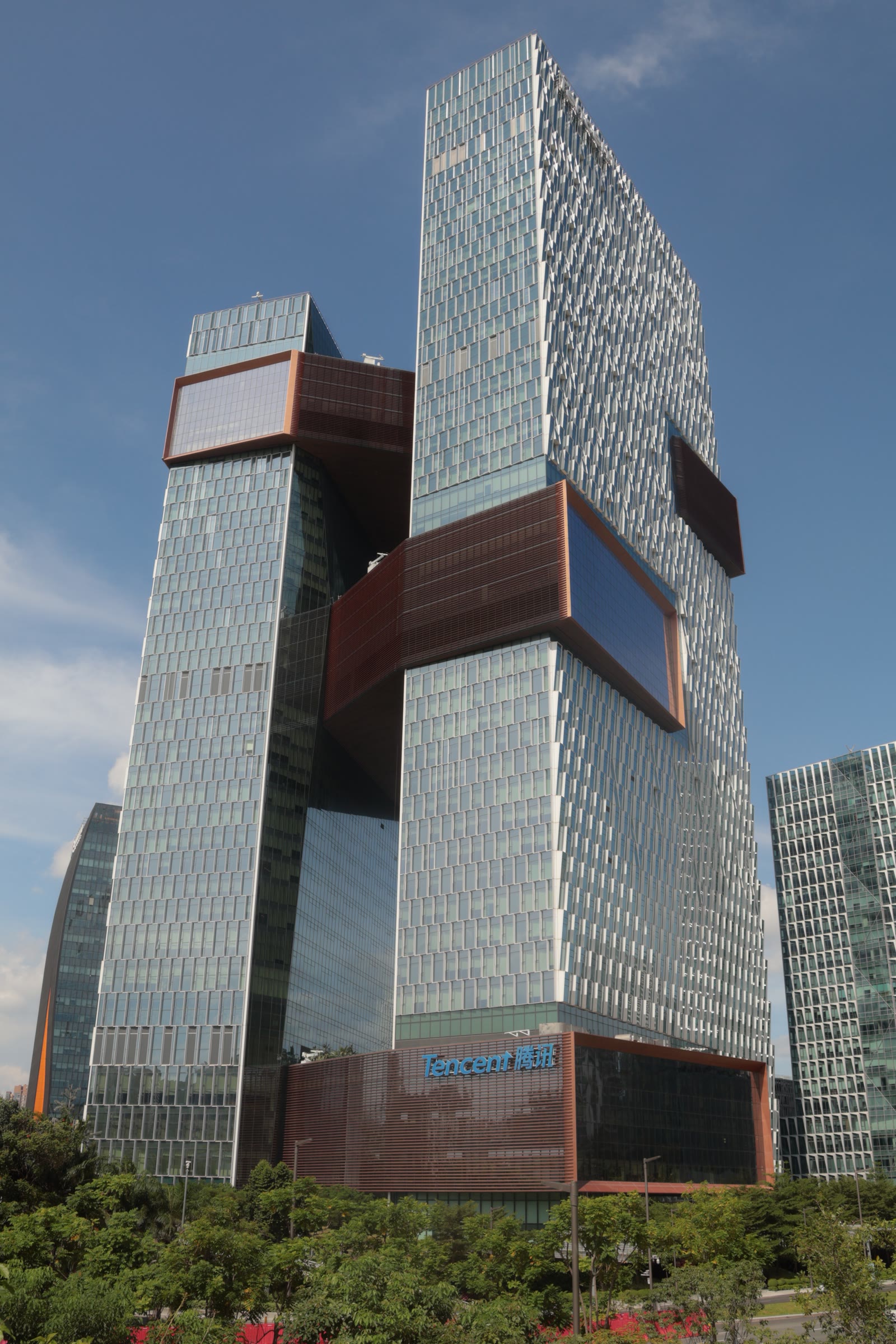
Image context: the cover uses a real Wikimedia Commons photograph of Tencent's Shenzhen headquarters. That is the right anchor here because the article is about Tencent's enterprise agent platform strategy, not about an abstract AI icon or a synthetic interface rendering.[6]
The front end is moving toward an internal workbench, not a hidden builder
The product page gives away the directional shift. Tencent is not presenting ADP only as a toolkit for developers. It now highlights an "intelligent workspace" positioned as a one-stop assistant for enterprise employees, connected to knowledge bases and tools, able to satisfy customized needs in complex scenarios and to plan and execute workflows out of the box.[1] That language matters because it pushes ADP up from a backstage builder into a user-facing operating surface.
The documentation reinforces that move. The overview page describes ADP as an enterprise AI application platform that can publish finished agents through multiple channels, expose standard API and SDK paths, and integrate with existing office systems and work scenarios.[2] In other words, Tencent does not want ADP to end at prototype authoring. It wants the platform to sit where employees, business flows, and governed AI execution actually meet.[2]
This is an important competitive position in AI-China. Chinese vendors already have enough model endpoints and enough agent demos. The harder problem is how an enterprise keeps those capabilities legible once they enter real operating environments. ADP's documents are trying to answer that with product structure rather than with benchmark theater.
The three application modes show Tencent wants to own execution topology
The clearest architectural clue in the dossier is the way ADP defines its three application modes.[2] Tencent's overview says the platform supports standard mode, multi-agent mode, and workflow mode, each mapped to a different operating pattern rather than to a different model family.[2] Standard mode starts from a single agent and gradually adds knowledge and plugin capability. Multi-agent mode is framed for tasks that need a small team of specialized sub-agents. Workflow mode is framed for fixed business processes such as ticket routing, after-sales handling, or approval chains.[2]
That matters because Tencent is productizing execution topology. The platform is not only saying "bring a model." It is saying "choose how work is structured, then stay inside our rails for the rest of the lifecycle."[2] That is a much stronger claim than ordinary chat-assistant packaging. Once a platform defines the topology of execution, it starts to influence how enterprises think about what an agent is for.
The same overview broadens the dossier beyond a narrow builder story. Tencent says ADP spans configuration, development, debugging, evaluation, release, and operations, and describes built-in quantitative evaluation, usage analysis, conversation logs, permissions, auditing, monitoring, and alerting as part of the same platform envelope.[2] The control-plane reading gets stronger here. Tencent is bundling not only the "do the task" layer, but also the "observe, compare, govern, and publish" layer.
The January changes turned cost governance into product logic
The product-dynamics page is where the business model becomes visible. In the January 2026 updates, Tencent said ADP would shift to subscription packages, stop selling the earlier prepaid token resource packs, dedicated concurrency packs, and knowledge-base expansion packs, and open a resource dashboard for package buyers to inspect model, plugin, knowledge-base, and platform-service usage.[3] That is a major tell.
The shift means Tencent no longer wants enterprises to experience ADP as a loose marketplace of disconnected meters. It wants them to experience ADP as a governed budget surface. The resource dashboard is especially revealing because it turns plugins and platform services into first-class billable and observable resources alongside models.[3] In practical terms, Tencent is teaching customers to buy not only inference, but an operating environment.
The current settings documentation fits that framing. ADP says new users receive a free quota for trying different models inside the platform, and then can continue by purchasing the relevant service after testing.[4] The important detail is where that choice happens. Model selection, context length, and generation settings are exposed through ADP's own application settings rather than through a raw API contract.[4] Tencent is keeping the control surface centralized even when model variety remains available.
Open plugin language sits inside a managed shell
Tencent is not building a closed product in the narrow sense. The overview says ADP supports multiple model types, self-built models, 150+ built-in plugins, and full support for MCP plus custom plugin extension.[2] On paper, that looks open. The more interesting question is what kind of openness it is.
The answer, from the dossier, is managed openness. Tencent is inviting outside tools and model diversity into ADP, but it is doing so inside a product shell that also owns application modes, publishing paths, permission hierarchies, logs, usage analytics, and billing.[2][3][4] This is a very different competitive posture from a company that only advertises raw endpoint compatibility. Tencent is trying to make openness consumable through governance.
That makes the May 7, 2026 commercialization notice for DeepSeek V4 Flash inside ADP especially revealing. Tencent's announcement says the model's limited-time free public beta will end at 2026-05-07 10:00 Beijing time, after which usage will shift to paid commercial service and subscription users will consume PU from their packages.[5] This is a small announcement with large strategic meaning. A third-party model lane is being monetized through Tencent's own platform accounting system.
In other words, ADP is not simply hosting tools. It is becoming the place where outside model supply is normalized into Tencent's internal meter, plugin rules, and enterprise workflow wrapper.
Why this matters in AI-China
The narrow claim is not that Tencent Cloud ADP has already won enterprise agents. The sources do not prove that, and the article does not need to claim it. The stronger conclusion is that Tencent is making a deliberate move up the stack.[1][2][3][4][5] ADP now reads as a platform designed to absorb the messy middle of enterprise AI adoption: distribution to employees, structured execution modes, plugin and MCP extensibility, testing and evaluation, cost visibility, and the monetization of third-party model lanes.
That is why the dossier matters in ai-china. As the model layer keeps getting cheaper and more substitutable, the competitive center of gravity shifts toward the surface that can govern how models are actually used inside organizations. Tencent Cloud ADP is increasingly trying to be that surface.
Sources
- Tencent Cloud, "Tencent Cloud ADP" product page (current product page highlighting the employee-facing "intelligent workspace," free trial path, and the positioning of ADP as an enterprise agent platform).
- Tencent Cloud Documentation, "产品概述 / Product Overview" (updated 2025-12-19; three application modes, 150+ plugins, MCP support, evaluation, operations, permissions, observability, and publishing paths).
- Tencent Cloud Documentation, "产品动态 / Product Dynamics" (current dynamics page covering the January 2026 subscription-package shift, retirement of older prepaid packs, and the launch of the resource dashboard).
- Tencent Cloud Documentation, "应用设置概述 / Application Settings Overview" (updated 2026-04-14; free model-testing quota for new users and centralized model/context/generation controls inside ADP settings).
- Tencent Cloud Announcement, "关于 DeepSeek V4 Flash 模型即将正式商业化的公告" (announced commercialization inside ADP starting 2026-05-07 10:00 Beijing time, with subscription-package PU deduction).
- Wikimedia Commons, "File:TencentBinhaiMansion.jpg" (source page for the real Tencent headquarters photograph used as the article image).