As of 2026-05-11 UTC, the useful way to read PaddleMIX is not as one more multimodal repository sitting beside the rest of China's fast-moving model shelves. The stronger ai-china signal is that PaddleMIX is becoming a workflow bridge.[1][2][3] In other words, the project is trying to connect several layers that are often left scattered: outside model intake, self-developed multimodal models, low-code data preparation, creator-facing workflow tools, and deployment paths that can travel onto domestic hardware. The practical value is not that PaddleMIX has one magical model of its own. It is that the stack is increasingly designed to keep multimodal work from fragmenting every time a team changes task, model family, or execution environment.
The official materials make that intent unusually legible. The current repository overview presents PaddleMIX as a development suite covering images, text, and video, with support for data processing, model development, pre-training, fine-tuning, and inference deployment in one chain.[1] The same page also frames the suite through ready-made practice lanes rather than abstract research categories alone: multimodal understanding, multimodal generation, WebUI entry points, best-practice guides for models such as Qwen2.5-VL and InternVL2, and explicit multi-hardware usage notes.[1] That is already a different posture from a pure model zoo. A model zoo mainly answers "what is available." A workflow bridge answers "how do I keep moving once I choose something."
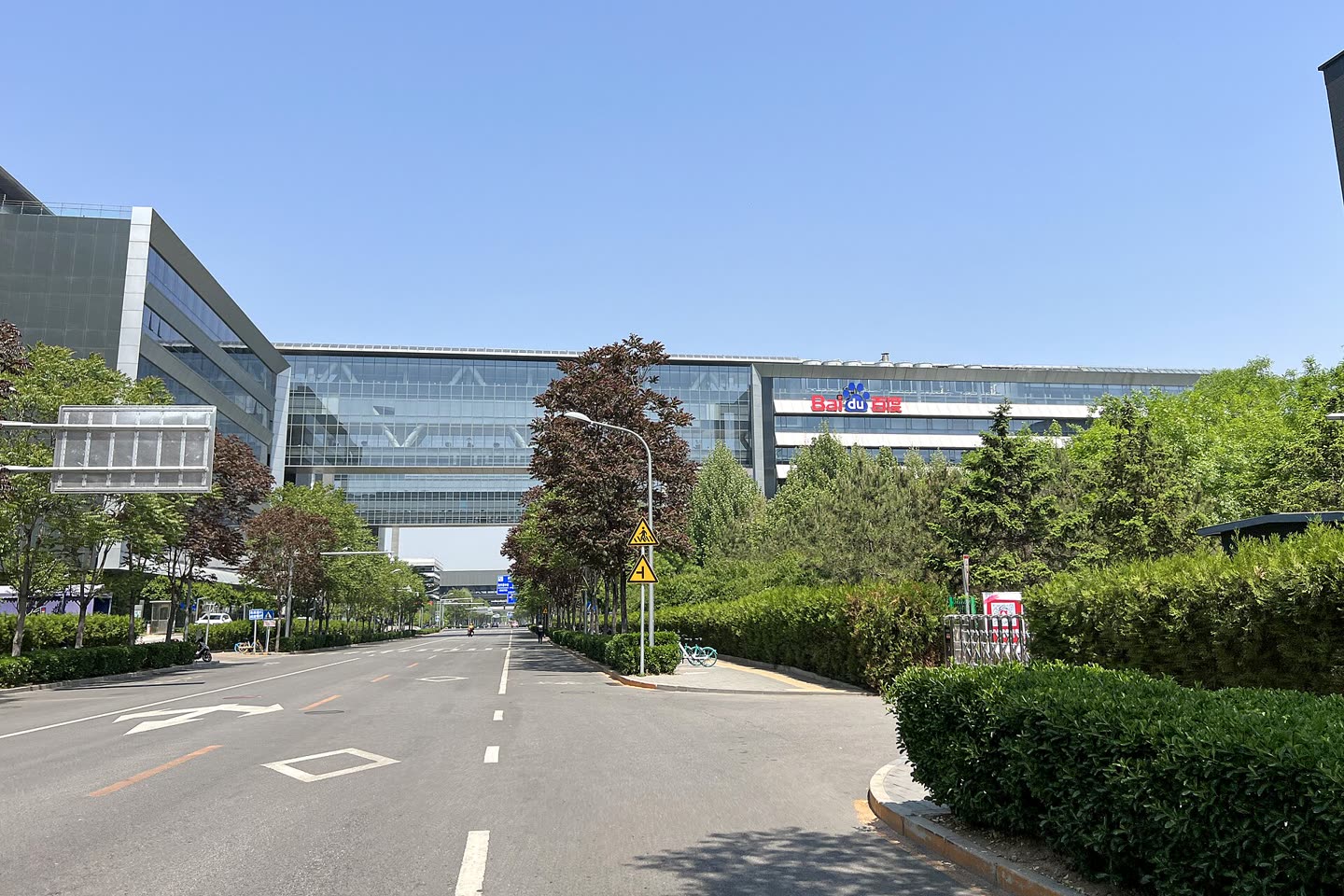
Image context: the cover uses a real Wikimedia Commons photograph of Baidu Technology Park at ZPark Phase II. That visual register fits because PaddleMIX matters here as company-shaped infrastructure: a broad software surface that tries to organize multimodal development, not a single benchmark screenshot or synthetic promo visual.[7]
The release trail shows assembly, not just model churn
The clearest evidence is in the release cadence. The 2025-05-09 v3.0.0-beta release did not merely add a few fashionable checkpoints.[2] It bundled new multimodal-understanding support for Qwen2-VL / Qwen2.5-VL, DeepSeek-VL2, MiniCPM-V 2.6, Janus, LLaVA-OneVision, and other families; it simultaneously foregrounded self-developed PP-DocBee for document understanding and PP-VCtrl for controllable video generation; and it paired those additions with an explicit toolchain claim that Qwen2.5-VL high-performance deployment on A800 was 11.5% ahead of vLLM in its published comparison.[2]
That combination matters more than any one item on the list. PaddleMIX is not asking developers to think in a single-house-model way. It is gathering rival and adjacent model families into one operable layer, then using self-developed PP-series components to fill the places where Baidu wants stronger control over the workflow itself.[2] My inference from these primary materials is that the project is optimizing for custody of the path, not exclusivity of the model.
The older 2024-07-29 v2.0.0 release makes the same direction visible earlier in the stack's history.[3] That release introduced the Auto module to unify SFT training flows, the mixtoken strategy with a claimed 5.6x SFT throughput gain, the DataCopilot multimodal data-processing toolbox, and a ComfyUI plugin built on ppdiffusers.[3] Read together with the newer 3.0 beta release, the pattern is consistent. PaddleMIX is being shaped less as a place where models are merely collected and more as a place where model work is made repeatable.
The important layer is the handoff from models to usable workflow
That handoff is where the project becomes strategically interesting. PaddleMIX's ComfyUI extension documentation says the project ships node extensions for text-to-image generation, image segmentation, and image captioning, with installation routed through the familiar custom_nodes path and reusable workflow JSON files in each extension directory.[5] This is not a small convenience feature. It means the stack is willing to meet creators and applied teams inside an existing node-graph habit instead of demanding that every experiment begin from scratch in notebook code.
The same bridging logic appears on the data side. DataCopilot is described as a multimodal data-processing toolbox built around low-code operations for preprocessing, augmentation, conversion, filtering, and export, with an MMDataset core that supports JSON, JSONL, and H5, plus chained map, filter, and schema-conversion operations.[4] That is a useful clue about where PaddleMIX thinks multimodal projects break in practice. They do not only fail at model selection. They fail when inputs arrive messy, schemas drift, and the data layer has to be rebuilt for every new training or inference loop. DataCopilot tries to keep that layer inside the same family as the model tooling.[4]
Placed next to the repository overview, the bridge becomes easier to see. PaddleMIX offers one surface for outside model intake and best practices, another for self-developed PP-series models, another for creator workflow through ComfyUI and WebUI, and another for data conditioning through DataCopilot.[1][4][5] Each piece on its own is not rare. The meaningful move is that these pieces are now being kept in one named suite, which lowers the cost of moving from "I want to test this model" to "I need a repeatable path for data, interface, and output."
Domestic-hardware travel is part of the bridge
The hardware path makes the supply-chain angle sharper. PaddleMIX's Ascend usage guide says the team has deeply adapted the stack for Ascend 910B, and it names supported multimodal-understanding models such as InternVL2 and LLaVA alongside multimodal-generation lines such as Stable Diffusion and SD3.[6] The guide then walks through container setup, Paddle installation, PaddleMIX installation, environment variables, and training or inference flows rather than treating domestic hardware support as a marketing footnote.[6]
That matters in AI-China because multimodal tooling is only strategically important if it can travel across compute constraints. A bridge that works only on one imported hardware path is a partial bridge. PaddleMIX's public documentation is making a different promise: the same suite should remain legible when the runtime boundary shifts onto domestic accelerators.[6] That does not prove perfect parity across every workload. The article should not overclaim that. But it does show where engineering effort is being spent, and that effort is aligned with the broader China stack problem of keeping model work portable enough to survive hardware fragmentation.
Why this matters in AI-China
The narrow conclusion is the useful one. PaddleMIX does not matter because it has ended multimodal competition or because every component in the suite is best in class.[1][2][3][4][5][6] The stronger reading is that PaddleMIX is helping turn multimodal abundance into a tractable route. The current stack tries to hold together outside model adoption, self-developed PP models, data preparation, creator workflow, deployment packaging, and domestic-hardware travel inside one operator surface.[1][2][3][4][5][6]
That is why PaddleMIX is worth tracking now. In ai-china, model proliferation is no longer the hard part by itself. The harder problem is how to keep multimodal work from splintering into separate repos, separate preprocessors, separate UI tools, and separate hardware-only branches. PaddleMIX is not solving that problem perfectly, but the public evidence shows it is trying to solve exactly that problem. That makes it a workflow bridge first and a model shelf second.
Sources
- PaddlePaddle, "PaddleMIX" repository README / overview (multimodal scope across image, text, and video; end-to-end toolchain from data processing through deployment; best-practice lanes; WebUI; and multi-hardware entry points).
- PaddlePaddle / PaddleMIX, GitHub release
v3.0.0-beta(published May 9, 2025; Qwen2-VL / Qwen2.5-VL, DeepSeek-VL2, PP-DocBee, PP-VCtrl, and the published Qwen2.5-VL deployment comparison against vLLM). - PaddlePaddle / PaddleMIX, GitHub release
v2.0.0(published July 29, 2024; Auto module, mixtoken training strategy, DataCopilot, and the ComfyUI plugin on ppdiffusers). - PaddlePaddle / PaddleMIX, "DataCopilot" documentation (low-code multimodal data processing,
MMDataset, schema conversion, chained dataset operations, and export formats). - PaddlePaddle / PaddleMIX, "PaddleMIX extensions for ComfyUI" documentation (custom node installation path, multimodal node scope, and reusable workflow JSON files).
- PaddlePaddle / PaddleMIX, "Ascend usage guide" (Ascend 910B adaptation, supported multimodal models, environment setup, and training/inference procedures on domestic hardware).
- Wikimedia Commons, "File:Baidu Technology Park at ZPark Phase II (20220502113614).jpg" (source page for the real Beijing campus photograph used as the article image).