A robot can learn where the plate belongs while absorbing accidental lessons about the table beneath it. RoboTwin lets researchers change the surroundings of a two-arm manipulation task and measure whether the learned behavior holds.[1]
Led jointly by groups at Shanghai Jiao Tong University and the University of Hong Kong, with collaborators including Shanghai AI Lab, the project offers training infrastructure for embodied AI: systems that act through physical machines.[1]
This reading fixes its experimental results to the August 27, 2025 revision of the RoboTwin 2.0 paper and the June 2025 challenge report. The software has continued to evolve: its repository records an August 3, 2026 addition of XPolicyLab-based evaluation.[2][4][6]
Make the training world less comfortable
RoboTwin 2.0 combines a library of 731 objects across 147 categories with a system for generating demonstrations. A multimodal language model proposes task code; execution inside the simulator supplies feedback for refinement. The resulting framework covers 50 tasks and five robot configurations. It varies clutter, lighting, backgrounds, tabletop height and language instructions.[1]
The appeal is repetition with controlled differences. A researcher can ask whether a learned movement persists when the scene changes, then use the answer to decide what kind of additional training is needed. That is more informative than watching another successful demonstration on a familiar table.
One benchmark, two very different averages
The paper’s standard simulation benchmark uses the Aloha-AgileX robot configuration, 50 clean demonstrations per task and 100 test rollouts, comparing clean “Easy” scenes with randomized “Hard” scenes. Across 50 tasks, DP3 falls from 55.2% to 5.0%; Pi0 falls from 46.4% to 16.3%. DP3’s clean-scene advantage also benefits from ideal simulated point clouds and background segmentation.[2]
A separate physical experiment uses RDT on COBOT-Magic across four tasks. Adding 1,000 randomized synthetic trajectories to ten real demonstrations raises average success under unseen, cluttered backgrounds from 9% to 42%. The roughly 367% relative gain therefore belongs to one test configuration; it is a 33-percentage-point improvement from a low baseline.[2]
These experiments answer different questions. The first measures sensitivity to simulated surroundings. The second tests whether synthetic practice helps on a particular physical platform. Neither produces a general-purpose robot reliability rating.
The configuration is part of the claim
The official configuration guide makes the environmental choices inspectable. random_background changes table and background textures; cluttered_table introduces distracting objects. Table-height variation and head-camera displacement have separate controls. The published example varies table height while leaving head-camera displacement at zero. “Randomized” therefore does not automatically mean that every source of variation is active.[3]
The same guide exposes decisions about what the learner can see: ordinary color images, depth, point clouds and segmentation data are distinct options. It also permits cropping table and wall points using known transforms.[3] Those choices help define the problem before a model makes its first prediction.
For a meaningful comparison, I would preserve the configuration alongside each score. A cleaner input can be a legitimate experimental choice; readers need to know when that choice carries part of the result.
A competition adds another boundary
The 2025 challenge’s second simulation round required one policy to handle six tasks under randomized conditions. Its physical final used five different tasks, including pouring water and folding cloth. Each physical task received 300 initial demonstrations, then 20 demonstrations from the target setting. Evaluation used 20 trials per task: 15 with familiar surroundings and five with unseen backgrounds. The best physical-track total was 26.4 out of 100.[4]
That is a competition score, and the changed tasks and protocol prevent treating it as a measured percentage drop from the simulation round. The challenge illustrates how demanding physical manipulation remained under its rules. It does not isolate the effect of moving an otherwise identical policy and task from simulation to reality.[4]
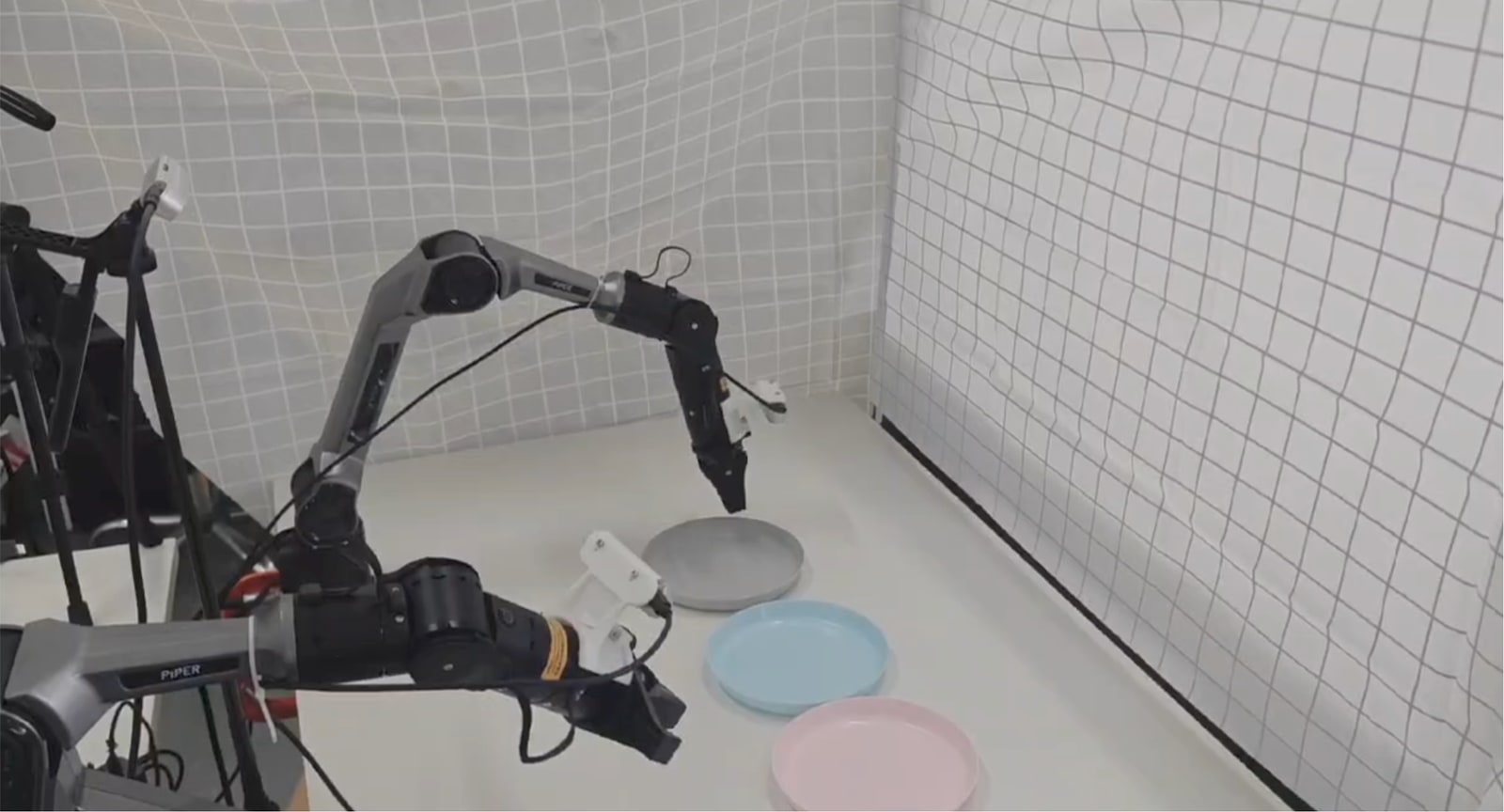
MIAA Lab’s Chinese-language participant account supplies a more tangible view. Its June 19 report describes adapting RDT and Pi0 models for the physical tasks and includes the plate-stacking photograph used here.[5] The photograph documents hardware and an actual task setting. A still image cannot establish repeatability, but it reminds the reader what the score eventually has to describe: grippers, contact and an object that must end up in the right place.
Keep the measuring instrument in view
RoboTwin’s repository records a DP3 evaluation-code correction on July 19, 2025, followed by an ACT deployment-code fix and leaderboard update on August 25. The newer XPolicyLab integration adds single-task evaluation, scheduling across multiple GPUs, and arrangements that separate a remote policy server from a local simulator.[6]
These are consequential changes to how experiments run. A reproducible result should travel with a code revision, model checkpoint, task configuration and evaluation protocol. A benchmark name alone is too little information to reconstruct the test.
My reading is that RoboTwin’s lasting value lies in making those experimental choices visible. Synthetic training can supply useful variation; physical trials can test whether that variation was useful where it mattered. Progress becomes easier to judge when the report preserves both the result and the conditions that produced it.
Sources
- RoboTwin team, “RoboTwin 2.0” — project affiliations, object library, demonstration generation and scope.
- Tianxing Chen et al., “RoboTwin 2.0,” arXiv v2, August 27, 2025 — sections 4.4–4.5 and Tables 4–5.
- RoboTwin team, “Configurations” — environment, camera and observation controls; accessed September 15, 2026.
- Tianxing Chen et al., “Benchmarking Generalizable Bimanual Manipulation,” June 2025 — challenge protocols and physical-track scores.
- MIAA Lab, Chinese-language report on the RoboTwin real-robot challenge, June 19, 2025 — participant account and plate-stacking photograph.
- RoboTwin team, official code repository — dated evaluation fixes and XPolicyLab integration; accessed September 15, 2026.