The most direct way to find out whether a rice seed will germinate is to let it try. That gives a seed tester an answer, but it also starts the biological process the grower may want to save for later. Optical testing offers a different possibility: measure the intact seed first, then use knowledge from earlier germination experiments to estimate its prospects.[1][2]
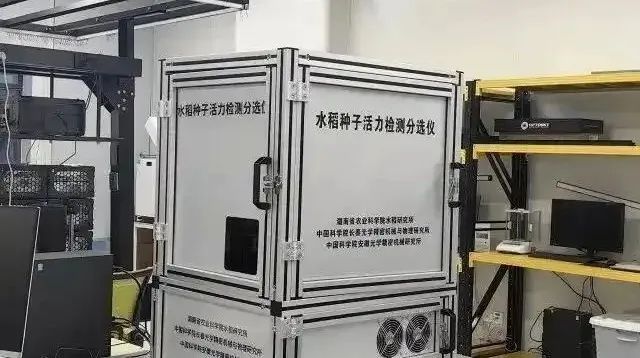
A collaboration between Hunan agricultural researchers and Chinese Academy of Sciences optical engineers has carried that idea into an automatic sorter. Its development runs through a 2020 spectroscopy paper, a documented prototype assessment in 2022, and public accounts of deep learning in 2025. Following those stages reveals the useful achievement: linking a prediction to a particular seed that remains available for planting.[1][3][4]
Getting light through the husk
A rice seed presents an awkward optical object. The information of interest lies inside, while the outer covering complicates the measurement. In a January 2025 review, Wang Xiaoyu and colleagues describe why a supercontinuum laser helps: it supplies a broad range of wavelengths with enough intensity to obtain useful transmission measurements through the covering. The instrument records how the seed changes the light passing through it.[2]
The spectrum supplies clues about composition. A model must learn how those clues relate to subsequent growth. Calling the instrument a seed “CT scanner,” as some reporting does, is an analogy; the spectral method described here does not depend on reconstructing an X-ray cross-section.[1][4]
The 2020 study by Jin Wenling and colleagues provides an early, inspectable example. It examined unhulled rice seeds from three harvest years, processing near-infrared spectra across 1,100–2,100 nanometers. The researchers reduced the spectral data and used partial least squares discriminant analysis, a statistical classification method. For the 2018 seed group, Table 4 reports 95.92% validation accuracy and 97.17% germination after screening. Other harvest groups produced different results.[1]
Those are two different measurements. Classification accuracy asks whether the model assigned the right category. Germination after screening asks what proportion of the retained seeds actually germinated. Neither number, by itself, tells a seed producer how many useful seeds were mistakenly rejected.
The lesson still comes from growing seeds
The research depends on a pairing: a spectrum taken from an individual seed and an observation of what that seed subsequently does. The instrument can learn to make an earlier judgment because researchers have already waited for the biological answer. The 2022 institutional account explicitly describes connecting spectral and seed-vigor phenotype datasets.[3]
This makes the germination experiment part of the AI system's foundations. A faster prediction does not make the original measurements dispensable. My reading is that the quality of that pairing matters as much as the sophistication of the classifier: a spectrum linked to the wrong seed would teach the wrong lesson.
By December 3, 2022, the work had reached an on-site expert assessment organized by the Hunan Provincial Agricultural Society. The Changchun Institute of Optics, Fine Mechanics and Physics reported that the joint team had built a prototype that automatically sorted rice seeds by vigor. The assessors recommended further gains in accuracy and speed, alongside progress toward mass production.[3]
That record places the hardware story before the 2025 headlines. It also identifies a practical transition: the prediction had become part of a machine that separated seeds. For a producer, that connection matters because a label on a computer screen is useful only if it can be associated reliably with the material moving through the equipment.
A better batch, and the seeds left behind
In a March 2025 interview reported by Science and Technology Daily, researcher Yu Yinghong described a database built from spectra and germination observations of hundreds of thousands of seeds across several crops. The account says the team used deep neural networks and reports prediction accuracy above 95%, with rice germination above 92% after sorting.[4]
These are reported development results. The article does not supply the dataset splits, crop-by-crop scores or operating throughput needed to compare them fairly with the 2020 experiment. They should not be combined into a performance trend. Yu also described higher-throughput equipment and more broadly applicable detection methods as continuing work, with industrialization challenges still ahead.[4]
The team's January 2025 review makes the underlying difficulty concrete: research had covered too few seed varieties and samples, and lacked a universal spectral database.[2] A model useful on one collection therefore needs testing on the varieties and storage histories it will encounter in another.
For a working sorter, I would want the evaluation to follow both exits. Test the retained seeds to measure planting quality; test the rejected seeds to discover how much viable material was lost. Report those results alongside the fraction retained and the processing speed. A machine can raise the germination percentage of its output by rejecting aggressively, yet leave a grower with too little seed.
The attraction of this work is the chance to make an informed choice while the seed is still intact. Its strongest demonstration would be a useful quantity of planting material, selected quickly, with evidence showing what was kept and what was sacrificed. The sprouting tray remains the place where the machine's judgment is checked.
Sources
- Jin Wenling et al., “Nondestructive grading test of rice seed activity using near infrared super-continuum laser spectrum,” Chinese Optics 13(5), 2020 — original Chinese research article; spectral method and harvest-specific results in Tables 2 and 4.
- Wang Xiaoyu et al., “Evaluation and Development Trends of Optical Detection Technology for Seed Vigor,” Spectroscopy, January 9, 2025 — researcher-authored review of transmission optics, seed testing and database limitations.
- Changchun Institute of Optics, Fine Mechanics and Physics, “Rice seed vigor nondestructive detection and sorting equipment passes assessment,” December 7, 2022 — Chinese institutional account of the December 3 assessment, paired datasets and automatic prototype.
- Yu Huiyou, Science and Technology Daily, “Rice seed vigor nondestructive detection and sorting prototype unveiled,” republished by the Beijing International Science and Technology Innovation Center, March 18, 2025 — interview with Yu Yinghong, reported deep-learning results and development plans.
- Zhang Yangzi, Changsha Evening News, “An instrument for nondestructive ‘CT scans’ of rice seeds emerges in Changsha,” March 21, 2025 — prototype photograph supplied by the interviewee and accompanying report.