As of 2026-04-07 UTC, the useful way to read Alibaba's Qwen3.6-Plus release is not as one more model-version jump. The sharper signal is that Alibaba is trying to turn the Qwen brand into a hosted bridge between three surfaces that often drift apart in China AI stacks: open-source model mindshare, enterprise agent deployment, and a consumer app that can feed product feedback at scale.[1][2]
The April 2 announcement makes that bridge unusually explicit. Alibaba says Qwen3.6-Plus will be integrated into Wukong, its AI-native enterprise platform, and Qwen App, its flagship AI application.[1] It also says the model is optimized for a "capability loop" in which perception, reasoning, and action sit inside one workflow, with a 1-million-token context window for repository-level engineering and multimodal reasoning aimed at document parsing, visual coding, and physical-world analysis.[1] Read literally, that is already bigger than a benchmark note. It is a routing note for how Alibaba wants Qwen to move through its own stack.
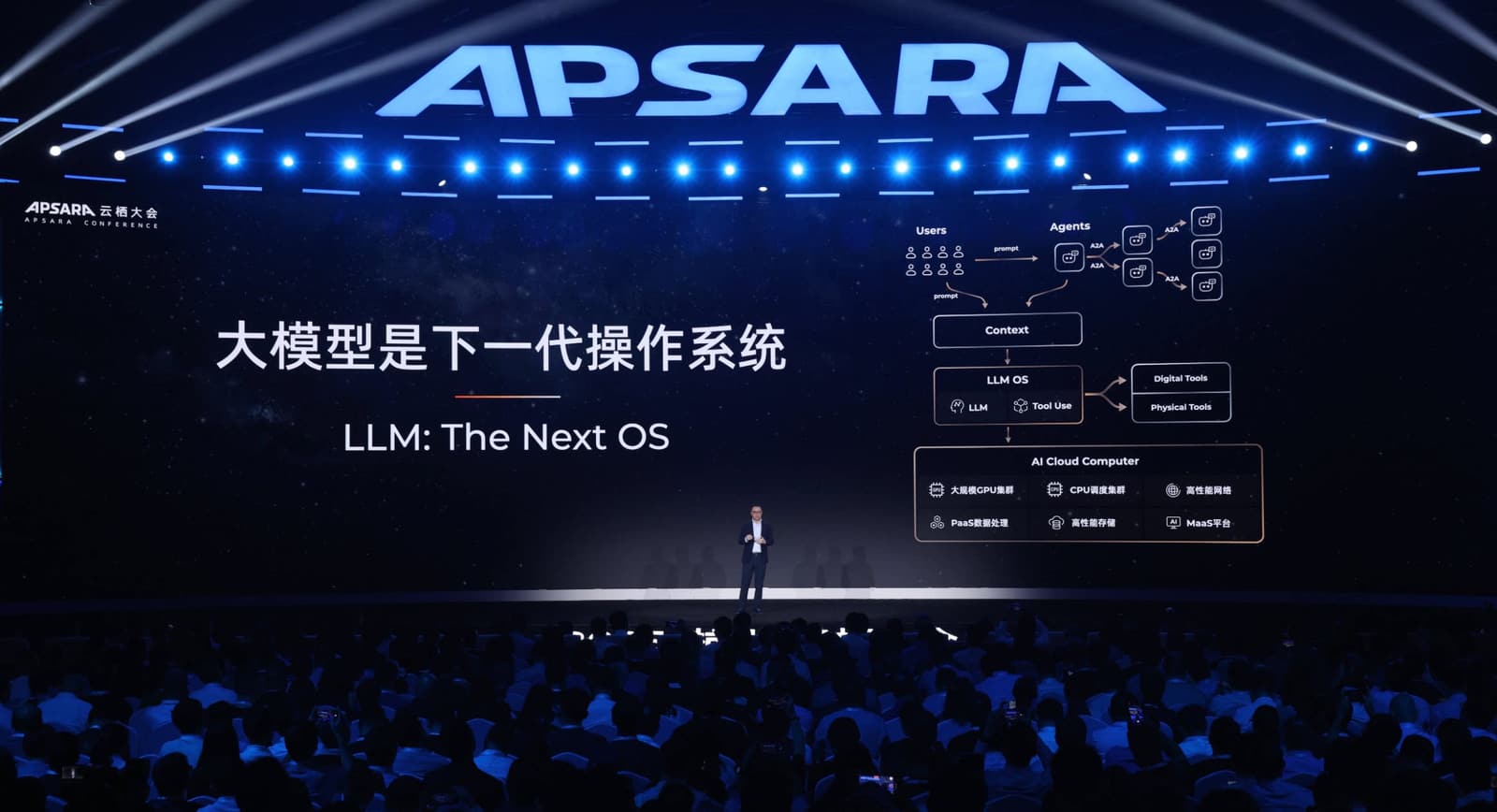
Image context: the cover uses Alibaba Cloud's Apsara Conference 2025 stage photograph. It fits here because the article is about the company pushing Qwen beyond a standalone model story and toward an operating-layer story. The stage slogan, "LLM: The Next OS," is not a decorative backdrop; it is the strategic frame behind the release.[2]
What changed in the April 2 release
The product claims in the release are concrete enough to matter.
Alibaba says Qwen3.6-Plus can autonomously plan, test, and iterate in frontend website development and repository-level engineering, effectively running more of the execution loop from task breakdown through refinement.[1] On the multimodal side, the company says the model can interpret screenshots, wireframes, and product prototypes and generate functional frontend code from them.[1] That combination matters because it places coding, tool use, and visual interpretation inside the same flagship release rather than splitting them across unrelated demos.
The distribution language matters just as much as the technical language. Users can deploy the model through Model Studio, experience it in Qwen Chat, and connect it to third-party coding assistants including OpenClaw, Claude Code, and Cline.[1] Alibaba also says it will continue supporting the open-source community with selected Qwen3.6 models in developer-friendly sizes.[1] That detail keeps the open-model door open while the highest-value integration points remain managed.
My inference from these release notes is that Alibaba no longer wants Qwen to be read only as an open-weight success story or only as a closed hosted endpoint. It wants both surfaces at once: open enough to stay culturally central for developers, managed enough to capture the execution layer where enterprises actually pay.
Why Wukong and Qwen App are the tell
The most revealing sentence in the release is not the coding claim. It is the integration path: Wukong on one side, Qwen App on the other.[1]
That pairing gives Alibaba two feedback loops. Wukong represents enterprise workflow packaging, where the value sits in agents that can automate multi-step business tasks under a controlled platform. Qwen App represents the consumer-facing surface, where habits, prompt patterns, and product expectations are observed at much larger scale. A flagship model that lands in both places is no longer just a model. It becomes shared middleware between business automation and mass-market interaction.
This reading aligns with Alibaba Cloud's broader roadmap from Apsara Conference 2025. There, the company described Qwen as the "operating system of the AI era," said it had already open-sourced more than 300 AI models, and reported more than 600 million downloads with 170,000+ derivative models.[2] In the same roadmap, Alibaba also expanded Model Studio-ADK, Model Studio-ADP, Model Studio Agent, and the surrounding enterprise tooling, saying more than 800,000 agents had been created on Model Studio and that model calls on the platform had increased 15 times over the prior 12 months.[2]
Put together, the April 2 release looks less like an isolated model refresh and more like a continuation of that operating-layer strategy. The open ecosystem keeps Qwen widely distributed; the hosted stack keeps the execution surfaces inside Alibaba's commercial boundary.
Why Model Studio is the commercialization hinge
Alibaba's own docs show that the managed Qwen surface is already being sold as an operating environment, not just as a benchmark shelf.
In the Qwen-Coder documentation, Alibaba recommends qwen3-coder-next for most coding scenarios because it combines multi-turn tool calling, optimized repository-level code understanding, improved tool-call stability, and Agentic tool compatibility.[3] The same docs describe tiered billing for the coder family and discounted context-cache pricing for repetitive prefixes such as code review.[3] Those are platform-control details. They matter when teams are budgeting real workloads, not when they are admiring a demo.
The broader text generation docs make a similar point from another angle. Alibaba presents Qwen-Plus as the recommended general-purpose choice because it balances performance, speed, and cost while supporting tool calling, agent tasks, image and video understanding, and GUI interactions.[5] The service is explicitly regioned across Singapore, US (Virginia), China (Beijing), China (Hong Kong), and Germany (Frankfurt), with separate API keys per region.[5] That is the language of global deployment infrastructure, not just model marketing.
Then the deep thinking docs add another layer: hybrid-thinking models can expose a per-request switch through enable_thinking, and Alibaba is direct that reasoning improves quality while increasing latency and token cost.[4] In other words, the hosted Qwen surface is increasingly about tunable operating behavior: when to think, how much to spend, which region to run in, which tool surface to attach, and which agent framework to place above the model.
That is why Qwen3.6-Plus reads as a bridge. The release inherits the cultural lift of the Qwen open-model family, but the monetizable surface lives in managed knobs, managed regions, agent platforms, and application entry points.
What to watch next
Three follow-up questions now matter more than the headline benchmark race.
First, watch how close the promised open-source Qwen3.6 sizes stay to the hosted flagship.[1] If the gap stays narrow, Alibaba preserves developer goodwill. If the gap widens sharply, the open-source story risks becoming a funnel rather than a peer surface.
Second, watch whether Wukong becomes more visible as a public enterprise agent product with clearer interfaces, pricing logic, and deployment stories.[1] That would confirm that Alibaba sees the flagship model mainly as the engine inside a larger operating product.
Third, watch whether the coding-tool compatibility line persists across future Qwen releases.[1][3] If OpenClaw, Claude Code, and Cline remain part of the official story, Alibaba is signaling that distribution through external agent tooling matters almost as much as direct usage inside its own app and cloud.
The April 2 release does not prove Alibaba has already won that bridge. It does show where the bridge is being built.
Sources
- Alibaba Cloud, "Alibaba Unveils Qwen3.6-Plus to Accelerate Agentic AI Deployment for Enterprises and Alibaba's AI Applications" (April 2, 2026).
- Alibaba Cloud, "Alibaba Cloud Unveils Strategic Roadmaps for the Next Generation AI Innovations" (September 24, 2025).
- Alibaba Cloud Model Studio, "Qwen-Coder" documentation.
- Alibaba Cloud Model Studio, "Using deep thinking models" documentation.
- Alibaba Cloud Model Studio, "Text generation overview" documentation.