
As of 2026-04-11 UTC, the useful way to watch Alibaba Cloud's 2-minute-31-second short "Qwen3.6-Plus by Alibaba: The Multimodal Execution System" is not as a generic launch trailer for one more large model.[1] The official description under the video already gives away a narrower and more interesting agenda. It highlights three concrete abilities: visual coding from design prototypes to functional code, video understanding for temporal reasoning in real-world tasks, and a GUI agent loop that can perceive interfaces and act inside them.[1] Read beside Alibaba's launch materials, the clip starts to look less like marketing garnish and more like a compact argument about what the company now thinks a flagship model should do.[2][3]
That argument matters in ai-china because Alibaba is trying to collapse several surfaces that are often discussed separately. The press release says Qwen3.6-Plus is built for a "capability loop" in which the model can perceive, reason, and act within one workflow, with a 1-million-token context window and stronger performance in repository engineering, multimodal perception, and long-form video reasoning.[2] The longer community post sharpens that language further. It describes gains in agentic coding, multimodal perception and reasoning, and a new preserve_thinking feature meant to let developers hold on to intermediate reasoning when they need it.[3] My inference from the video plus the written sources is that Alibaba wants the audience to stop thinking of Qwen3.6-Plus as only a chatbot or only a code model. It is being positioned as a single execution system that can move across interfaces, files, terminals, and time-based media.[1][2][3]
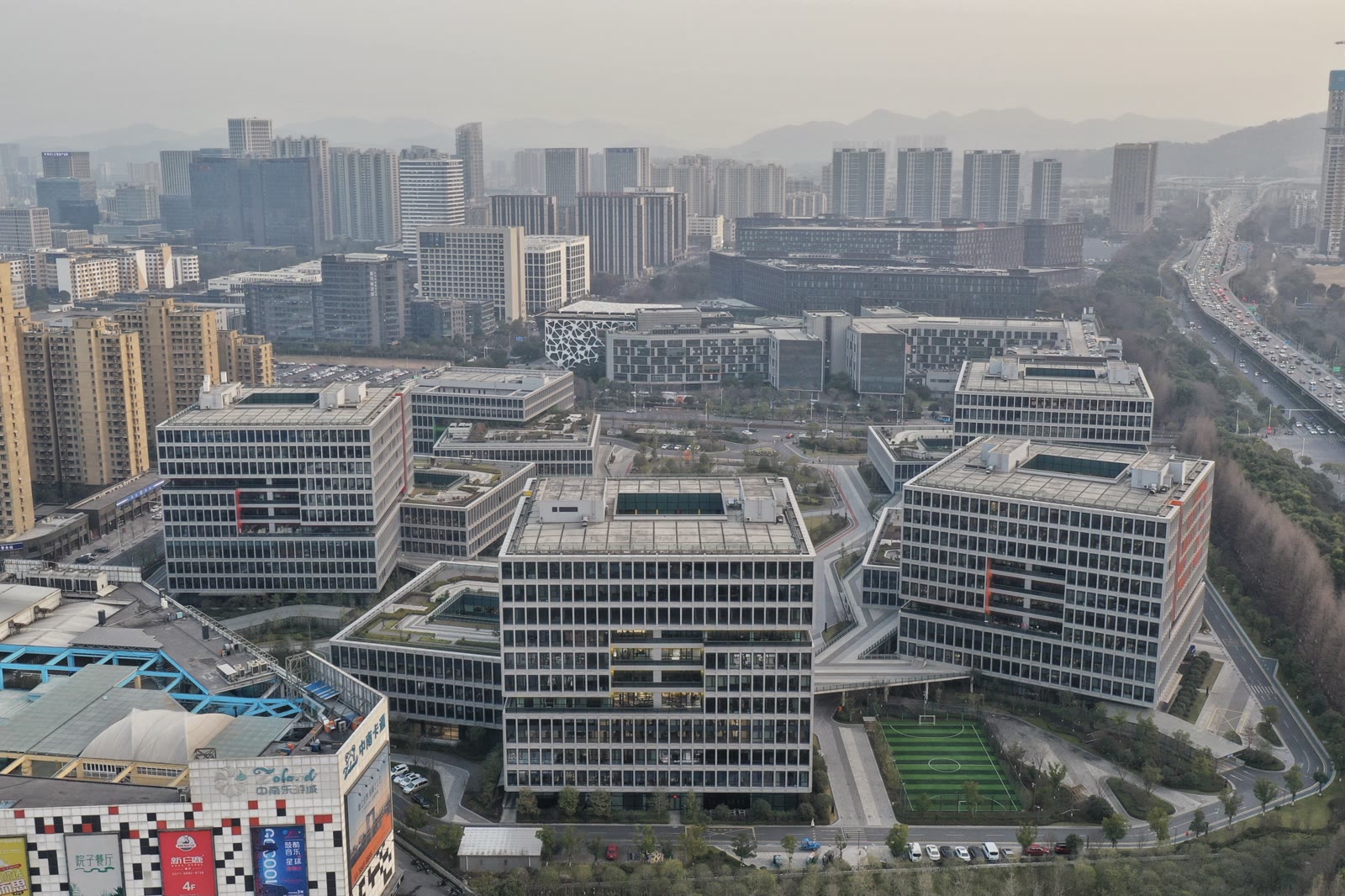
Image context: the cover uses a real Wikimedia Commons photograph of Alibaba Center in Binjiang, Hangzhou. That is the right visual here because the video is making an operational claim about a company stack, not offering an abstract AI mood board. A real campus photograph keeps the piece tied to an identifiable corporate surface while the article traces how Alibaba packages model perception, reasoning, and action together.[6]
The opening teaches viewers to group coding, video, and GUI work together
The strongest choice in the video is structural. Alibaba does not spend its first seconds on a benchmark chart or a founder-style declaration.[1] It cuts quickly across three demonstrations that are usually marketed as separate product lanes: a prototype becoming frontend code, a time-based video task that requires temporal understanding, and a GUI agent interacting with a visual surface.[1] That sequencing does more than show variety. It trains the viewer to treat these as one family of execution problems.
The launch materials support that reading. The press release does not describe visual reasoning as a side capability bolted onto a coding model. It explicitly places repository-level engineering, high-density document parsing, physical-world visual analysis, and long-form video reasoning inside the same release.[2] The community post repeats the same move when it frames Qwen3.6-Plus as a step toward real-world agents, not just a stronger assistant in a text box.[3] Put differently, the video is saying that code generation, temporal interpretation, and interface control now belong to one operational layer.
The visual-coding segment matters because it shifts the model from completion to translation
The visual-coding sequence is easy to underestimate because it passes quickly.[1] Yet it is doing one of the video's heaviest conceptual jobs. A model that writes code from a textual instruction is still operating within a relatively familiar lane. A model that turns screenshots, prototypes, or wireframes into working frontend code is doing a different kind of labor: it has to translate from visual layout, hierarchy, and component cues into executable structure.[2]
That is why Alibaba keeps returning to this example in its written launch copy. The press release says Qwen3.6-Plus can convert UI screenshots, hand-drawn wireframes, and product prototypes into functional frontend code.[2] The community post folds that claim into a broader push around agentic coding and visual execution.[3] My inference is that Alibaba wants to shift the conversation from "Can the model autocomplete code?" toward "Can the model read the same artifacts designers, PMs, and QA teams already use?" Once the claim is stated that way, the model becomes less of a coding assistant and more of a translation layer between visual product work and implementation.
The video-reasoning segment is there to prove that time is part of the stack
The middle section on video is just as important because it quietly expands the scope of what counts as model perception.[1] Still images are now common in flagship releases. Video remains harder, because useful performance depends on sequence, change, persistence, and action over time. Alibaba's own wording is careful here. The description says the model can handle advanced temporal reasoning for real world tasks, while the press release refers to long-form video reasoning as part of the multimodal package.[1][2]
That matters for the larger product thesis. If Qwen3.6-Plus can reason over interfaces, documents, code repositories, and videos, then the same model can theoretically follow a task as it unfolds rather than only summarize static inputs.[2][3] In practice, that is exactly the kind of ability an agent stack needs. An agent that can watch a changing screen, read a repository state, interpret a document, and then decide on an action is much closer to executable workflow software than to a chat endpoint. The clip uses video not as spectacle but as evidence that time itself has been added to the model's working surface.[1][2]
The GUI-agent close gives the release its real commercial shape
The final segment on GUI action is where the video's thesis becomes hardest to miss.[1] Alibaba describes the model's GUI agent as a loop of perception and action for complex interfaces.[1] The press release uses nearly the same grammar at the platform level, saying Qwen3.6-Plus is optimized for perceive-reason-act workflows and naming external coding tools such as OpenClaw, Claude Code, and Cline as compatible surfaces.[2] The community post adds Qwen Code and OpenCode to the same orbit.[3]
That external-tool list matters because it shows Alibaba is not limiting the execution claim to one first-party demo. The Qwen Code repository makes the strategy even clearer. It presents Qwen Code as an open-source AI agent for the terminal, with interactive and headless modes, IDE integration, and an April 2 note that Qwen3.6-Plus can be reached through Alibaba's OpenAI-compatible API surface.[4][5] When the GUI-agent segment in the video is placed beside that repo and the compatibility docs, the commercial picture sharpens: Alibaba wants one flagship model that can sit underneath both terminal agents and visual-interface agents while keeping the integration path easy for developers who already build against OpenAI-style APIs.[3][4][5]
The clip does not prove that this stack is already frictionless. A short official video cannot tell us how reliably the GUI loop holds up in messy enterprise software or how often visual coding still needs repair passes. What it does prove is how Alibaba now wants the release to be read. Qwen3.6-Plus is being marketed as a unified execution system where visual translation, temporal reasoning, and interface action belong to the same flagship model. In the ai-china landscape, that is a stronger and more consequential claim than another benchmark headline.[1][2][3][4]
Sources
- Alibaba Cloud, "Qwen3.6-Plus by Alibaba: The Multimodal Execution System," official YouTube video, published April 2, 2026.
- Alibaba Cloud, "Alibaba Unveils Qwen3.6-Plus to Accelerate Agentic AI Deployment for Enterprises and Alibaba's AI Applications" (press-room release, April 2, 2026).
- Alibaba Cloud Community, "Qwen3.6-Plus: Towards Real World Agents" (official product post, April 2, 2026).
- QwenLM, "qwen-code" GitHub repository README (terminal-agent positioning and April 2, 2026 Qwen3.6-Plus note).
- Alibaba Cloud Model Studio, "Compatibility of OpenAI with DashScope" (OpenAI-compatible API documentation).
- Wikimedia Commons, "File:Alibaba Center in Binjiang Hangzhou2021.jpg" (source page for the real campus photograph used as the article image).