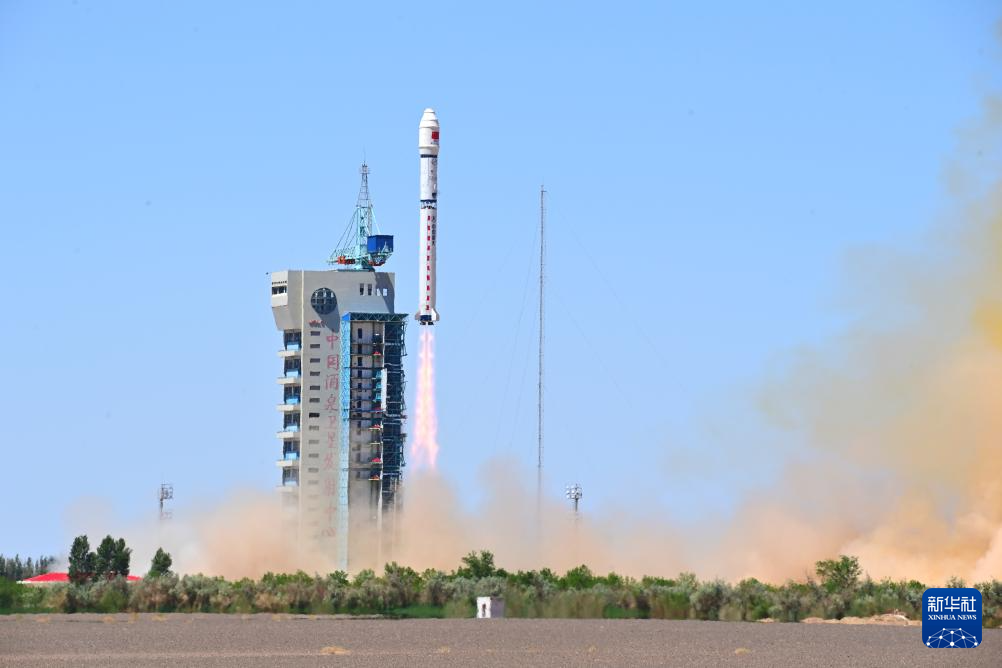
China's orbital-AI story begins with a fact sturdy enough to survive the slogans: 12 computing satellites reached orbit on one Long March 2D launch on May 14, 2025. Almost everything after that needs a label. The same launch inaugurated Zhejiang Lab's Three-Body Computing Constellation and Guoxing Aerospace's Star Compute plan. Those partners supplied different layers of the system and now describe different expansion paths. Shanghai has since announced a third orbital-computing architecture of its own.[2][5][6]
Flatten those programs into one headline and China appears to have a single 2,800-satellite AI constellation under construction. Keep the owners, dates, and evidence states separate, and a more useful picture emerges. There is a real 12-node orbital cluster with project-reported in-orbit work behind it; there are several much larger roadmaps; and there is still a wide engineering gap between peak operations per second and a dependable service.
The field signal is not that a terrestrial data center has literally moved above the atmosphere. It is that a satellite is being redesigned from a sensor with a downlink into a networked edge-computing node: one that can filter observations, run an uploaded model, exchange data with neighboring spacecraft, and return a smaller result rather than every raw byte.
The baseline was a book-sized computer, not a constellation
The cleanest way to read the 2025 launch is against Zhejiang Lab's prior baseline. On February 3, 2024, its onboard intelligent computer rode to orbit on the Oriental Smart Eye satellite. Zhejiang Lab described a 1.4-kilogram, book-sized device capable of 32 trillion operations per second. One month into the mission, the lab said it had completed more than 30 tests and was operating normally.[1]
That was single-node validation. The May 2025 mission changed the unit of ambition. Official launch reporting described a maximum of 744 TOPS on an individual satellite, 5 POPS of aggregate in-orbit computing capacity, 30 terabytes of storage, inter-satellite communications, and an 8-billion-parameter model able to process multiple levels of satellite data.[2] Zhejiang Lab supplied the onboard computers, software, and space-based models; Guoxing developed the intelligent networked satellite platform and the complete spacecraft.[2]
Even the launch arithmetic deserves care. “Up to 744 TOPS per satellite” is a maximum, while 5 POPS is the published constellation total. Multiplying the maximum by 12 and announcing 8.928 POPS would manufacture a fleet specification the source does not claim. Precision, workload, power state, and the hardware mix behind both labels are not disclosed in enough detail to translate either number into model throughput.
One rocket opened two named programs
The naming problem is structural, not merely editorial. The 12 spacecraft were simultaneously the first launch of Three-Body and the first launch of Star Compute.[2] Three-Body is Zhejiang Lab's research-and-infrastructure program, centered on onboard computing, models, a distributed operating system, and a shared scientific platform. Star Compute is Guoxing Aerospace's commercial constellation plan, centered on the spacecraft platform and a much larger proposed network.[4][5]
The shared first batch makes the programs collaborators. It does not make every later number interchangeable.
This distinction also clarifies what “launched” proved. On May 14, the evidence was successful insertion into orbit, return of initial telemetry, and the presence of computing, storage, networking, and model payloads.[2][8] Stable multi-satellite operation, link formation, scheduling, and useful application output had to be demonstrated afterward. A launch photograph can establish that hardware left Earth. It cannot establish that the hardware behaves like a cloud.
Nine months produced partial cluster evidence
By February 2026, reporting based on Zhejiang Lab's in-orbit tests had moved beyond payload inventory. The project said it had deployed or validated 10 AI models and applications, coordinated all in-orbit computing nodes through a space-based distributed operating system, and established links among six satellites. A three-satellite water-monitoring experiment reportedly exercised the chain from sensing and onboard processing through inter-satellite transfer, model computation, and result downlink.[3]
The most concrete application claim involved gamma-ray bursts. Two satellites carried X-ray polarization detectors, while an onboard time-domain astronomy model classified candidate events. The project reported that daily output fell from hundreds of megabytes to tens of kilobytes, processing fell from hours to seconds, and event-recognition accuracy reached 99 percent.[3]
Those figures describe the right kind of value: not generic chatbot intelligence in orbit, but a high-reduction task in which a model converts a large sensor stream into a small, time-sensitive signal. They remain project-reported results, however. The public account does not provide the event denominator, class balance, false-negative rate, energy per inference, comparison model, or an independently reproducible evaluation packet. The 99 percent figure is directional evidence of a functioning experiment, not a portable accuracy guarantee.
The disclosed model count kept moving. A July 29, 2026 report put the tally at 20 deployed AI models, up from February's formulation of 10 “models and applications.”[4] That is evidence of updateability and a widening workload set. Because the category wording changed, it should not be treated as a clean doubling of production-grade applications.
The big numbers belong to three different roadmaps
As of July 29, Zhejiang Lab's stated Three-Body path was approximately 100 satellites by 2027 and a network on the order of 1,000 by 2032.[4] The frequently repeated 2,800-satellite target belongs to Guoxing Aerospace's Star Compute plan.[5] The two roadmaps share the original 12-satellite mission, but they come from different organizations and should remain separately attributed.
Shanghai's Xingshu plan, announced in July 2026, is separate again. Its proposed minimum cluster uses one central computing satellite, one Fuxi weather satellite, and one immediate remote-sensing satellite. The published staging then calls for two computing plus 12 edge satellites in an engineering phase, 50 plus 100 in commercial deployment, and eventually a thousand-satellite system.[6] None of those Xingshu stages should be added to the 12 spacecraft already operating under the earlier launch. The Shanghai source describes an announced architecture and deployment plan, not an in-orbit cluster.
This produces a simple evidence ledger:
- 12 is launched hardware shared by Three-Body and Star Compute.
- Six linked satellites is a February 2026 project-reported networking milestone inside that batch.
- About 100 and about 1,000 are Zhejiang Lab's later Three-Body expansion targets.
- 2,800 is Guoxing Aerospace's Star Compute ambition.
- One-plus-two, two-plus-12, 50-plus-100, and 1,000 describe stages of Shanghai's separately announced Xingshu plan.[3][4][5][6]
Separating those numbers does not diminish the Chinese orbital-computing push. It makes the push legible enough to evaluate.
Five POPS is a capacity label, not an application benchmark
Peak-operation labels are especially fragile in orbit. A model cannot consume nameplate compute when a spacecraft is power-limited, thermally constrained, recovering from a radiation upset, outside a useful communication window, or waiting for data held on another moving node. Nor does a laser link create a stable rack-scale fabric: orbital geometry changes which peers are reachable and for how long.
Independent systems research from Peking University and Beijing University of Posts and Telecommunications helps define this boundary. Their RHONE emulator models power, temperature, orbit, network state, and computation together because ordinary cluster testbeds do not reproduce the operating conditions of a space-computing network. The work is not an audit of Three-Body, but its design makes the missing measurements obvious: application performance has to be aligned with telemetry and changing links, not inferred from accelerator arithmetic alone.[7]
The next credible disclosure would therefore pair every orbital-AI result with the model version and numerical precision, task dataset, energy and wall-clock latency, thermal state, link path, retry behavior, and ground-processing baseline. For the cluster itself, useful measures include the share of time all intended links are available, work completed after a node or link disappears, model-update success, effective storage throughput, and the quantity of raw data avoided per correct result.
Those metrics would also reveal where orbital inference actually wins. The strongest early cases are likely to be selective: discard cloud-obscured imagery, flag a fire or flood, compress a transient astronomy event, or coordinate observations whose value decays before the next ground-station pass. Training a frontier model in space is a very different proposition from running a bounded classifier near its sensor.
The durable signal is the stack around the satellite
China's 12-satellite experiment matters because it joins layers that are usually announced separately: spacecraft, onboard accelerators, inter-satellite links, an IP-based network, a distributed operating system, remotely uploaded models, sensors, and ground control. That integration is the real delta from the 32-TOPS single computer launched in February 2024.[1][3]
The larger constellations remain roadmaps until launches, links, and workloads arrive. Yet Shanghai's separate Xingshu design suggests the architecture is spreading: central compute nodes, edge sensing nodes, laser links, model services, and orbital scheduling are becoming a repeatable industrial vocabulary.[6] Competition may form around which organization can turn that vocabulary into a maintained service, not merely who publishes the largest satellite count.
For now, the responsible reading is exact. China has one 12-satellite orbital-computing batch with meaningful but largely first-party operating evidence. Zhejiang Lab, Guoxing Aerospace, and Shanghai have described different routes outward from that proof point. Watch the applications, energy, network availability, and repeatable service levels before watching the next zero added to a constellation target.
Sources
- Zhejiang Lab, “Build Up a Space Computing Network at Zhejiang Lab” (March 22, 2024; 1.4-kilogram onboard-computer baseline, 32-TOPS claim, and first-month test status).
- Digital China, republishing Xinhua, “Analysis of highlights from China's space-computing satellite constellation launch” (May 15, 2025; launch specifications, model payload, and Zhejiang Lab–Guoxing division of responsibilities).
- National Science and Technology Innovation Center portal, republishing Science and Technology Daily, “The Three-Body Computing Constellation weaves a space-computing network” (February 13, 2026; nine-month in-orbit tests, model deployments, six-satellite link, distributed scheduling, and astronomy claims).
- Hangzhou municipal English portal and China Daily, “Space-AI computing solutions paving way for faster smart tech development” (July 29, 2026; deployed-model tally and Three-Body's 2027/2032 roadmap).
- People's Daily, “Space computing: moving the data center into orbit” (July 21, 2026; Star Compute's 2,800-satellite plan, development stages, and engineering constraints).
- Shanghai Municipal Government, “Shanghai unveils the first constellation of the Xingshu plan” (July 19, 2026; proposed one-plus-two cluster architecture and phased deployment counts).
- Liying Wang et al., “Emulating Space Computing Networks with RHONE,” USENIX ATC 2025 (open-access paper; power, thermal, orbital-network, and application-performance evaluation boundaries).
- Xinhua, “China successfully launches space-computing satellite constellation” (May 14, 2025; source page for Wang Jiangbo's launch photograph and mission timestamp).