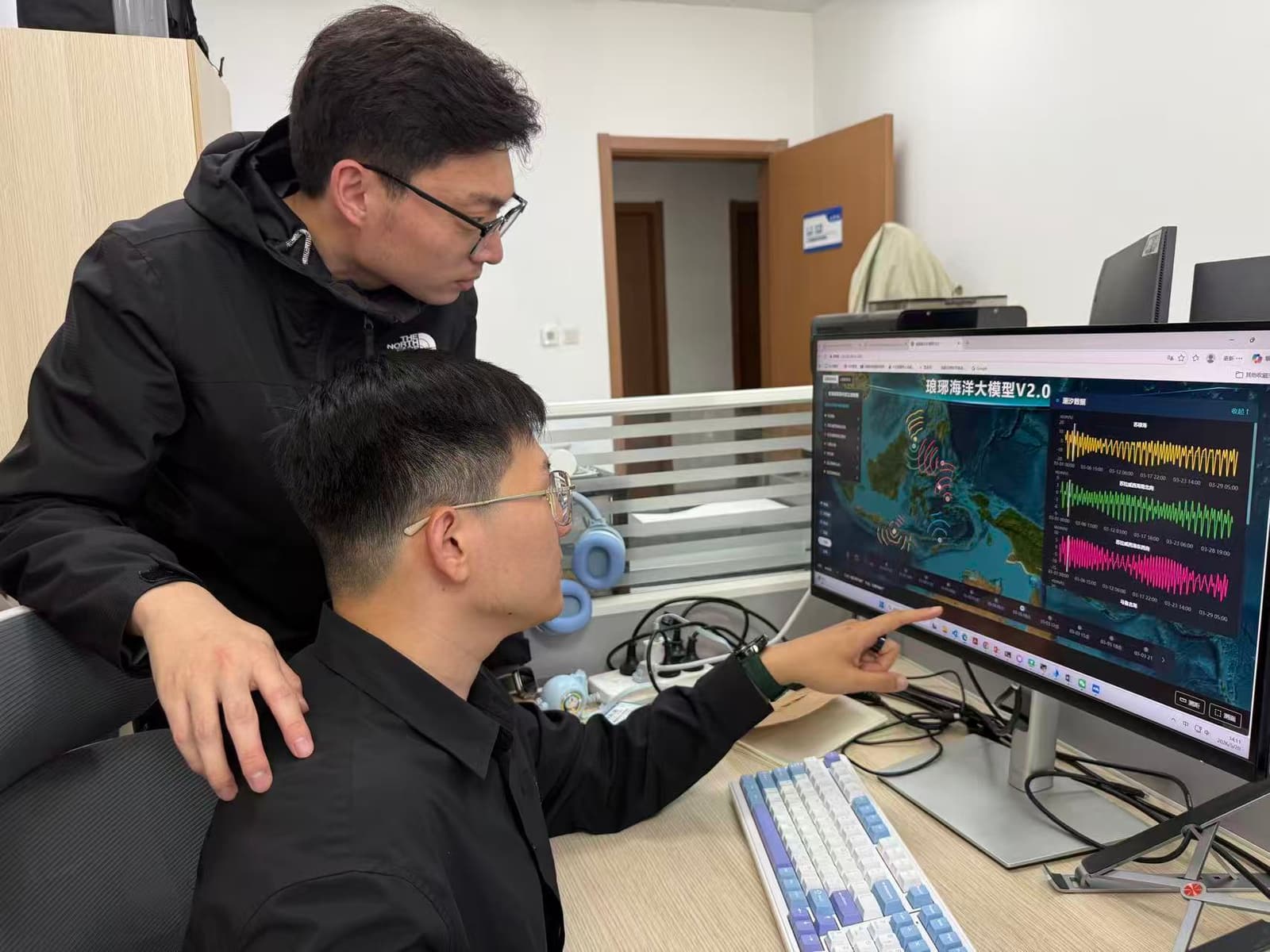
Within twelve days in June, two ocean-AI systems surfaced in Qingdao that could hardly be more different. LangYa 2.0, released on June 6, forecasts typhoons, storm surges, sea ice and other physical phenomena. BlueOmniBreed 1.0, launched on June 18, tries to connect genes, traits and breeding decisions across fish, shrimp, shellfish, sea cucumbers and algae.[2][4] Four months earlier and farther south, the Chinese Academy of Sciences' South China Sea Institute of Oceanology had open-sourced SciAssistant, a multi-agent tool for literature retrieval and research-report assembly.[6][7]
As of 2026-07-14 UTC, the useful signal is not that China has built one grand “ocean model.” It is almost the opposite. Ocean AI is separating into instruments built for different handoffs: observations into forecasts, biological data into breeding hypotheses, and scattered papers into an inspectable research brief. Those handoffs share a policy and infrastructure orbit, but they do not share a meaningful scoreboard. A lower forecast error, a promising gene candidate and a well-cited literature review are three different achievements with three different ways to fail.
That distinction sharpens the broad landscape described in the China Academy of Information and Communications Technology's May 2026 report on AI and the ocean economy. The report maps a growing Chinese collection of vertical models for environmental forecasting, fisheries, ports, marine biomedicine, education and navigation. It also says the toolchain is only moving from isolated research prototypes toward early integrated platforms, with many deployments still customized around a particular project.[1] The three systems here show what that platform turn looks like in practice—and why “vertical” must mean more than adding marine vocabulary to a chatbot.
LangYa turns state variables into hazard instruments
The first LangYa system began with a bounded physical task. Its 2024 research paper describes a global forecasting model trained on 27 years of GLORYS12 ocean reanalysis data from 1993 through 2019 and tested on 2020–2021 data. At 1/12-degree spatial resolution, one model forecasts temperature, salinity and currents across 32 depth layers and lead times from one to seven days. The disclosed training run used 16 Nvidia A800 GPUs for 14 days.[3]
Those details make the evaluation envelope visible. LangYa 1.0 is not a language model answering questions about the sea. It treats gridded ocean evolution as a forecasting problem conditioned on ocean and atmospheric fields. The paper compares errors against reanalysis, observations, other AI systems and numerical forecasts; it also acknowledges a crucial deployment limit. Training and testing on reanalysis data does not reproduce the data path of an operational center using real-time numerical assimilation. Performance can shift when the input system shifts.[3]
LangYa 2.0 changes the product boundary. The June release adds six specialized models for typhoons, precipitation, storm surge, internal solitary waves, mesoscale eddies and sea ice. The public description says its storm-surge system covers more than 400 tide gauges; its internal-wave model projects evolution for 30 days and offers seven-day point queries; and its Arctic sea-ice model operates at three-kilometre resolution on horizons longer than a month.[2]
This is a move from forecasting state variables to packaging forecasts around events that people recognize and act on. A separate Xinhua report says LangYa 1.0 has been deployed at China's National Marine Environmental Forecasting Center for real-world application testing.[8] The careful word is testing. The release pages provide ranges and use cases, but not one common evaluation table across all six 2.0 modules. A production claim therefore needs event-specific evidence: performance on rapid typhoon intensification and sudden track changes, storm-surge error at individual gauges, sea-ice calibration at the navigation edge, latency after new observations arrive, and uncertainty when the atmosphere-ocean regime leaves the training distribution. The instrument is useful only if the decision boundary travels with the forecast.
BlueOmniBreed turns biological relationships into candidates
BlueOmniBreed starts from a different kind of ocean. Its object is not a gridded water column but a population of living organisms whose useful traits emerge from genes, environments and husbandry over time. Ocean University of China's launch account says the platform is built around OmniG, a biological foundation model intended to analyze gene function and pleiotropy—the fact that one gene or mutation can affect several traits. The broader platform combines protein language models, multi-omics analysis, evolutionary information and statistical genetics, then adds species-specific models and a breeding toolchain.[4][5]
The institutional bundle is as notable as the model bundle. BlueOmniBreed was developed by the Qingdao Institute of Blue Seed Industry with Ocean University of China research units. At launch, the institute signed cooperation agreements with ten companies around data, breeding technology, commercialization and industrial use.[4] That makes the intended handoff explicit: the system is supposed to move from laboratory analysis toward breeding bases and production lines.
But a breeding instrument cannot be validated like a text benchmark. A model may flag a gene, predict a complex trait or transfer a signal across species; the consequential evidence arrives later, through wet-lab work, phenotyping, crosses, survival, growth, disease resistance and performance in actual production environments. Fish, shrimp and algae also do not become interchangeable because their data pass through one platform. Cross-species transfer is a hypothesis about biological generalization, not proof of it.
The public launch materials cited here describe the architecture and intended applications but do not publish a model card, training-corpus audit, external benchmark or calibrated confidence study for OmniG.[4][5] That does not make the platform empty. It defines its current evidence level: a serious institutional launch with a specific technical thesis and industry partners, still awaiting the reproducible results that would tell outsiders which predictions survive biological validation. The most convincing future case study will not say that an “AI breeder” found a better animal. It will trace a candidate from model output through experiment, breeding cycle and field outcome, including the candidates that failed.
SciAssistant turns literature into a research workspace
SciAssistant operates one level upstream from both systems. The South China Sea Institute of Oceanology released it on February 4 as an open-source research assistant built on Pangu's deep-search framework. The institute describes a planner, information-seeking agents and a writer working across scholarly search services and local documents to produce structured long-form reviews. It also draws a useful limit around the first release: the present focus is literature review, while automated data analysis and scientific coding remain future directions.[6]
The repository makes that workflow more concrete. It exposes the Planner–Information Seeker–Writer split, local document handling, MCP-connected search, Markdown and PDF output, and an Apache 2.0 codebase that can be installed and inspected.[7] The institute says the model layer is accessed through an OpenAI-compatible interface and can be replaced, which is strategically important. The durable object is meant to be the research workflow around the model, not one irreplaceable checkpoint.[6]
Here, “accuracy” means something different again. A literature agent should be tested for source recall, source quality, citation fidelity, deduplication, faithful handling of contradictory papers and reproducibility of the search path. A polished ten-thousand-character report can still omit a decisive negative result or attach a citation to a claim the paper never made. Open code makes those failures easier to investigate; it does not make them disappear. SciAssistant is most credible when it reduces the mechanical cost of review while leaving literature judgment with the scientist.
One ecosystem, three validation contracts
The common pattern is specialization at the last useful mile. LangYa gets closer to a warning desk. BlueOmniBreed gets closer to a breeding decision. SciAssistant gets closer to a scientist's evidence folder. None is merely a marine-themed chat interface, and none should inherit credibility from the others.
Three tests would show that this ocean-AI stack is maturing:
- Operational evidence for physical forecasts. LangYa-style systems should publish event-stratified hindcasts, real-time trials, uncertainty and comparisons against the numerical systems forecasters already use.
- Traceable biological validation. BlueOmniBreed-style platforms should connect model versions and training data to candidate selection, experiments, multi-environment trials and outcomes that independent breeders can inspect.
- Reproducible evidence assembly. SciAssistant-style agents should preserve queries, retrieved records, exclusions, citation spans and human corrections so a report can be audited rather than merely admired.
The falsifier is straightforward. If ocean AI remains a sequence of launches whose forecasts cannot be replayed, whose biological predictions cannot be traced into trials and whose research reports cannot reproduce their evidence trail, then “vertical platform” is branding rather than infrastructure. If those records become public and routine, China will have built something more interesting than one ocean foundation model: a family of instruments that know which part of scientific work they are allowed to claim.
Sources
- China Academy of Information and Communications Technology, Research Report on Artificial Intelligence Empowering the Marine Industry (2026)—industry map, vertical-model landscape, toolchain maturity and deployment constraints.
- Chinese Academy of Sciences, “LangYa 2.0, a large model for intelligent forecasting of global ocean phenomena, released” (June 8, 2026)—official release scope, six vertical models, forecast horizons and application claims.
- Nan Yang et al., “LangYa: Revolutionizing Cross-Spatiotemporal Ocean Forecasting,” arXiv:2412.18097—training data, architecture, evaluation setup, compute disclosure and reanalysis-to-operations limitation.
- Ocean University of China and Qingdao Institute of Blue Seed Industry, “BlueOmniBreed marine seed-industry large-model platform launched in Qingdao” (June 20, 2026)—institutional launch, model scope, species coverage and industry partnerships.
- Zhao Ruixue and Hu Qing, “Latest AI wizardry unravels genetics in aquaculture,” China Daily (June 22, 2026)—OmniG description, multi-omics framework, intended breeding handoff and documentary launch photograph.
- South China Sea Institute of Oceanology, Chinese Academy of Sciences, “SciAssistant research-work assistant agent software project open-sourced” (February 4, 2026)—official architecture, current literature-review scope, model interface and planned expansion.
- South China Sea Institute of Oceanology,
scsio-marinebio/SciAssistantGitHub repository—source code, agent roles, retrieval and document features, installation path and Apache 2.0 license. - Chinese Academy of Sciences and Xinhua, “AI forecasts typhoons and sea ice: LangYa ocean model 2.0 released” (June 8, 2026)—application-testing status and the Zhang Yiyi/Xinhua documentary photograph of the research team used as the article image.