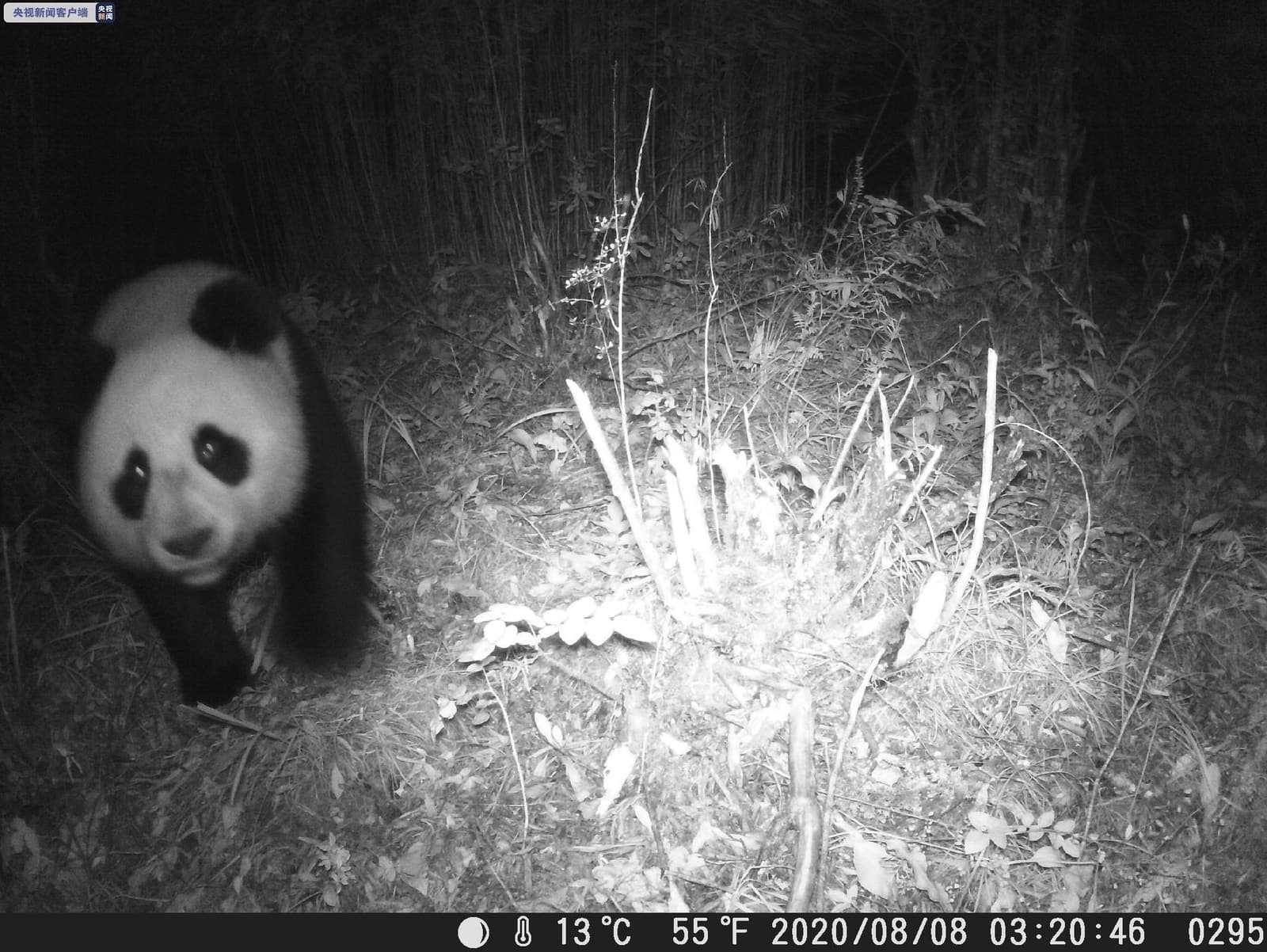
At 03:20:46 on August 8, 2020, a wild giant panda walked up to Camera No. 22 in Qingcaopo, in Sichuan's Tudiling corridor, and looked almost straight into the infrared lens. The frame is comically intimate: black ears merge into the night, two eye patches tilt toward the camera, and a bamboo forest disappears behind the animal. The image then traveled by microwave and 4G links to a monitoring center in Mao County. At the time, the corridor system had 120 infrared cameras operating around the clock.[1]
That photograph contains one fact no model needs to embellish: a panda was present. It does not by itself say whether this was the same animal recorded two nights earlier, how many pandas used the corridor that season, whether the visitor was merely walking or investigating the camera, or whether a change in sightings reflects a population change rather than camera placement. Those are different questions, and each requires a different layer of evidence.
As of July 13, 2026, that separation is the most useful way to read China's smart panda-monitoring push. The infrastructure has advanced from cameras that store or transmit rare encounters toward systems that automatically sort species and behaviors. Research models can now detect partially hidden pandas, localize behavior in video, and compare faces. But “AI monitoring” is not one capability. It is a chain from sensor to ecological inference, and the chain is only trustworthy when a detection, a behavior label, and an individual identity are not treated as interchangeable.
The network is part of the model
The scale of the image stream explains why automation is attractive. A 2024 National Forestry and Grassland Administration account described Giant Panda National Park as 22,000 square kilometers across Sichuan, Shaanxi, and Gansu, protecting about 1,340 wild pandas, more than 70% of their habitat, 13 population corridors, and more than 8,000 associated rare plant and animal species. In Sichuan alone, the account listed 1,086 monitoring quadrats, 7,830 infrared-camera points, and more than 7.3 million collected records. In Gansu, it listed 620 conventional infrared cameras and 680 real-time-return cameras, plus an intelligent data system for automatic processing, classification, habitat analysis, and reporting.[2]
Those are government-reported operating figures, not an independent performance audit. They still reveal the shape of the use case. The bottleneck is no longer simply getting a camera into a remote forest. It is moving data from thousands of sites, separating wildlife from empty frames and false triggers, attaching place and time, and delivering a manageable queue to people who can interpret it.
By November 2025, an official account of the Deyang section described a “sky-space-ground” monitoring system whose infrared cameras captured and transmitted wildlife activity continuously. It said AI automatically recognized species and behavioral characteristics, shifting management from passive patrol toward active sensing.[3] That is a meaningful delta from the 2020 Tudiling photograph: the network is being asked to do more than carry a dramatic frame home.
The account does not disclose the model, label set, test data, precision, recall, abstention rule, or false-alert rate. “Automatically recognizes” should therefore be read as a deployment claim, not a validated accuracy claim. The distinction matters in a forest where rain, moving leaves, glare, partial bodies, other black-and-white textures, and changing camera angles all enter the same stream. A smart camera system is useful before it is perfect—it can rank and route material for review—but its label should not silently acquire more authority as it moves across a dashboard.
Presence is the first question
The first model task is modest and essential: is a giant panda visible in this frame? A 2022 study led by Sichuan University and the Wolong reserve team built a wild-panda detector from data gathered by 139 infrared camera traps between 2015 and 2021. After cleaning the image stream, the researchers retained 1,169 wild-panda images and divided them 4:1 for training and testing. Their system combined an object detector with two kinds of context: information across adjacent frames and a species-distribution model estimating whether the location was suitable panda habitat.[5]
That context is not decorative. A small patch of white fur behind bamboo may be visually ambiguous; a sequence of nearby frames, a camera location, and known habitat suitability can change the probability that it is a panda. On the study's boundary, the combined method reported 98.1% mAP at an intersection-over-union threshold of 0.5 and 82.9% recall on difficult-to-see images.[5]
Both numbers belong in the sentence. The high mean average precision says the proposed detector ranked and localized examples well under the test setup. The recall says some difficult pandas still went unseen. The dataset also began after cleaning thousands of camera images down to retained panda frames, so it did not evaluate every stage of a live, mostly empty stream. Most important, the model detected the species. It did not identify an individual or estimate a population.
That bounded capability is already valuable. It can pull likely panda events from millions of records, preserve the surrounding frames, and reduce the amount of video a field team must watch. It can also fail safely if uncertain cases remain in a human-review queue. Trouble begins only when the presence label is allowed to answer the next question.
Behavior is a different label
In March 2026, a multi-institution team working with four years of Wolong field video published PandaSlowFast, a model designed to locate behavior in space and time rather than merely classify a whole clip. The source material came from roughly 150 infrared cameras deployed from 2018 through 2022 and covered at least 20 wild individuals. From 984 collected videos, the team retained 547 after quality filtering, segmented them into 1,879 ten-second clips totaling 5.2 hours, and produced 14,427 frame-level behavior boxes with the help of 30 trained annotators.[7]
The annotation scheme kept eight behaviors separate: walking, scent-marking, scent-sniffing, object exploration, resting, environmental investigation, parental behavior, and tree climbing. That vocabulary makes the system more useful than a generic “panda activity” score. A long run of scent-marking at a corridor, for example, is a different ecological record from a panda passing through once. The authors also split the data by camera location and recording period, rather than scattering neighboring frames randomly across training and test sets, to reduce scene leakage.[7]
PandaSlowFast reported 85.38% mean average precision across three training runs. An FP16 version retained 85.16% mAP while running at about 3.2 frames per second and using 480 MB of peak memory on a Raspberry Pi 4.[7] That edge result matters because sending every raw video out of a mountain reserve is expensive and fragile. A small device can screen footage near the camera or station and send selected events onward.
The boundary matters just as much. The benchmark used 547 quality-filtered videos, not the full unattended stream. The paper says confusion remained among visually and temporally similar behaviors such as sniffing, resting, and exploration. Its discussion presents abnormal-behavior alerts and a broader management platform as future applications, not demonstrated park-wide outcomes.[7] And a correct behavior label still does not reveal whether three walking clips show three animals or one animal making three visits.
The census begins where the detector stops
Population inference needs identity. The same panda can trigger several cameras, return over many nights, or produce a burst of ten frames in seconds. Counting images will overcount animals; merging two similar pandas will undercount them. A 2016 field study in Foping Nature Reserve showed how demanding this was before deep learning. Researchers arranged multiple cameras to capture several angles, then catalogued permanent and temporary traits such as scars, teeth, facial markings, pelage boundaries, wounds, and missing fur.[4]
From 12,871 wild-panda photographs, the researchers identified 11 individuals. Yet 59 of 192 panda encounters at the multi-camera sites remained individually unidentifiable because image quality or viewing angles were insufficient. Twelve independent volunteers agreed on identity assignments 80% of the time overall and 93% when they reported high confidence. Their false-match bias was especially consequential: merging distinct pandas creates a low population estimate.[4]
Deep learning can accelerate that comparison, but the best-known score illustrates the transfer problem. A 2020 face-recognition study assembled 6,441 frontal-face images from 218 captive pandas, whose identities were already recorded, and reported 96.27% identification accuracy in its closed-set test. The pipeline detected, segmented, aligned, and classified faces; the authors also constructed an experimental open-set split with seen and unseen captive animals.[6]
That is substantial work, not a field census. The images came from archives and professional cameras at breeding facilities, the system began with frontal faces, and the identity gallery was curated. The panda in the 2020 cover photograph is close, but many wild encounters offer only a rump, a partial flank, glare, rain, or a few blurred night frames. A current Chinese review of panda-identification methods reaches the same practical boundary from a wider survey of footprints, DNA, images, and sound: data acquisition, model generalization, and field deployment remain the central challenges.[8]
The correct production behavior is therefore abstention, not forced identity. A system should be able to say “panda present, identity unknown,” preserve the original sequence, show the closest candidates, and route the case to an expert. That unknown label protects the census from a polished but unsupported guess.
What would make the chain trustworthy
The next proof is not another isolated leaderboard number or a larger wall of live feeds. It is an audited encounter history that survives the trip from forest to population estimate.
First, every automated record should keep its task explicit: presence, species, behavior, or individual identity. Second, evaluation should start from the full field stream, including blank triggers and hard negatives, and report performance across cameras, seasons, sites, day and night. Third, individual matching should be tested as an open-set problem, with false merges and false splits reported separately because they bias a census in opposite directions. Fourth, low-confidence cases should remain reviewable alongside time, location, neighboring frames, and the unmodified image. Finally, image-based encounter histories should be compared with complementary field evidence—DNA, footprints, patrol observations, and ecological models—rather than advertised as their automatic replacement.[4][8]
The falsifier is simple. If camera counts and dashboard features keep rising while park operators cannot publish field-level error rates, abstention behavior, or agreement with independent survey methods, then the AI layer is a useful sorting system but not yet population evidence. If identities remain stable across seasons and sites, uncertain cases reach human reviewers, and resulting estimates agree with complementary surveys, then the camera network has crossed an important line: it is no longer only showing pandas. It is helping conservationists know which animals are using the landscape.
The 2020 Tudiling photograph should remain the standard. It is specific about what happened, where, and when. A panda approached a camera in the dark. Good AI can make that moment easier to find and connect to other evidence. Trustworthy AI also knows what the frame has not proved.
Sources
- CCTV News, “A precious sighting: a wild giant panda photographed by an infrared camera in Sichuan's Tudiling section” (August 10, 2020—camera number, capture time, wireless transmission, monitoring network, and source page for the cover photograph).
- China Green Times via the National Forestry and Grassland Administration, “Protection upgrades and development in Giant Panda National Park” (October 10, 2024—park scope, corridor and population figures, camera deployment, record volume, and intelligent data-management systems).
- National Forestry and Grassland Administration / Xinhua, “The Deyang section of Giant Panda National Park achieves active-sensing wildlife monitoring” (November 12, 2025—real-time infrared cameras and official AI species-and-behavior recognition claim).
- Xiaogang Zheng et al., “Individual identification of wild giant pandas from camera trap photos—a systematic and hierarchical approach,” Journal of Zoology 300 (2016)—field-camera design, identifiable encounters, observer agreement, and false-match bias.
- Hanlin Wang et al., “Automatically detecting the wild giant panda using deep learning with context and species distribution model,” Ecological Informatics 72 (2022)—wild-camera dataset, evaluation boundary, contextual detector, mAP, and recall.
- Peng Chen et al., “A study on giant panda recognition based on images of a large proportion of captive pandas,” Ecology and Evolution 10 (2020)—6,441-image captive dataset, 218 known individuals, automated face pipeline, and closed/open-set experiments.
- Jin Hou et al., “Enhancing Wildlife Monitoring: An Advanced AI Approach for Accurate Giant Panda Behavior Detection and Conservation Insights,” Animals 16 (March 17, 2026)—wild-video dataset, behavior labels, split design, PandaSlowFast results, edge benchmark, and stated future applications.
- Yuhang Wang et al., “Advances in individual identification technology for Giant Panda,” National Parks (early online—review of footprint, DNA, image, and acoustic methods, plus data, generalization, and deployment challenges).