On September 1, 2026, Nubia's NaviX Ultra received a network-access permit from China's Ministry of Industry and Information Technology. The handset, which integrates ByteDance's Doubao phone assistant, is planned for sale in September. That is a meaningful release milestone: the project has moved beyond the M153 technology-preview handset offered for trial to early adopters at the end of 2025 and toward a product intended for the open market.[1][3]
It is also easy to overread. A network permit is not a score for agent intelligence, a security audit of every model action, or evidence that arbitrary cross-app jobs now finish reliably. It clears a defined regulatory gate for a telecommunications terminal. The sharper release note is therefore two-part: NaviX Ultra has acquired a credible route to retail, while its most consequential capability still depends on borrowed authority. The assistant may plan a task, but the operating system, an app, an authenticated account, and ultimately the user must let it act.
That distinction makes this launch more interesting than the familiar promise of “AI inside a phone.” A chatbot can be wrong in a text box. A system-level agent can be wrong while opening an app, retrieving private information, changing a setting, publishing a message, or preparing a payment. NaviX Ultra's product claim is not merely better answers. It is controlled execution across those domains.
Nine months, three kinds of evidence
The starting point was deliberately provisional. Doubao's official M153 page framed the device as a trial for industry participants and early adopters, warned that its software experience was not guaranteed to be mature, and set out a rapid update cadence. In March, ZTE still introduced the M153 at Mobile World Congress as a technology preview: a Nubia handset with the Doubao assistant integrated at system level and able, in the company's description, to understand complex natural-language instructions and perform cross-app tasks.[3][4]
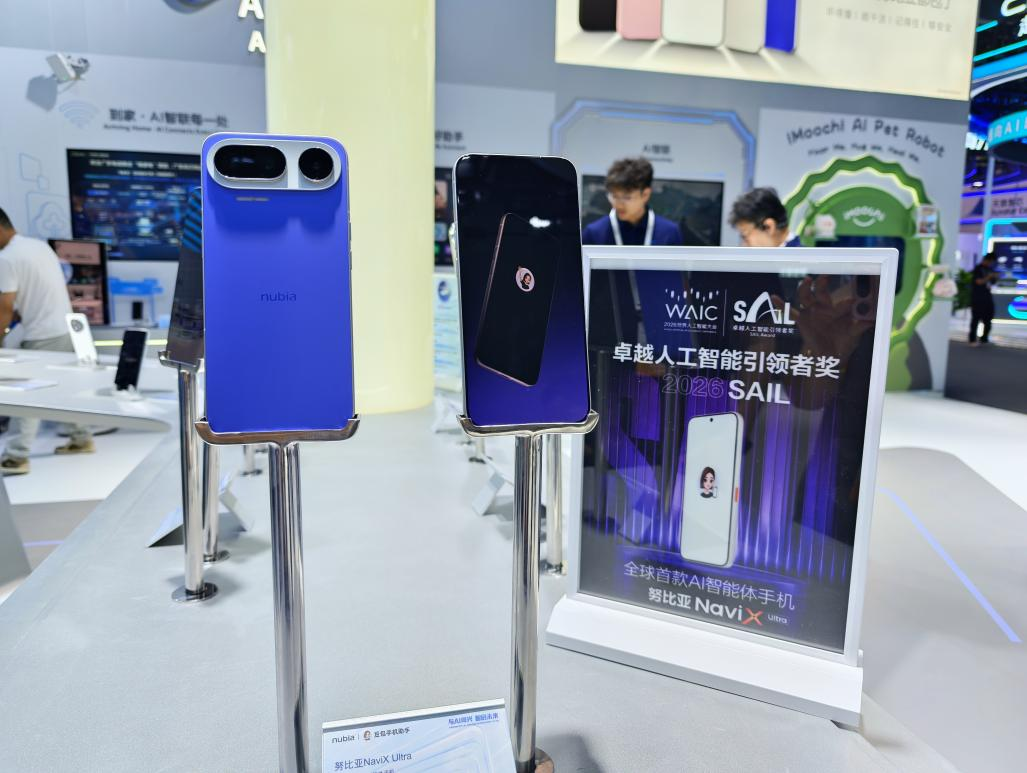
By July, the name and presentation had changed. NaviX Ultra appeared as a public device at the World Artificial Intelligence Conference in Shanghai; the contemporary show-floor photograph used above records the handset standing beside its SAIL award placard.[9] ZTE's 2026 interim report subsequently listed the handset among its mobile and innovative-terminal releases, described its system-level Agent architecture, recorded its WAIC SAIL award, and said the phone had made its first appearance at the conference.[2] That filing is stronger evidence of corporate product commitment than a booth demo alone, but it remains ZTE's own account of the product.
The September permit is a third and different kind of evidence. A report credited to Science and Technology Daily and republished on September 3 by Beijing's International Science and Technology Innovation Center platform says NaviX Ultra obtained the permit on September 1 and is planned to go on sale during the month.[1] The report calls it the world's first AI-agent phone. That superlative should remain attributed: “agent phone” has no neutral industry test that cleanly separates one vendor's product category from another's.
The progression is real nonetheless. In nine months the public description moved from early-adopter trial, to overseas technology preview, to named conference hardware and a listed company filing, and then to a network-permitted retail candidate. What has not appeared publicly is just as important: a final price, a complete supported-app matrix, a reproducible cross-app task evaluation, or retail evidence at scale. “Planned for September” is a schedule, not a completed sale.
What the permit says—and what it cannot say
China's rules for telecommunications equipment give the permit a precise meaning. A terminal covered by the regime must obtain network-access approval before it may connect to a public telecommunications network and be sold domestically. The application and testing framework addresses conformity with applicable standards, the safe and smooth operation of the public telecommunications network, quality systems, and after-sales obligations.[6] Reaching that point is not ceremonial. It is part of turning hardware into a lawful commercial product.
But the object being admitted is the telecommunications terminal. The permit does not certify that a language model chose the right restaurant, interpreted an ambiguous contact name, resisted a prompt injection inside a web page, or recovered cleanly when an app changed its interface. Those are product and evaluation questions, not conclusions supplied by the permit.
The model-service gate is separate. China's Interim Measures for Generative AI Services require providers of services with public-opinion attributes or capacity for social mobilization to conduct the applicable security assessment and algorithm-filing procedures.[7] The September report says the NaviX path ran from large-model filing through terminal network access.[1] Taken together, those steps show movement through two regulatory frameworks. They should not be collapsed into a government endorsement of task-level accuracy.
That narrow reading matters because compliance language can create an accidental halo. “Filed” answers whether a provider has completed a specified administrative process. “Network permitted” answers whether a terminal may enter the network and market under the equipment rules. Neither answers the buyer's most practical question: when the assistant acts across apps, how often does it do exactly what the user meant?
System-level integration enlarges the action set
ZTE's March description and the September report make the intended delta clear. NaviX Ultra is not presented as a normal handset with a chat app pinned to the home screen. Under the vendors' account, the assistant can understand and decompose a request, then call system functions, applications, and hardware under authorization.[1][4] That deeper integration is what makes an instruction such as finding content, coordinating information between apps, or changing a device state plausible without the user tapping through every screen.
It also makes “supports cross-app tasks” an incomplete specification. Execution can depend on whether an app exposes a stable interface, whether the user is logged in, which permissions are active, which screen state the app presents, and whether the requested final action is reversible. The September interview acknowledges that the experience requires cooperation from the application ecosystem rather than one hardware maker acting alone.[1] This is less like shipping one model feature than maintaining a chain of agreements among model, operating system, handset, app, service, and account.
A July hands-on report offers one concrete but sharply bounded glimpse. At WAIC, a reporter asked the phone to find a video of two cats on Douyin; the demonstrated task took about 30 seconds, and the interface exposed its progress through the operation. The report also noted that the interface was not yet public.[8] One selected task on a conference device cannot establish a success rate, and a stopwatch on one run is not a latency benchmark. It does reveal the right unit of analysis: not whether the model can describe what to do, but whether an end-to-end sequence reaches the intended state while showing the user what is happening.
There is no public, reproducible measurement yet for that unit. Without a declared handset build, model version, app versions, network conditions, task set, retry policy, and scoring rubric, broad comparisons would be theater. NaviX Ultra has crossed a commercialization checkpoint, not an evaluation finish line.
The product is a ladder of consent
The most revealing technical document in the release trail is Doubao's phone-assistant privacy and security white paper. It describes access authentication around intent registration, intent execution, and data use; additional authentication for sensitive operations when the phone is locked; and explicit user confirmation for operations involving sensitive data. Six classes receive secondary confirmation: permissions and privacy, finance and transactions, system and device control, legal or compliance actions, high-risk irreversible actions, and health or medical data.[5]
That list is not a side feature. It is the architecture by which an agent's proposed action becomes an authorized action. A model may infer that “settle the bill” means opening a payment flow, but it does not own the account or the money. It borrows a narrow grant, and the grant should expire at the edge of the confirmed operation.
The same logic applies to memory. Doubao's paper says global memory can be disabled or deleted, protected from casual viewing, and limited by application, time period, geographic fence, or a natural-language instruction not to record particular information. For global memory, it says processing should occur on the device where possible; elsewhere, it describes a Trusted Execution Environment, an NPU inference engine, and hardware-level file encryption for model data.[5] These are specific design disclosures, but they are still vendor claims. The paper is not an independent penetration test, and it does not report measured rates of mistaken capture, over-broad retrieval, or unauthorized action.
The difficult design work sits between too much friction and too little. Ask for confirmation at every harmless transition and the agent becomes slower than manual operation; users may also learn to approve prompts without reading them. Ask too late, after the consequential state has already changed, and confirmation is cosmetic. The useful handoff occurs after the system has assembled enough context for the user to understand the decision, but before a payment, post, disclosure, deletion, or settings change becomes effective.
This is why “borrowed authority” is a more accurate product model than autonomy. The agent can prepare, navigate, and recommend. Authentication establishes who is present. App permissions constrain the reachable data and functions. A final confirmation transfers authority for one consequential step. Logs and visible progress make the transfer inspectable afterward. If any part is vague, a fluent assistant can conceal rather than reduce operational risk.
What the retail build needs to make legible
The next useful NaviX Ultra release note should contain fewer category claims and more testable particulars. At minimum, buyers and developers need four things.
Start with the shipped software and model versions, the supported app-and-task combinations, and which operations use documented app interfaces rather than screen-level automation. “Cross-app” should be a compatibility statement that can be revised as apps change.
A serious end-to-end evaluation comes next. A credible protocol would freeze the phone build, app versions, accounts, network, and task wording; report complete-task success rather than partial navigation; count unintended actions and correct refusals; and disclose retries, human rescues, and latency distributions. Sensitive tasks should be scored for whether the agent stops at the right confirmation point, not merely whether it eventually reaches the target screen.
The retail interface should also make the authority chain visible. A user needs to know which app is active, what data the assistant just read, what it plans to do next, whether the step is reversible, and why authentication or confirmation is being requested. A chronological action log should distinguish model reasoning summaries from actual device events.
Finally, update notes need regression scope. The M153's rapid iteration made sense for a technology preview. A daily phone is different: a model or operating-system update that improves one workflow can silently break another. Versioned compatibility and known-issue records would turn that churn into something users can assess.
Retail use will expose the category claim quickly. If NaviX Ultra works mainly with curated partner apps, loses its place whenever interfaces change, or requires frequent human rescue before low-risk tasks finish, then the agent remains a preview inside retail hardware. If it completes a broad set of ordinary tasks across changing app states, explains its progress, and reliably stops before irreversible actions, the product will have established something more important than a “first”: a workable pattern for delegated action on a personal device.
The September permit makes NaviX Ultra eligible to approach the market. It does not settle the agent-phone question. That will be decided one small grant at a time—when the software asks for only the access it needs, uses it for the job the user actually specified, and hands the decision back before convenience becomes consequence.
Sources
- Science and Technology Daily via Beijing's International Science and Technology Innovation Center platform, “The world's first AI-agent phone receives network-access permission” (republished September 3, 2026; September 1 permit, planned September sale, system-level execution, ecosystem dependence, and confirmation model).
- ZTE Corporation, 2026 Interim Report (August 22, 2026; official Shenzhen Stock Exchange filing identifying NaviX Ultra, its Doubao system-level Agent architecture, WAIC debut, and SAIL award).
- Doubao, “Doubao Phone Assistant” official site (M153 early-adopter trial notice, software-maturity caveat, and update plan).
- ZTE, “Full-scenario AI terminals debut at MWC26 Barcelona” (March 3, 2026; official M153 technology-preview and cross-app integration description).
- Doubao, Doubao Phone Assistant Privacy and Security White Paper, version 1 (official architecture disclosures for authentication, secondary confirmation, device-side protection, and global-memory controls).
- Ministry of Industry and Information Technology, Measures for the Administration of Telecommunications Equipment Network Access (promulgated May 10, 2001 and most recently amended January 18, 2024; official scope, application, testing, sales, and network-access rules).
- Cyberspace Administration of China and six other departments, Interim Measures for the Management of Generative Artificial Intelligence Services (effective August 15, 2023; official security-assessment and algorithm-filing requirements).
- Zhidx via 36Kr Global, “Hands-on with the second-generation ‘Doubao phone’: Douyin in one hand, Luckin in the other, with apps lining up to work” (published July 19, 2026; independent WAIC account of a hands-on session reported July 18, including one Douyin task and the non-public interface).
- China.org.cn News Center, “New directions in AI industry development seen through a conference” (July 19, 2026; page carrying the Xinhua-distributed exhibition photograph used above).