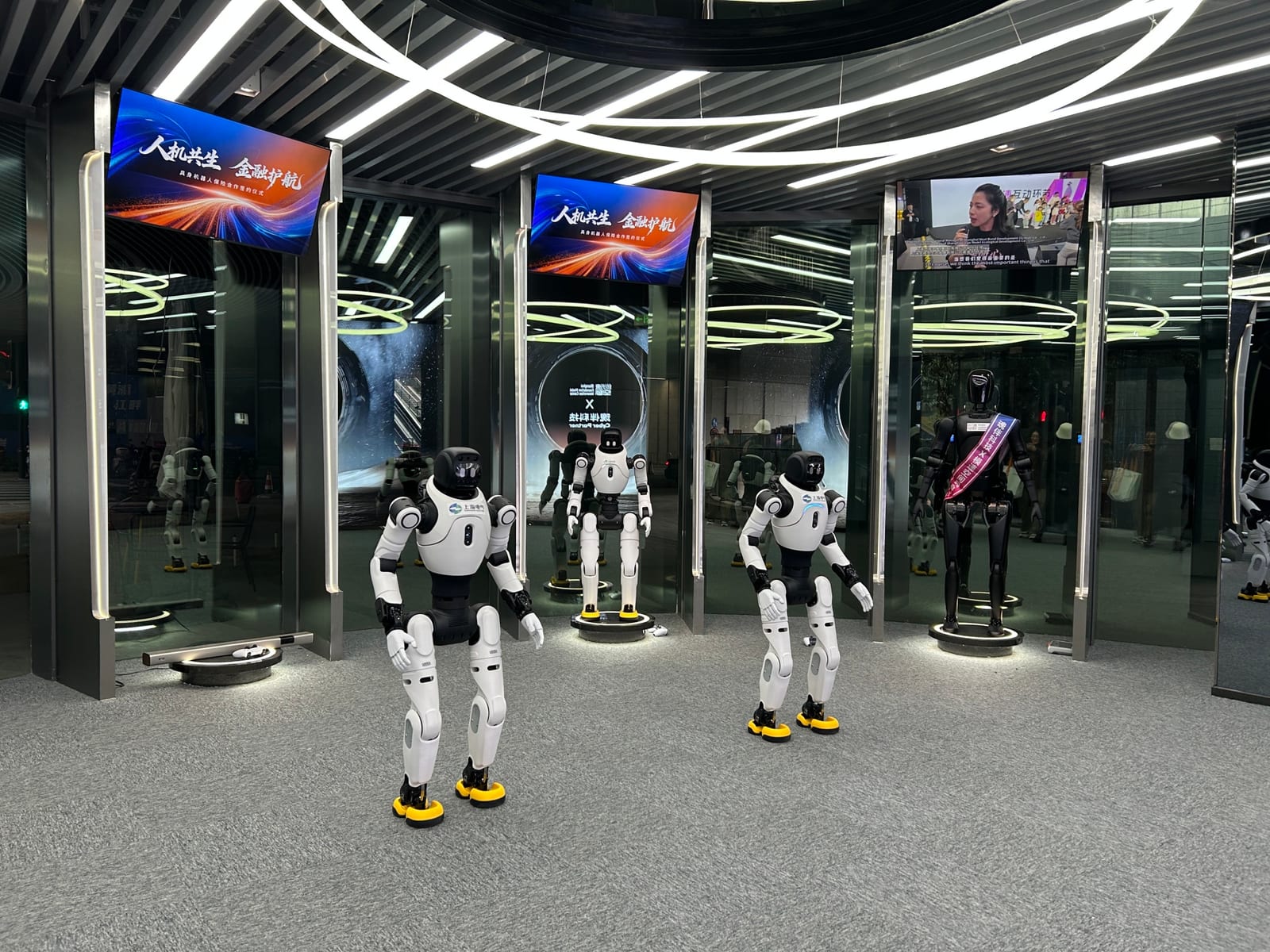
Nanjing has put a new phrase into China's technology-insurance ledger: artificial-intelligence service liability. On August 13, 2026, the city said insurers had issued a first batch of policies covering risks including algorithm drift. The announcement placed those policies inside a larger local program of more than 100 technology-insurance products, 39 completed policies, and over RMB100 million in aggregate cover.[1] A separate account sourced to PICC Property and Casualty's Nanjing branch identifies that branch as the issuer and describes a paired AI service-liability and overseas intellectual-property cover for a robot company.[8]
That is a meaningful market signal, but not yet a price signal. The announcement establishes that an insurer is willing to use an AI-specific risk label. It cannot, by itself, show whether that label is an operative cause of loss, an underwriting category, or a shorthand for narrower covered events. Nor does it show what is excluded, how much capacity is available, or whether the premium reflects observed risk. Nanjing's public notice gives no policy wording, premium, limit, deductible, term, claims trigger, or loss history for the AI-service cover.
As of August 25, the defensible conclusion is narrow: Chinese insurers are moving beyond generic equipment and cyber labels toward products marketed around risks in AI behavior itself. The stronger conclusion—that the contract treats model behavior as a distinct covered cause, or that model risk has become routinely measurable and transferable—still lacks the receipts.
The novelty is in the risk label, not the existence of insurance
AI businesses in China were already buying several adjacent kinds of protection. In May 2025, PICC announced generative-AI infringement cover for a service provider whose output, through negligence or oversight, infringed a third party's copyright, portrait right, reputation, or other lawful interest. The disclosed trigger required a formal administrative request, filed lawsuit, or accepted arbitration claim; the insurer would cover qualifying compensation and legal costs.[3]
Robots added a physical layer. By April 2026, the Insurance Association of China said PICC had provided more than RMB74 million of body-damage and third-party-loss cover to robots on the Qingtianzu rental platform. The same industry briefing described more than 200 PICC technology-insurance products across 13 categories and dedicated AI-insurance laboratories or centers established by major insurers.[7] National Business Daily separately found filed robot products covering the machine itself, product and quality liability, design defects, interaction-module failures, collisions, hacking, and information leakage.[4]
The Nanjing label therefore does not mean China had no AI-related insurance before August. Its significance is more specific. “Algorithm drift” points attention toward the probabilistic behavior of a deployed system rather than only the broken chassis, stolen data, or infringing output that appears afterward.[1] It does not reveal whether drift is an operative cause of loss, an underwriting factor, or public shorthand for an algorithm-related accident. That distinction matters because the undisclosed policy language decides whether an AI failure is treated as a covered cause, an ordinary product defect, a cyber event, operator error, or an excluded performance shortfall.
A separate, publicly available contract shows how much qualification sits behind the headline. China Pacific Property Insurance published its Guangdong artificial-intelligence system liability wording on March 31, 2026. It covers an “uncontrollable fault or failure” during testing or use when that event causes bodily injury or property damage and the injured party first makes a compensation claim during the policy period. Qualifying arbitration, litigation, and pre-approved legal expenses are also covered.[2]
That wording is evidence of a real risk-transfer architecture, not evidence that PICC's Nanjing cover uses identical terms. The comparison is useful precisely because neither the city notice nor the PICC-sourced account publishes the operative contract.[1][8]
A model failure still has to survive a claims investigation
Imagine a service robot colliding with a display after a software update. The loss may look algorithmic from the shop floor. The claim file has to separate at least six possibilities: perception-model drift, a damaged sensor, a mechanical actuator fault, an unsafe operator command, a changed floor layout, or hostile access to the system. A seventh possibility is interaction among several of them.
Those distinctions are not semantic housekeeping. They allocate the loss among equipment, product-liability, cyber, professional-liability, and AI-specific policies—and among the manufacturer, model supplier, integrator, owner, and operator. They also determine whether an exclusion applies.
The Pacific policy makes the fault lines unusually concrete. It excludes an operator's own error unless the accident would have occurred without that error. It also excludes illegal testing or use, the insured system's own damage, recall and upgrade costs, data or information leakage, fines, punitive damages, mental-distress damages, and indirect losses. Limits and deductibles are negotiated. The annual premium may be based on the number of systems tested, sales, or another agreed measure.[2]
The contract also turns model change into an insurance event before any accident happens. If technical specifications, system construction, or production design change in a way that materially increases risk, the insured must notify the carrier; failure to do so can defeat coverage for a resulting loss. Multiple injuries or property losses from the same defect in the same batch count as one accident, and legal-cost reimbursement is capped at 10% of the per-accident limit unless the parties agree otherwise.[2]
This is why publicly associating the cover with “algorithm drift” is only the beginning. An underwriter needs to know which model and software versions were assessed, what tasks and environments they were approved for, how updates are gated, what telemetry is retained, who can override the system, and how a near miss becomes an incident record. Without that configuration history, neither causation nor accumulation is easy to price.
Demand has arrived before the loss curve
The demand side is not hard to see. The Geneva Association surveyed 600 corporate insurance decision-makers across China, France, Germany, Japan, the United Kingdom, and the United States in early 2025. More than 90% expressed interest in insurance for generative-AI risk, while more than two-thirds said they would pay at least 10% more for explicit cover. China and the United States showed the strongest combined adoption and insurance appetite in the comparison.[6]
Supply is harder. The same report found that scarce historical loss data, difficulty verifying a customer's controls, uncertain liability, and potentially large or correlated losses make AI risk difficult to assess and cap. It describes a nascent market experimenting with extensions to cyber and liability policies, due-diligence protocols, and standalone AI cover—not a settled line with a stable loss distribution.[6]
Reporting from China's robot-insurance market reaches the same boundary from the ground. National Business Daily found that limits and deductibles were generally negotiated rather than standardized. Industry participants identified confidential technical data, the changing needs of startup manufacturers, and moral hazard around individually held machines as obstacles. One source described pricing as conservative because real operating and incident data were still scarce; Ping An said it planned to work with industry and academic partners on a shared risk database and standards.[4]
The missing denominator is as important as the missing claims count. Ten robot accidents mean something different across 100 machines working 500 hours each and 10,000 machines working 5,000 hours each. A useful loss record would pair paid and reserved claims with robot-hours, task cycles, public-contact time, software versions, operating environments, interventions, near misses, and severity. It would distinguish a repeatable small collision from a rare multi-site software defect that can strike an entire fleet after one update.
Nothing in the public Nanjing announcement shows those exposure-adjusted results. Nothing says the insurer lacks private underwriting data, either. The honest boundary is that outsiders cannot yet tell whether the quoted risk has been modeled, cautiously capped, heavily excluded, subsidized as an experiment, or assembled from several familiar policies under a new name.
Insurance could become a governance layer—but only with evidence
China's financial regulator is simultaneously tightening the discipline for banks and insurers when they use AI themselves. Its June 18 guidance calls for lifecycle governance, scenario and process controls, model development and evaluation, data governance, operational resilience, and continued risk assessment across 32 measures.[5] That document governs financial institutions' own AI development and use; it is not an underwriting rule for outside robot or model companies.
Its operating logic is nevertheless instructive. The same artifacts that make an institution's AI governable—an accountable owner, version inventory, evaluation record, access controls, incident response, continuity plan, and documented human handoff—can make a commercial risk more inspectable. This is an inference, not a stated regulatory requirement. If insurers translate those artifacts into underwriting questions and renewal conditions, insurance can reward safer deployment with better limits, lower deductibles, or lower premiums. It can also surface where a vendor's “AI system” is actually an untracked chain of model, sensor, cloud, and integration dependencies.
There is a public-policy wrinkle. Nanjing's broader technology-insurance program includes provincial premium subsidies.[1] Subsidy can be useful during the data-poor pilot phase because it brings more firms into the pool. It can also blur market demand. A first-batch policy bought at a supported price is not equivalent to an unsubsidized renewal after the carrier has observed a year of operation.
The watchlist is a set of insurance receipts
Five disclosures would show this market hardening. First, publish or summarize the operative wording: insured system, covered cause, territorial scope, claims trigger, exclusions, sublimits, deductible, and update obligations. Second, report exposure denominators rather than policy counts alone. Third, classify incidents and near misses consistently enough to compare causes and severity. Fourth, show claims, reserves, renewals, and changes in price or terms. Fifth, identify whether repeat capacity comes from the direct insurer alone or a wider co-insurance and reinsurance market.
The falsifier is straightforward. If the first batch produces no comparable policy wording, no repeat customers beyond subsidized pilots, no claims protocol, and no exposure-based renewal evidence, “AI service liability” will remain a marketing wrapper around negotiated technology cover. If those receipts appear—and premiums begin to respond to version control, testing, telemetry, and incident history—insurance will have become something more consequential: a market price on the quality of AI operations.
Nanjing has supplied the new label. The next year has to supply the loss record.
Sources
- Nanjing Municipal Government, “Nanjing lands a batch of nationwide first and first-batch technology-insurance products” (August 13, 2026) — AI service-liability announcement, algorithm-drift scope, policy counts, aggregate cover, co-insurance network, and subsidy context.
- China Pacific Property Insurance, Guangdong Artificial Intelligence System Liability Insurance Terms (registration C00001430912026030981163, March 31, 2026) — coverage trigger, exclusions, limits, premium bases, change notification, aggregation, and claims requirements.
- PICC Property and Casualty, “The first batch of generative-AI infringement insurance is launched nationwide” (May 30, 2025) — official description of covered rights, claim triggers, compensation, and legal expenses.
- Tu Yinghao, “Who pays when an embodied robot injures me? They are starting to buy insurance,” National Business Daily (January 6, 2026) — filed robot products, negotiated terms, pricing-data constraints, incidents, and source photograph.
- National Financial Regulatory Administration, “Guiding Opinions on the Safe Development and Application of Artificial Intelligence in the Banking and Insurance Industries” (June 18, 2026) — official summary of lifecycle governance and the 32 supervisory measures.
- The Geneva Association, Gen AI Risks for Businesses: Exploring the Role for Insurance (October 2025) — six-market survey, demand estimates, insurability constraints, and emerging product structures.
- Insurance Association of China, “Transcript of the first regular press conference of 2026” (April 27, 2026) — technology-insurance product inventory, AI-insurance institutions, and aggregate cover for rented embodied robots.
- Nanjing Financial Development Promotion Association, “PICC Nanjing lands a nationwide first batch of artificial-intelligence service-liability insurance” (August 5, 2026; sourced to PICC Property and Casualty's Nanjing branch) — carrier attribution and the paired AI-service and overseas-IP cover.