
As of 2026-04-27 UTC, the most useful way to watch WorldofAI's 9:49 MiniMax Agent video is not as one more open-source benchmark recap.[1] The creator does open with the usual headline numbers: MiniMax M1 as an open reasoning model, a 1 million token context window, and 80,000-token reasoning output.[1][4] Those facts matter. But they are not the real reason the demo belongs in ai-china. The stronger signal is the shape of the product surface itself. Again and again, the video returns to the same idea: one window where the prompt, the process log, the file list, the live browser view, the MCP shelf, and the final artifact all remain visible at once.[1]
The official MiniMax sources make that reading stronger rather than weaker. The company's Agent page does not frame the product as a clever chat box. It frames MiniMax Agent as an intelligent agent for complex long-horizon tasks with multi-step planning, programming, multimodal generation, and native MCP integration with tools such as GitHub, GitLab, Slack, and Figma.[2] The retrospective post on building the product is even more revealing. It says "Context and State Are the Real Moat" and argues that serious agents have to live inside environments, not appear only for one-off executions.[3] Put next to the video, the product claim becomes clearer: MiniMax does not only want to win a model-comparison round. It wants to sell an operational console where context persists and tools stay attached.
That distinction matters because ai-china coverage in 2026 has started to split into two different races. One race is model release theater: bigger context, better scores, cleaner demos. The other is product-surface competition: which companies can turn model capability into a repeatable working environment. MiniMax Agent sits more convincingly in the second race.[1][2][3] The video is useful precisely because it shows the transition from talking about capability to staging a workspace where capability can be routed into output.
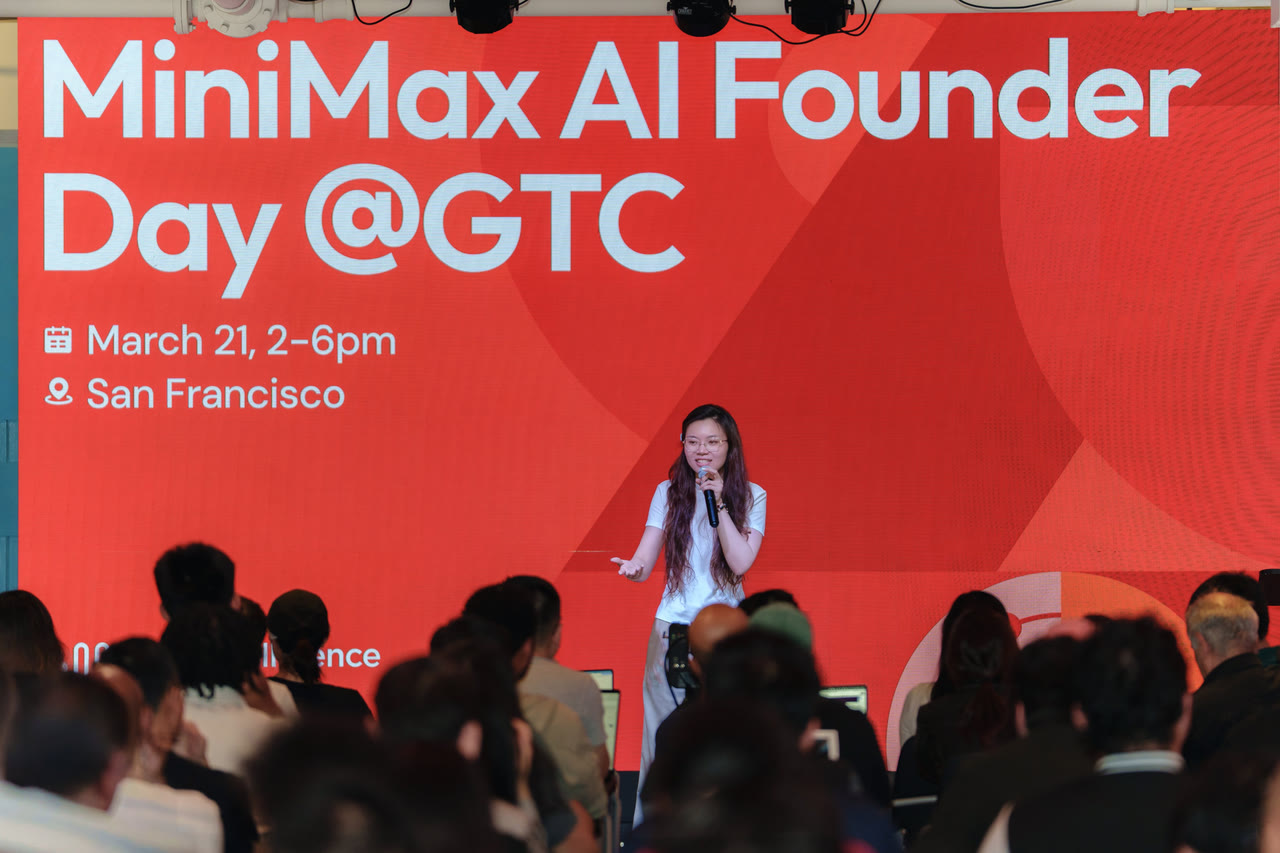
Image context: the cover uses a real event photo from MiniMax AI Founder Day at GTC in San Francisco. It belongs here because the article is not mainly about one benchmark or one flashy generated asset. It is about MiniMax trying to define an "agentic" working surface, and the GTC keynote frames that effort as a systems problem rather than a single-model stunt.[6]
Around 0:50, long context is the admission ticket, not the whole product
The first minute of the video is dominated by scale language: 1 million tokens, 80K reasoning output, and comparisons against better-known model names.[1] That is the part most people will remember because it sounds like the headline. But MiniMax's own M1 launch note already gives a better way to read those numbers. The company says the million-token context window matters because the model is meant to handle long inputs and deep inference efficiently, not simply because a giant number looks impressive on a chart.[4] In other words, context size is being sold as infrastructure for longer tasks.
That matters because the rest of the demo immediately spends that capacity on work objects rather than on abstract reasoning prompts. The product is shown dealing with reports, file sets, application builds, and multi-step execution.[1] The takeaway is narrower and more useful than "MiniMax has a big context window." The better reading is that MiniMax needs very large context in order to make the workspace believable. If the agent is supposed to keep a plan, inspect assets, maintain state, and still produce a deliverable, then context is the admission ticket to that workflow, not the workflow itself.[2][3][4]
Around 2:55, the UI stops behaving like chat and starts behaving like an operator console
The video becomes much more informative once the actual interface is shown in detail.[1] By the 2:55 mark, the viewer is no longer looking at a plain answer thread. The screen shows a left rail, a central execution transcript, and a right-hand panel titled "MiniMax's Window" with a file list and current process state. One sampled frame shows the agent finishing a 50-page electric vehicle report with images and PDF export, while the workspace root on the right is filled with charts, datasets, and generated assets.[1] That is not a chatbot aesthetic. It is an operator-console aesthetic.
This visual choice lines up closely with the official Agent page. MiniMax says it evaluates the product by the standard of a "reliable teammate", and it lists programming capabilities that include handling complex logic, performing end-to-end testing, and caring about UX/UI quality rather than just raw code emission.[2] The interface shown in the video makes that standard legible. A teammate needs visible state, visible artifacts, and visible progress. The console framing tells the user where the work is happening and what the agent has touched.
That is a stronger commercial claim than intelligence alone. Plenty of agents can answer a question. Fewer can keep the question, the plan, the files, and the execution view on one screen long enough for a user to supervise the job. MiniMax is clearly trying to occupy that narrower position.[1][2]
Around 5:45, browser use and asset gathering show why MiniMax keeps talking about "the work" instead of the model
The middle portion of the demo is where the product philosophy in MiniMax's 2025 retrospective becomes easiest to see.[1][3] Around 5:45, the creator walks through a build sequence for a Twitter clone and notes that the agent is using browser-use, image search, web search, and multiple internal steps to produce something that can actually be inspected live.[1] One frame shows the generated application on the right while the action list on the left logs searches, browser actions, and deployment checks. This is exactly the sort of workflow the retrospective is trying to privilege when it says "Benchmark the Work, Then the Agent" and "Vibe Demos > PRD Documents."[3]
The M2.1 post-training write-up helps explain why this matters technically. MiniMax says its agentic training data is divided into SWE Scaling, AppDev, and WebExplorer, separating coding-heavy tasks from longer-horizon search tasks.[5] The video's build sequence looks like a productized version of that training agenda. The user is not being asked to admire isolated answers. The user is being asked to watch search, planning, generation, inspection, and revision get folded into one task lane.[1][3][5]
That is also why the demo feels more substantial than a benchmark screenshot. A benchmark score can only imply general capability. A live workspace, even in a promotional video, can show whether the product has been shaped around the actual order of operations. MiniMax wants the viewer to see that order of operations as the product.[1][3]
Around 7:25, the MCP shelf makes the interoperability bid explicit
The clearest product thesis arrives when the video opens the MCP Market around 7:25.[1] The frame is unusually direct: Figma, Slack, Notion, GitHub, GitLab, MySQL Server, Google Maps, and MiniMax's own server all appear inside one addable shelf.[1] The official Agent page makes the same promise in text, but the video makes it concrete. This is not "we also have APIs." This is "the connector layer is supposed to live inside the same working window as the reasoning and output."[2]
That placement matters. Once the connectors are shown as part of the product surface, MiniMax Agent stops reading like a consumer demo and starts reading like an organization-facing tool. Slack and GitHub imply handoff into team systems. Figma implies movement toward design surfaces. Google Maps implies domain-specific utility beyond generic chat.[1][2] The connector list does not prove deep enterprise adoption on its own. But it does show what kind of future MiniMax is selling: not a solitary assistant, but an extensible workspace with context entering from many directions.
Around 8:25, the deliverable matters more than the thought trace
The final useful turn comes when the demo stops emphasizing process and shows a finished travel-planning artifact with a map, dated itinerary cards, and explanatory notes.[1] This matters because it clarifies what MiniMax thinks the handoff should look like. The point is not merely that the agent reasoned for a long time. The point is that the reasoning was converted into something another person could inspect, use, or revise.
That is where the official slogan on the Agent page suddenly feels less like marketing copy and more like product architecture: "Code is cheap, show me the requirement."[2] The 2025 retrospective sharpens the same idea from another angle when it says agents should move beyond one-off execution toward persistent, context-rich operation inside real environments.[3] The video's itinerary page is simple, but it is enough to make the transition visible. A requirement enters the system once, and the product tries to push it all the way through planning, tool use, interface actions, and final handoff.[1][2][3]
That is the real ai-china signal here. MiniMax is not only presenting an open model with aggressive context claims.[4] It is trying to define an agent workstation where long context, visible state, MCP attachment, and deliverable handoff belong to one continuous surface.[1][2][3][5] The video is worth curating because it shows that product ambition in action.
Sources
- WorldofAI, "MiniMax Agent: NEW Opensource General AI Agent /w MCP & 1 Million Context!", YouTube video, published June 24, 2025.
- MiniMax, "MiniMax Agent - Code is Cheap, Show Me the Requirement" (official product/news page describing long-horizon tasks, programming capabilities, multimodal generation, and MCP integration).
- MiniMax, "MiniMax Agent: What We Learned While Building in 2025" (official retrospective on demo-first product design, benchmarking work instead of isolated agents, and context/state as moat).
- MiniMax, "MiniMax-M1, the World's First Open-Source, Large-Scale, Hybrid-Attention Reasoning Model" (official launch note on the 1 million token context window and 80,000-token reasoning output).
- MiniMax, "MiniMax M2.1: Post-Training Experience and Insights for Agent Models" (official post on AppDev, WebExplorer, context management, and agentic training/evaluation).
- MiniMax, "MiniMax AI Founder Day @ GTC: Inside the Conversations on What's Next in AI" (official event post and source page for the photographic image used in this article).