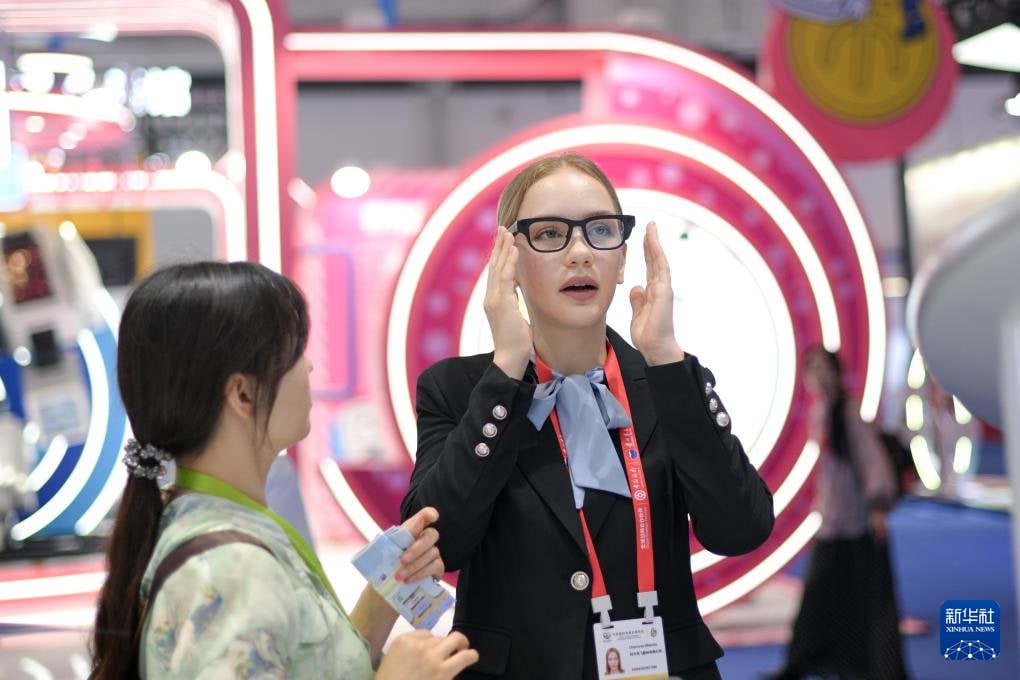
At a technology stand in Hainan, an iFLYTEK employee wearing a pair of AI glasses adjusts the device while a visitor watches. The glasses project real-time translation into the wearer’s view. Xinhua’s photograph was taken at the China International Consumer Products Expo on April 14, 2026—exactly the kind of launch-and-trial setting that China’s newest artificial-intelligence policy now wants to multiply.[7][1]
The image contains the whole market problem. A demonstration can make an unfamiliar product legible in seconds. A subsidy can make its price easier to accept. Neither can make a person wear it again next Tuesday.
In an implementation opinion dated June 9, 2026 and publicly released on June 18, the Ministry of Commerce and seven other departments detailed an “AI plus consumption” policy. It reaches well beyond gadgets: AI phones and computers, glasses, robots, smart homes, elder care, tourism, hotels, restaurants, education, retail, e-commerce, and delivery all appear. So do exhibitions, branded stores, experience centers, rentals, shared use, trials, consumer credit, local subsidies, product standards, privacy, and safety.[1] As of July 25, 2026, the important change is therefore not another model release. Beijing is assembling a demand-side system meant to carry AI from abundant supply into ordinary transactions.
That system can bring purchases forward and give manufacturers a larger field in which to iterate. Its success should not be judged by subsidized shipments alone. China can help finance the first sale; durable demand begins only when the product earns a habit.
From an adoption target to a checkout lane
The national baseline arrived in August 2025. The State Council’s “AI Plus” guideline set a target for new-generation intelligent terminals and AI agents to exceed 70% penetration by 2027 and 90% by 2030.[3] Those numbers established ambition, but they did not settle the denominator. A device shipped, an assistant activated, a feature used once, and a service used every week are four different kinds of penetration.
The 2026 policy stack starts to make the mechanism more concrete. From January 1, smart glasses joined phones, tablets, and smart watches or bands in the national purchase-subsidy program. An eligible device costing no more than RMB 6,000 receives a subsidy equal to 15% of its final price, capped at RMB 500, with one subsidized item per person in each category.[2] The June implementation opinion then gives local governments room to support other next-generation terminals within the broader trade-in framework.[1]
But the policy is more interesting than a rebate list. It calls for AI product launches at the World Artificial Intelligence Conference, the China International Import Expo, the Canton Fair, the consumer expo in Hainan, and the Global Digital Trade Expo. It encourages specialist stores and experience centers, along with rental, sharing, and trial models in malls, pedestrian streets, museums, scenic areas, and elder-care institutions. It also proposes application lists, pilot bases, supply-demand matching, financial leasing, personal-consumption loan support, smart roadside and edge infrastructure, product grading, interoperability, and consumer-data protection.[1]
In other words, policy is trying to build three things at once: a reason to buy, a place to try, and a setting in which the product can become useful. That is a more coherent commercialization thesis than simply discounting hardware.
A large AI supply meets a cautious consumer
The macro setting explains the urgency. China’s total retail sales of consumer goods reached RMB 24.8722 trillion in the first half of 2026, up only 1.3% from a year earlier. Goods retail grew 1.1%; sales at brand-specialty stores among larger retailers fell 8.7%. Online goods-and-services retail was stronger, rising 5.2%, including 6.0% growth in online services.[4]
Those figures do not prove that households are waiting for AI devices. They show why policymakers would prefer a new category that can stimulate both goods and services: sell the terminal, then attach translation, travel, care, entertainment, commerce, or household functions to it. The June opinion repeatedly links a physical endpoint to a service context rather than treating “AI” as a label that adds value on its own.[1]
Smart glasses are the cleanest early test because they already sit inside the subsidy program and still have to prove their everyday role. The official government account says sales at monitored key enterprises rose 42.4% by volume and 46.8% by value in the first quarter after glasses became eligible. That is evidence of acceleration among the companies observed, not a national sell-through total and not evidence of retention.[6]
IDC’s wider shipment data shows both momentum and the boundary. It counted 2.46 million smart glasses shipped in China in 2025, up 87.1% year over year. More than 68% of shipments were online, while products supporting a large-model voice assistant reached 50.5% of the market. Yet IDC also judged that much of current AI use remained in general functions such as questions and translation, with long-term user value and offline channel conversion still unresolved.[5]
The new policy appears to recognize that weakness. It names real-time translation and mobile payment as visible use cases for glasses; it also asks for experience centers and trial models that can reduce the fit, comfort, prescription, and explanation friction of buying something worn on the face.[1] The Hainan photograph is therefore not decorative. It shows a sales channel performing work that an app-store listing cannot: fitting the object, demonstrating the display, and letting the buyer decide whether the interface belongs in daily life.[7]
The market loop begins after the unboxing
A subsidy changes the purchase equation once. A useful AI product has to keep solving the equation.
For glasses, the loop might begin with translation but must survive ordinary conditions: different accents, noisy rooms, weak connectivity, battery limits, prescription needs, heat, weight, social acceptability, and uncertainty over when a camera or microphone is active. For a home robot, the loop includes maintenance, recovery from failure, and whether it works across rooms rather than only in a demonstration zone. For an elder-care device, the relevant outcome is not installation but sustained use by residents and staff, with clear escalation when the system is wrong. For an AI service in tourism or retail, success means completed tasks and repeat visits rather than generated suggestions.
This is where China’s large domestic market could become an advantage. Many deployments across varied homes, shops, institutions, dialects, and service workflows can expose failure modes faster than laboratory evaluation. Trial and rental channels can also create feedback without forcing every user into a full-price purchase. The policy’s “market demand as traction” language is economically meaningful because use can guide product definition, channel design, and after-sales service.[1]
The same mechanism creates a governance obligation. More ambient devices mean more cameras, microphones, location traces, health signals, household routines, and payment intent. The policy explicitly calls for stronger network, data, and content security, protection of consumer information, and controls against algorithmic abuse and fraud. It also calls for terminal grading and cross-brand interoperability standards.[1] Those provisions are not an administrative side note. If consumers cannot understand what a device records, move their data, connect products across brands, or obtain a remedy when the AI service fails, trust becomes a direct constraint on demand.
Five receipts that matter more than the launch count
The first receipt is net category sales after returns. Subsidy dashboards should separate redemptions, fulfilled orders, cancellations, returns, and recovered subsidy funds. Gross redemptions can otherwise reward channel loading or purchases that do not survive the trial period.
The second is feature-level retention. Vendors should disclose whether buyers still use translation, navigation, capture, payment, care, or household functions after 30, 90, and 180 days. “AI activated” is too weak a measure for a policy built around application.
The third is service burden. Repair rates, battery replacement, fitting visits, remote assistance, and warranty claims reveal whether a product is becoming infrastructure or merely moving cost from the checkout to support.
The fourth is standards that change buyer outcomes. The promised terminal-grading and interoperability work should make products easier to compare and connect, with plain explanations of recording state, permissions, offline behavior, model updates, and data exit.[1] A badge without test conditions would add compliance theater, not confidence.
The fifth is demand after the incentive. If sales and weekly use persist among unsubsidized cohorts, the program may have bridged a genuine adoption gap. If activity collapses when discounts, launch events, or novelty fade, public money will have accelerated inventory turnover without establishing a market habit.
This is the article’s falsifier as well as its watchpoint. Cohort evidence showing strong repeat use, low returns, manageable support costs, and continued purchases outside subsidized windows would demonstrate that the policy bought time for products to become useful—not simply a temporary shipment spike.
China’s AI-plus-consumption policy is notable because it treats commercialization as a system. It connects the rebate counter to the exhibition hall, the trial site, the service workflow, the road edge, the standard, and the complaint channel.[1][2] That breadth gives domestic AI companies more than a larger launch stage. It gives them a chance to discover which products deserve to remain in people’s lives.
The decisive moment still comes after the photograph: the employee lets go of the frames, the visitor leaves the stand, and the device must earn the next use by itself.
Sources
- Ministry of Commerce of the People’s Republic of China and seven other departments, “Implementation Opinions on Accelerating the Development of ‘AI + Consumption’” (issued June 9, 2026; official text covering products, services, trial channels, finance, infrastructure, standards, and safety).
- Ministry of Commerce and four other departments, “Notice on 2026 subsidies for replacing home appliances and purchasing digital and smart products” (effective January 1, 2026; official rules for smart-glasses eligibility, the 15% rate, and the RMB 500 cap, republished by the National Development and Reform Commission).
- State Council of the People’s Republic of China, “China issues guideline to accelerate ‘AI Plus’ integration across key sectors” (August 27, 2025; official summary of the 2027 and 2030 adoption targets).
- National Bureau of Statistics of China, “Total retail sales of consumer goods grew 1.3% in the first half of 2026” (July 15, 2026; official retail, channel, and online-services data).
- IDC China, “China’s smart-glasses market grew 87.1% in 2025, moving from hardware rollout toward value validation” (March 26, 2026; shipment, channel, AI-feature, and adoption-boundary data).
- State Council of the People’s Republic of China, “China’s wholesale, retail sectors log steady growth in Q1” (April 27, 2026; Ministry of Commerce figures for smart-glasses sales at monitored key enterprises).
- Xinhua, “The 6th China International Consumer Products Expo: AI sketches a new consumer landscape” (April 14, 2026; documentary photograph and caption identifying the iFLYTEK translation-glasses demonstration used as the article image).