At China's Experimental Advanced Superconducting Tokamak, the most useful artificial intelligence does not write reports or converse with operators. It watches a plasma that can change state in milliseconds and tries to answer two narrow questions: Is this particular instability about to end the discharge, and what confinement state is the machine in now?
Two papers from the EAST team, published on June 23 and June 26, 2025, turn those questions into separate machine-learning systems. One predicts disruptions caused by locked modes. The other distinguishes low confinement, high confinement without edge-localized modes, and high confinement with them. The Chinese Academy of Sciences presented both as steps toward intelligent fusion control.[1][2][3]
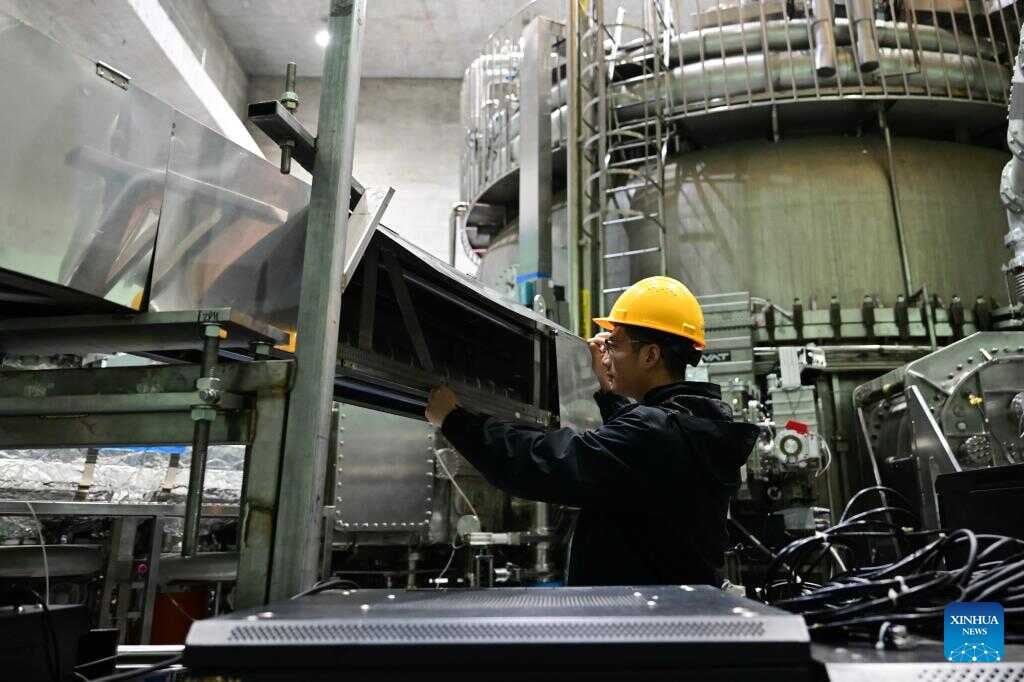
The cover photograph was taken during an EAST upgrade on April 28, 2026. Researcher Guo Jin is working amid the machine's diagnostics and metalwork—the physical layer that every “real-time” model eventually has to enter.[6]
The headline result—a 94% successful alarm rate with an average 137-millisecond warning—sounds like an autonomous safety system.[1][2] It is not yet evidence of one. It is a test result for one disruption mechanism at a stated 10% false-alarm rate. The real use case begins after the prediction, when a control system has to accept live signals, hold a threshold long enough to reject noise, choose an actuator, and intervene before the plasma collapses.
A warning about one way a plasma can fail
A tokamak confines hot plasma with magnetic fields. Inside that field, a rotating magnetohydrodynamic disturbance can slow until it becomes fixed relative to the machine. This “locked mode” may enlarge a magnetic island, degrade confinement, and sometimes lead to a disruption—the rapid loss of stored thermal and magnetic energy. “Sometimes” matters: a predictor must distinguish a locked mode that remains tolerable from one approaching collapse.[2]
The EAST study used locked-mode data from error-field-penetration experiments conducted between 2015 and 2022. The researchers built two decision-tree ensembles. A physics-oriented model was designed to reveal which variables separated disruptive from non-disruptive cases; a second model was restricted to signals suitable for real-time prediction.[2]
On its test set, the interpretable model reported an area under the receiver-operating-characteristic curve of 0.997. Its most important feature was d_edge, the distance between the outer boundary of the magnetic island and the plasma's last closed magnetic surface. Stored energy, heating power, internal inductance, electron temperature, and magnetic quantities also contributed.[2]
That feature ranking is more useful than a generic claim that “AI found a precursor.” It gives physicists a proposition they can examine: as the island approaches the confined plasma's edge, the risk changes in a way that the ensemble finds decisive. The model does not replace plasma physics; it compresses several measurements into an alarm while leaving a trail back to physically meaningful variables.
The real-time model produced the more operational number: 94% successful alarms, 137 milliseconds of average warning, and 10% false alarms.[1][2] Those three figures belong together. Increasing sensitivity can create earlier warnings by accepting more false triggers; tightening the threshold can protect scarce experimental pulses while missing dangerous events. An alarm rate without its false-alarm operating point would conceal that trade-off.
The boundary is equally important. The training data came from one device and a deliberately produced class of locked-mode experiments. The result does not cover every EAST disruption, much less every future tokamak. Nor is 137 milliseconds pure spare time. Signal acquisition, filtering, model inference, threshold logic, communications, and actuator response must all fit inside the warning margin.
The second model tells the controller where it is
Avoiding catastrophe is only one part of control. A tokamak also needs to know whether it is operating in low-confinement mode, or L-mode, and whether an efficient high-confinement mode, or H-mode, is accompanied by edge-localized modes. ELMs are brief edge instabilities that can release bursts of energy toward plasma-facing components. A system that cannot name the present state cannot reliably decide which control objective comes next.[1][3]
The EAST team framed this as two related tasks. Six scalar features—including electron density, plasma current, toroidal field, elongation, power loss, and minor radius—help identify L-mode versus H-mode. Fast sequences from deuterium-light emission and Mirnov magnetic coils help detect ELM bursts. A shared neural-network layer lets evidence from the two tasks correct inconsistent results.[3]
The physical relationship supplies the useful constraint. If the ELM detector sees a real edge-localized mode, the operational state should be H-mode; there is no corresponding “ELMy L-mode” class in this setup. Joint training can therefore make an obvious signal spike help resolve the harder state-classification task instead of forcing two independent models to reconcile their answers afterward.[3]
The evaluation used 226 EAST shots from ELM-control experiments conducted between 2016 and 2022. Experts divided them into 78,328 labeled 20-millisecond samples: L-mode, ELM-free H-mode, or ELMy H-mode. The main train-validation-test split was 60:20:20 and randomly shuffled samples, so portions of a previously seen shot could appear in the test set. The authors separately evaluated 61 unseen shots, an important stronger check.[3]
The combined model reached 96.7% overall accuracy on the main test set, 3.6 percentage points above the paired single-task approach. The class results expose where the problem remains hardest: the paper reports 97.8% for L-mode, about 92% for ELM-free H-mode, and 97.9% for ELMy H-mode. On the unseen shots, its accuracy fell by 0.8 percentage points, compared with 1.8 points for the separate models.[1][3]
The paper also reports 0.68 milliseconds per sample for inference, versus 5.4 milliseconds for a full bidirectional LSTM using all inputs as sequences.[3] That is evidence that the modular design can be fast. Because the processing-speed table does not specify a deployment processor, it is not yet a latency guarantee for a hardened control computer.
Prediction only matters when an actuator listens
EAST has already demonstrated the broader pattern with an earlier, separate disruption predictor. At a 2022 IAEA technical meeting, researchers described a random-forest model integrated into the EAST plasma-control system. When its disruption-probability signal stayed above a configurable threshold for more than 10 milliseconds, the system triggered massive gas injection; neon entered the plasma to mitigate damage.[4]
That prior experiment is crucial context and a crucial distinction. It proves that an EAST machine-learning signal has crossed the boundary from retrospective classification into threshold logic and a physical actuator. It does not prove that the 2025 locked-mode predictor or confinement-state network has been deployed in the same closed loop.
The difference between prediction and mitigation is physical. ITER's official description of its disruption-mitigation system centers on shattered pellets: frozen hydrogen and neon fragments injected into the plasma to spread energy through radiation and reduce thermal and mechanical loads. The system acts on a millisecond timescale after detection.[5] A better predictor may buy that system time, but the predictor does not cool the plasma by itself.
For the confinement classifier, the missing handoff is different. A state label must connect to a policy: maintain the present regime, change heating, adjust magnetic perturbations, or suppress an instability. That policy needs guardrails for contradictory sensors, missing signals, rapid transitions, and out-of-distribution conditions. “Real-time monitoring” becomes “control” only when the allowed action and fallback state are explicit.
What would earn trust in the next campaign
The next proof should be an event ledger rather than a larger aggregate score. For every live alarm, record the model version, input availability, probability trace, threshold dwell time, actuator command, actuator response, plasma outcome, and operator override. Report missed disruptions and unnecessary interventions separately. Stratify results by experimental campaign so changes to diagnostics, wall conditions, heating, and control software cannot hide inside one average.
The state classifier needs the same discipline. Its test should reserve complete future shots—and ideally a later experimental campaign—rather than only shuffled 20-millisecond samples. The difficult ELM-free H-mode class deserves its own error budget because confusing it with L-mode or ELMy H-mode could recommend the wrong control action. Hardware-in-the-loop testing should measure the complete sensor-to-command path, not neural-network inference alone.
Cross-machine transfer is the longer test. A feature that is physically meaningful on EAST may still depend on its diagnostics, calibration, geometry, and operating scenarios. Moving the method toward BEST or ITER will require new labels, uncertainty checks, and probably retraining. The honest claim today is not that EAST has produced a universal fusion autopilot. It has produced two compact, bounded, testable candidates for specific places in a control stack.
That is why the 137 milliseconds matter. The number is large enough to make an intervention imaginable and small enough to expose every weak link between a model and the machine. In fusion control, AI earns trust neither by sounding certain nor by winning a retrospective leaderboard. It earns trust when the warning survives the wires, the threshold, the actuator, and the next pulse.
Sources
- Chinese Academy of Sciences, “New AI Advances Boost Safety and Performance in Fusion Reactors” (July 11, 2025; official overview of the two EAST systems and their headline results).
- Guo-Hong Deng et al., “Interpretability analysis and real-time prediction of locked mode-induced disruptions in EAST,” Plasma Physics and Controlled Fusion 67, 075013 (published June 26, 2025; dataset boundary, features, warning performance, and false-alarm operating point).
- Guo-Hong Deng et al., “Automatic identification of tokamak plasma confinement states (L-mode, ELM-free H-mode, and ELMy H-mode) with multi-task learning neural network,” Nuclear Fusion 65, 076035 (published June 23, 2025; architecture, labeled dataset, split, class results, unseen-shot test, and processing speed).
- International Atomic Energy Agency, “Applications of machine learning for plasma control in fusion reactors” (July 20, 2022; EAST control-system integration, threshold dwell, and massive-gas-injection handoff for a separate earlier predictor).
- ITER Organization, “Disruption mitigation” (official explanation of disruption loads, shattered-pellet injection, and the millisecond detection-to-mitigation timescale).
- Chinese Academy of Sciences, “Pic Story of Young Scientists on Science Island in China's Anhui” (May 6, 2026; source and context for the Xinhua photograph of Guo Jin debugging EAST).