As of 2026-04-23T02:00:49Z UTC, Moonshot's Kimi K2.6 release is best read as a field signal about coordination. The model announcement does include the expected frontier-model material: benchmark tables, open weights, multimodal input, a 1T-parameter MoE architecture, 32B activated parameters, and a 256K context window.[1][2] The more useful AI-China signal sits one layer above that. Moonshot is trying to make the model act as a coordinator for long-running work: coding, interface generation, proactive background agents, and agent swarms that divide a task across specialized workers.[1][2][3][4]
That matters because the earlier Kimi K2 story was already about moving from chat toward agentic execution: the public repository framed the line around 1T-scale MoE architecture, tool use, reasoning, autonomous problem-solving, and open deployment routes.[5] K2.6 does not simply add a larger score table to that ladder. It sharpens the product grammar. The official K2.6 blog says the model is available through Kimi.com, the app, the API, and Kimi Code, then organizes the release around long-horizon coding, coding-driven design, elevated agent swarms, proactive agents, and bring-your-own-agent collaboration.[1] That is a stack-shaped announcement. It tells builders to evaluate Moonshot by how well it keeps work moving across tools, files, agents, and humans.
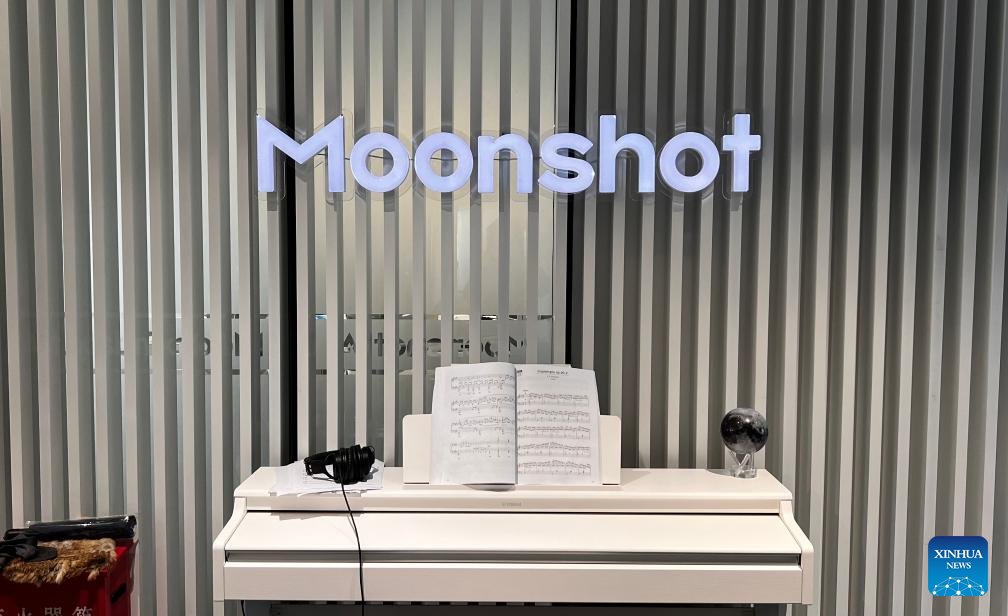
Image context: the cover photograph shows Moonshot's office piano rather than a benchmark chart. That choice is intentional. The release already has plenty of scoreboards. The more durable story is whether a Beijing model lab can turn multimodal and agentic capability into a repeatable work surface that developers actually keep open all day.[6]
The release is about work duration
The first thing to notice is duration. Moonshot's K2.6 blog says the model handled one long coding case with 4,000+ tool calls, over 12 hours of continuous execution, and 14 iterations while optimizing local inference for Qwen3.5-0.8B on a Mac.[1] It also describes a separate 13-hour refactor of exchange-core, including more than 1,000 tool calls, changes to 4,000+ lines of code, and reported throughput gains from 0.43 to 1.24 MT/s on median throughput and 1.23 to 2.86 MT/s on performance throughput.[1]
Those numbers are first-party claims, so they should be treated as release evidence rather than independent proof. Still, the shape of the claim matters. Moonshot is not only asking readers to admire a pass rate. It is asking them to imagine a model that remains useful after the first patch, after the first failed route, and after the task has accumulated enough files, logs, flame graphs, and partial decisions to become operationally messy.[1]
That is a different evaluation problem from single-turn coding. For a coding agent, the hard part is not producing one plausible diff. The hard part is preserving intent while the task stretches over hours, keeps calling tools, meets unexpected runtime behavior, and has to revise its own plan without losing architectural boundaries. Kimi K2.6 is being positioned around that failure surface.
The Hugging Face model card reinforces the same framing. It calls K2.6 an open-source, native multimodal agentic model and lists long-horizon coding, coding-driven design, proactive autonomous execution, and swarm-based orchestration as the key capabilities.[2] The architecture table keeps the model lineage legible: 1T total parameters, 32B activated, 384 experts, 8 selected experts per token, 256K context, MLA attention, MoonViT as the vision encoder, and a 400M-parameter vision encoder.[2] The public message is that the model is large enough to compete, but its job is to remain coordinated under real work pressure.
Kimi Code is the distribution surface
The release would be weaker if it stopped at model weights. The more practical move is Kimi Code. Moonshot's Kimi Code page says the K2.6 official version is updated and shows a CLI surface where the model is identified as kimi-for-coding, powered by kimi-k2.6.[4] The same page presents Kimi Code as a membership-linked coding agent for terminal and IDE workflows, with install instructions and an example assistant that can write, debug, refactor, inspect codebases, run commands, process files, search code, fetch web content, and spawn subagents for parallel work.[4]
This is where the AI-China signal becomes concrete. A model release can create attention for a week. A coding surface can create habit if it sits where work already happens. Kimi Code gives Moonshot a way to keep K2.6 in the terminal, the IDE, and the developer's daily loop rather than only in a chatbot tab.[4]
The API documentation points in the same direction. It now identifies kimi-k2.6 as Kimi's most intelligent model to date, supporting text, image, and video input, thinking and non-thinking modes, conversation, code generation, visual understanding, and agent tasks.[3] It also says the platform exposes a Chat Completions interface and that K2.6 supports context windows up to 256K.[3] In other words, the public distribution layer is split across open weights, hosted API, product app, and coding agent.
That split is strategically useful. Open weights let Moonshot remain visible to the open-source community. The API makes the model routable for builders who do not want to host a 1T MoE system. Kimi Code turns the capability into a software-work surface. The app keeps the consumer funnel alive. K2.6 is therefore not just a model object. It is a distribution test.
Agent Swarm is the actual coordination bet
The most distinctive part of K2.6 is the scale-out language. Moonshot says K2.6 Agent Swarm can scale horizontally to 300 sub-agents across 4,000 coordinated steps, up from K2.5's 100 sub-agents and 1,500 steps.[1][2] The blog describes an Agent Swarm as a system that decomposes a task into heterogeneous subtasks executed by domain-specialized agents, then recombines outputs into deliverables such as documents, websites, slides, spreadsheets, research reports, and role-specific applications.[1]
This is the clearest field signal. Moonshot is not only increasing the model's single-agent ability. It is trying to sell the idea that the model can manage a working organization of agents. That idea is ambitious, but it also creates a hard evaluation boundary. If the coordinator cannot detect stalled work, reconcile conflicting outputs, preserve source discipline, and assign subtasks to the right worker, then 300 sub-agents become a larger error surface rather than a productivity multiplier.
Moonshot seems aware of that boundary. The K2.6 blog frames Claw Groups as a research preview for "bring your own agents," where agents and humans share an operational space, and K2.6 acts as an adaptive coordinator that matches tasks to agents, detects failures, regenerates subtasks, and manages deliverables through validation and completion.[1] That is the core bet: the model is not merely a worker; it is becoming a work allocator.
For AI-China, this is a meaningful competitive direction. Alibaba and Tencent have both pushed model capability toward enterprise platforms and governed agent surfaces. Baidu and Zhipu have emphasized phone, visual, and coding agents. Moonshot's K2.6 angle is more visibly prosumer and developer-led: open weights, Kimi Code, proactive agents, and swarm orchestration are meant to make a user feel that a single prompt can unfold into a team-like execution run.[1][2][4]
What still needs proof
The caveat is evidence maturity. Kimi K2.6's benchmark table is broad, but it is still first-party. The blog reports scores such as 58.6 on SWE-Bench Pro, 80.2 on SWE-Bench Verified, 54.0 on HLE-Full with tools, and 86.3 on BrowseComp in Agent Swarm mode.[1] The Hugging Face card publishes the same broad evaluation story and links the model distribution to the open-source release.[2] Those are useful release artifacts, but serious adoption needs reproduction under team-specific toolchains, repositories, budget limits, and human-review rules.
The test should therefore move from "Is K2.6 strong?" to "Where does coordination break?" A useful pilot would include stale dependencies, failing tests, ambiguous tickets, partial documentation, tool-rate limits, contradictory sub-agent outputs, and a forced handoff to a human reviewer. It should measure not only final task success, but rollback rate, review burden, command safety, source traceability, and whether the agent preserves repository style under stress.
That boundary does not weaken the release. It clarifies it. Moonshot has made K2.6 legible as a coordination-layer model: open enough to inspect, hosted enough to route, and productized enough to enter coding workflows. The next proof is whether that coordination stays valuable when the work stops looking like a demo and starts looking like a real backlog.
Sources
- Kimi, "Kimi K2.6: Advancing Open-Source Coding" (official tech blog, April 20, 2026; long-horizon coding, Agent Swarm, proactive agents, benchmark table, and release surfaces).
- Moonshot AI, "moonshotai/Kimi-K2.6" Hugging Face model card (architecture, open-source release framing, multimodal and agentic feature list, benchmark table, and license metadata).
- Kimi API Platform, "Main Concepts" documentation (Kimi K2.6 model description, 256K context note, API service boundaries, rate-limit and token behavior).
- Kimi, "Kimi Code" product page (K2.6-powered terminal/IDE coding-agent surface, installation path, and workflow positioning).
- MoonshotAI, "Kimi-K2" GitHub repository (Kimi K2 lineage, 1T MoE architecture, tool-calling orientation, deployment notes, and Modified MIT license context).
- Xinhua, "China Focus: China promotes 'Tech for Good' with open-source, user-friendly AI models" (August 6, 2025; source page for the Moonshot office piano photograph used as cover image).