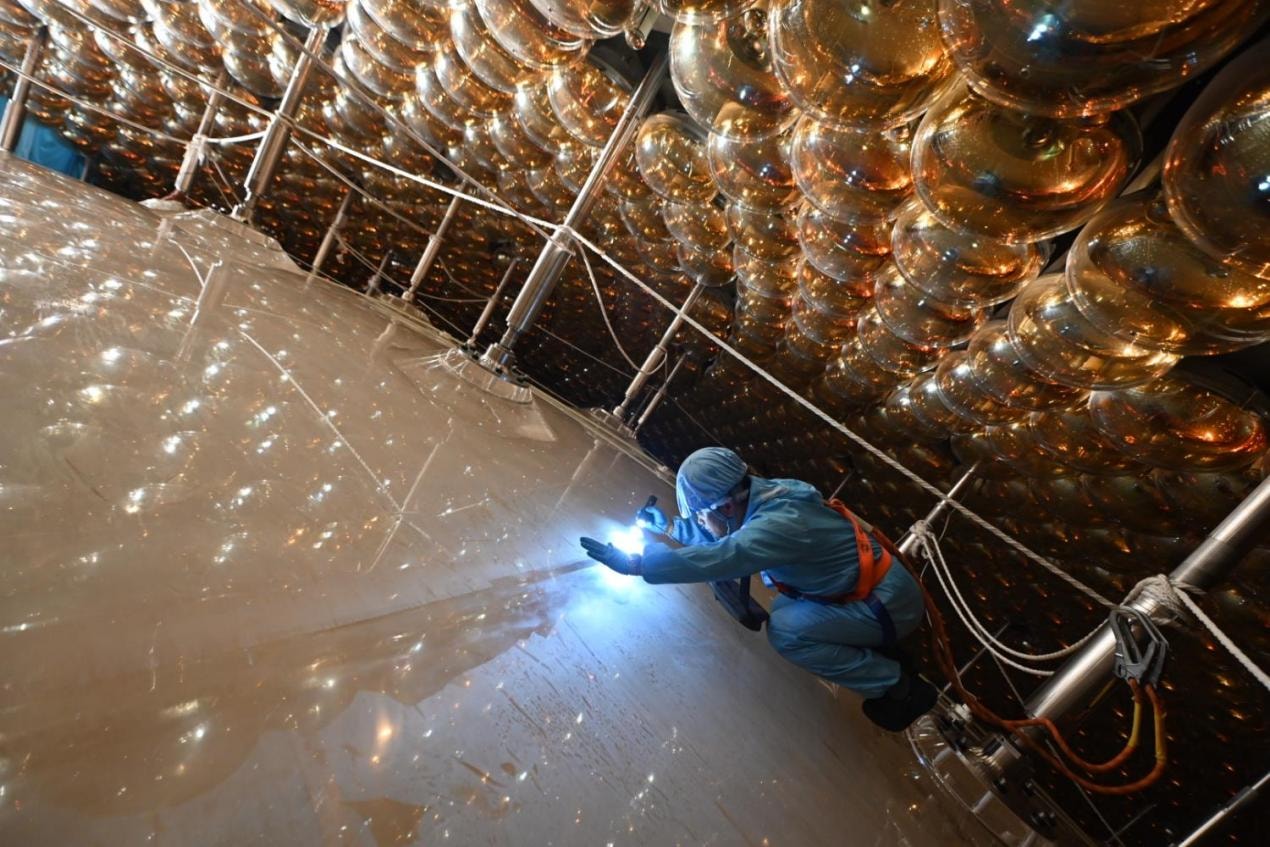
The photograph looks like an enormous eye turned inward. Rows of light-sensitive tubes surround a transparent sphere, waiting for flashes from within. At the Jiangmen Underground Neutrino Observatory, or JUNO, that sphere holds 20,000 tonnes of liquid scintillator: a material that emits light when charged particles deposit energy in it. The Chinese-led international experiment began taking physics data on August 26, 2025, beneath roughly 700 metres of rock in Guangdong.[1]
Those energy measurements serve JUNO's effort to determine the ordering of neutrino masses.[1] For an AI researcher, the question begins after the flash. Where did the interaction happen, and how much energy did it leave behind? Studies published in 2021 and 2022 explored how machine learning could answer those questions. Read alongside JUNO's initial operating report, they reveal a demanding use case: learning to measure an event inside an instrument whose behaviour must itself be measured.[2][3][4][5]
Turn the detector into an image
A photomultiplier tube converts arriving light into an electrical signal. Across the detector, the amount of collected charge and the arrival times carry information about the event. The reconstruction problem runs backwards from those observations to an estimated position, called the vertex, and an energy.[1][2]
Zhen Qian and colleagues' 2021 study compared decision trees and several neural-network architectures. Training and testing used simulated positrons with kinetic energies from zero to 10 megaelectronvolts, relevant to JUNO's reactor-antineutrino signal.[2]
One route treated individual tubes as pixels. Their signals formed images that a neural network could learn to associate with an interaction position.[3] This is an unusual kind of computer vision: the image is assembled from sensor measurements, rather than taken by a camera. Its organisation determines what the model can learn about the apparatus.
The next improvement came from the tubes
JUNO's large tubes use two designs with different timing behaviour. In May 2022, Zi-Yuan Li and colleagues separated their signals into distinct neural-network inputs and added second-hit timing. Against the earlier input configuration, they reported about a 9.4% improvement in vertex resolution at 1 MeV.[3]
The evaluation included simulated electronics effects. Even its sample labelled “real” was simulated data. The improvement describes a narrower position-error distribution, rather than a share of neutrinos identified.[3]
Here, the useful distinction began in the hardware. The model needed to know which kind of sensor had spoken.
How much of the flash must a model remember?
Energy estimation offered another route. In a separate 2022 study, Arsenii Gavrikov and colleagues asked how far carefully chosen summaries of the sensor readings could go. They tested boosted decision trees and a fully connected neural network using aggregated features, instead of passing every tube's measurements through a detailed image-processing model.[4]
Their training and testing again used JUNO Monte Carlo simulations of positron events. Selected combinations of features reached an energy resolution of approximately 3% at 1 MeV. This describes the spread of reconstructed energies under that simulated setup; it is not a claim of 97% accuracy on live detector data.[4]
That result makes the design question more interesting than choosing the largest network. The position and energy tasks need different information. For energy, the study showed that substantial compression of the measurements could preserve the information needed for its target resolution.[4] A useful model can therefore begin with a physicist deciding what deserves to survive that compression.
The real detector gets a vote
The 2021 researchers anticipated biased predictions on the physical detector. They proposed checking calibration measurements, using some for further training if needed and reserving others for validation. Those measurements would still leave gaps in energy and spatial coverage.[2]
JUNO's November 2025 initial-performance report describes reference signals from radioactive sources and lasers, with calibration before science runs and weekly checks afterwards.[5]
Its central-detector reconstruction section presents JVertex, OMILREC and VTREP, including likelihood-based methods; machine learning appears separately in its discussion of muon tracks.[5] The early neural-network studies establish a research programme. They cannot be credited with all of JUNO's operating performance.
One especially revealing finding concerns the materials. Measured liquid and water transparency exceeded the values used in simulation; updating those parameters helped reproduce the observed light yield.[5] Even an improvement in the hardware can change the world a model was trained to recognise.
For China's scientific AI, JUNO offers a concrete measure of progress: a prediction that remains trustworthy when checked against the apparatus. The striking photograph supplies the scale. The quieter achievement lies in connecting a fleeting flash to a defensible measurement—and knowing which parts of that connection still need experimental proof.
Sources
- Institute of High Energy Physics, Chinese Academy of Sciences, “JUNO officially begins operation,” August 27, 2025; Chinese-language primary announcement, detector description and interior photograph, Figure 2.
- Zhen Qian et al., “Vertex and Energy Reconstruction in JUNO with Machine Learning Methods,” January 2021, revised January 15; simulation setup, reconstruction methods and Section 5.1 on calibration.
- Zi-Yuan Li et al., “Improving the machine learning based vertex reconstruction for large liquid scintillator detectors with multiple types of PMTs,” May 9, 2022; sensor-specific inputs, simulated samples and resolution improvement.
- Arsenii Gavrikov, Yury Malyshkin and Fedor Ratnikov, “Energy reconstruction for large liquid scintillator detectors with machine learning techniques: aggregated features approach,” 2022; simulation-based energy estimation using engineered summaries.
- JUNO Collaboration, “Initial performance results of the JUNO detector,” November 18, 2025, version 1; Sections 6–7 on calibration, reconstruction, optical properties and muon tracking.