China's AI capital market has crossed a threshold: companies at opposite ends of the stack can now raise serious money close to home. A memory-chip manufacturer can finance fabrication and research in Shanghai; a humanoid-robot maker can fund its next production and development cycle on the same exchange. What the market has not yet established is that the spectacular prices printed on their first days are stable valuations of the whole businesses.
As of August 31, 2026, IPOs and secondary listings in Hong Kong and Shanghai have raised more than $54 billion this year, already above the $46 billion-plus raised across 2025. The two venues account for about 21% of global proceeds so far in 2026, according to LSEG figures reported by the Associated Press.[1] Hong Kong entered the year with momentum of its own: HKEX recorded 40 first-quarter listings, HK$110.4 billion in IPO funds—nearly six times the year-earlier total—and 431 active applications at March 31.[5]
The new fact is therefore not merely that investors like an AI story. It is that China now has a working two-venue financing channel for that appetite: Shanghai's STAR Market for domestic hard-tech issuance, and Hong Kong for companies seeking a broader pool of international capital. The harder question is what the headline debuts actually measured.
Two machines, one rush for shares
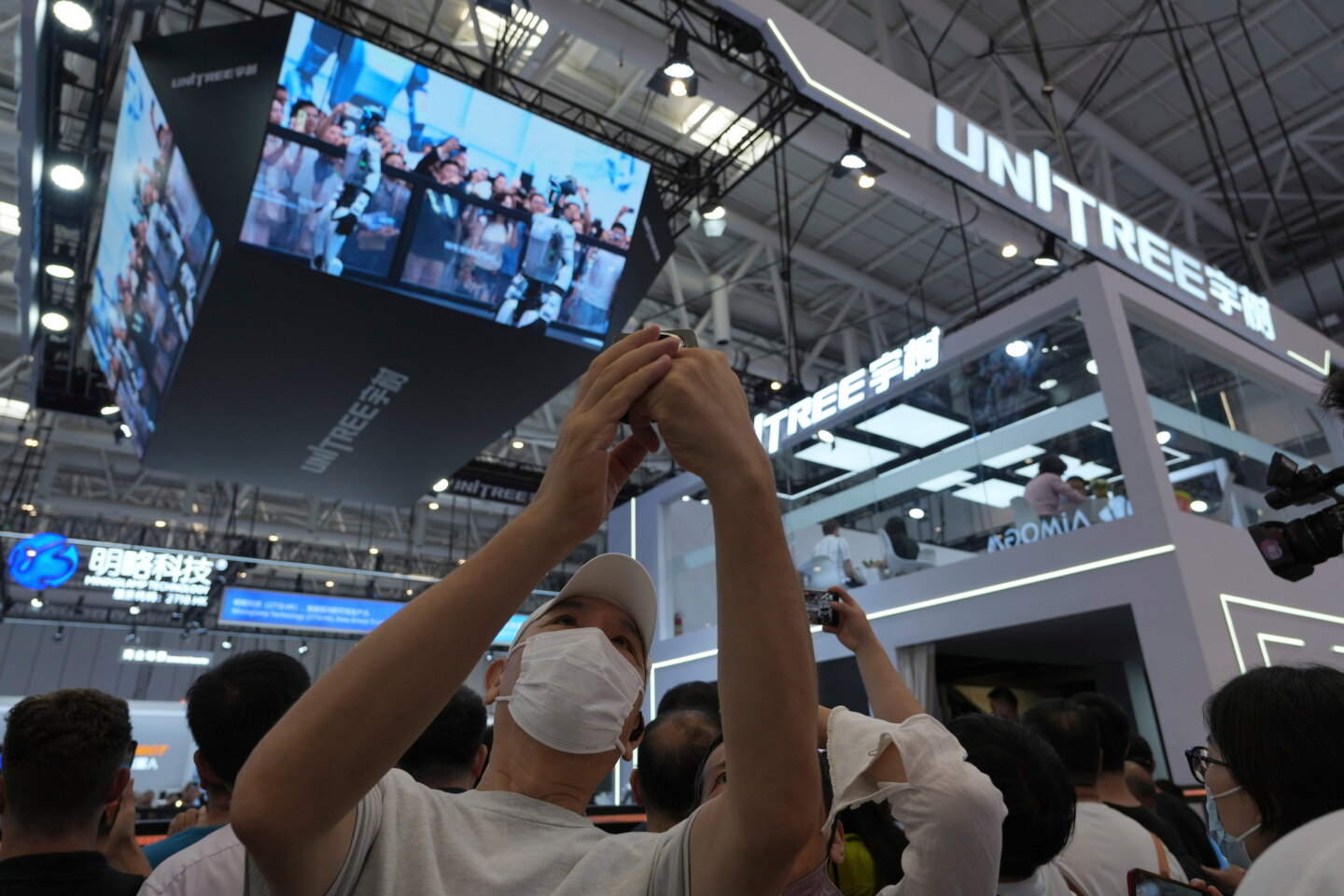
CXMT and Unitree make a revealing pair because their capital needs are so different. CXMT makes DRAM, a manufacturing business shaped by fabs, process yields, equipment access, product cycles, and enormous fixed costs. It raised more than $8.6 billion in July; its shares finished their first trading day 466% above the offer price. Unitree sells quadruped and humanoid robots, components, and embodied-AI systems. It raised about RMB 6.1 billion in August; its shares closed the first day 460% higher.[1][6]
Those outcomes show that public investors will fund both the compute substrate and a visible application layer. They also create an easy but mistaken narrative: if two stocks traded at roughly five-and-a-half times their offer prices in one session, the market must have discovered that the underlying companies were worth five-and-a-half times as much.
The exchange's own notices supply the missing denominator. Unitree had about 404.46 million A shares after the offering, but only about 30.09 million were admitted to trading on August 19—roughly 7.4% of the total by calculation.[2] CXMT had about 66.88 billion A shares, of which about 4.50 billion began trading on July 27—roughly 6.7%.[3] These are initially tradable fractions calculated from the published share counts, not estimates of how many shares changed hands.
That distinction matters. A market-capitalization headline multiplies the last traded price by the entire share count, including shares that were not available for sale that day. When intense demand meets an initially tradable slice of less than one share in thirteen, a relatively small part of the company can set the quoted value of all of it.
The debut rules let scarcity speak loudly
Thin initial supply is only one side of the mechanism. Under the Shanghai Stock Exchange's rules, a STAR Market IPO has no daily price-movement limit for its first five trading days; afterward the limit is 20%.[4] The rule is designed to let a new issue find a price quickly. In a theme crowded with retail attention, it also lets demand and scarcity produce an unusually large first print.
None of this proves that either debut was irrational. CXMT's revenue rose more than 700% year on year to RMB 50.8 billion in the first quarter of 2026, according to the AP account, amid a spike in demand for memory used in AI systems.[1] Unitree arrives with recognizable products, manufacturing experience, and a rare position in China's embodied-AI supply chain. Investors may be pricing strategic scarcity, future growth, or the value of a domestic alternative—not merely chasing a ticker.
But price discovery is a process, not an opening ceremony. By Friday, August 28, Unitree's shares had fallen more than 40% from their intraday debut peak.[1] That reversal does not establish a fair value either. It shows that the first session was an unstable auction conducted with limited supply, unusually loose price bounds, and exceptionally concentrated attention.
The cash raised is more durable than the first-day market cap
There are two financial numbers in an IPO, and the boom makes them easy to blur. The first is the cash delivered to the company by shares sold at the offer price. That money can pay for equipment, engineering, production capacity, and working capital. The second is the market capitalization implied by trades after listing. A soaring secondary-market price does not retroactively multiply the cash the company raised.
For China's AI ecosystem, the first number is the more important macro signal. CXMT's offering gives a capital-intensive memory supplier a domestic pool of long-duration funding. Unitree's listing gives a younger robotics company a public currency for hiring, investment, acquisitions, and later fundraising. Hong Kong adds a route for international participation that mainland-market access alone cannot fully provide.[1] Together, the venues can recycle enthusiasm into industrial spending across chips, optical links, models, robots, and applications.
That channel can change company behavior even if debut valuations cool. It shortens the distance from an industrial-policy priority to a financed factory or engineering program. It also creates public disclosure, quarterly scrutiny, and a continuously quoted cost of capital. Private-market claims that once circulated through funding announcements now have to meet prospectuses, exchange questions, financial statements, and daily trading.
The counterweight is allocation discipline. If issuers and investors treat a dramatic debut as proof that every AI-adjacent project deserves capital, the channel can fund duplication and capacity ahead of demand. If they treat listing as the beginning of evidence—then compare proceeds with shipped products, utilization, gross margins, cash conversion, and repeat customers—the same boom can make the ecosystem more legible.
Four readings after the confetti
First, watch the tradable fraction, not only the total market cap. Strategic placements and shareholder lockups expire on schedules; a price that survives materially wider supply says more than one established by a thin opening float.
Second, separate offer proceeds from trading gains. The former finances the company. The latter may lower the cost of future capital, but it can reverse without putting cash into—or taking cash out of—the operating business.
Third, match each issuer to its own proof. For CXMT, the useful evidence is production yield, product mix, capital efficiency, and durable profitability across the memory cycle. For Unitree, it is repeat shipments, service and software revenue, manufacturing quality, task-level robot deployment, and margins after scaling. A shared AI label does not create a shared operating model.
Fourth, track whether the pipeline broadens without simply repeating the same scarcity trade. More robotics and hard-tech applicants can deepen the market, but only if later offerings arrive with enough tradable supply and disclosure for investors to distinguish one business from another.
The claim here has a clear falsifier. If Unitree and CXMT remain well supported as their tradable supply widens, while operating results grow into the quoted values, then the early surges will look less like float-amplified attention and more like fast, accurate repricing. Until then, the cleanest conclusion is narrower. China's markets have proved they can finance the AI stack at scale. They have not proved that a tiny opening slice can reliably price the whole machine.
Sources
- Chan Ho-him, “AI and robotics drive an IPO boom in China as Shein lists in Hong Kong,” Associated Press (August 31, 2026) — combined fundraising, CXMT and Unitree offer and trading figures, market context, Unitree's post-debut retreat, and source page for the cover photograph.
- Shanghai Stock Exchange, “Announcement on the listing and trading of Unitree Robotics Co., Ltd. renminbi ordinary shares on the STAR Market” (August 18, 2026) — total A shares, initially tradable shares, ticker, and trading date.
- Shanghai Stock Exchange, “Announcement on the listing and trading of CXMT Corporation renminbi ordinary shares on the STAR Market” (July 24, 2026) — total A shares, initially tradable shares, ticker, and trading date.
- Shanghai Stock Exchange, SSE Trading Rules (2026 Revision) (published April 24, effective July 6, 2026) — current STAR Market price-limit framework, including the first five trading days of an IPO.
- Hong Kong Exchanges and Clearing, Quarterly Results Announcement for the Period Ended 31 March 2026 — first-quarter listings, IPO funds raised, application pipeline, and Hong Kong's primary-market position.
- Chan Ho-him, “Shares in Chinese humanoid robot maker Unitree soar in its Shanghai trading debut,” Associated Press (August 19, 2026) — offer proceeds, issue price, first-day close, and intended use of funds.