As of 2026-05-21 UTC, Honor's clearest AI-China signal is not that it has renamed a phone feature with an AI badge. It is that the company is trying to make the handset the endpoint for a personal agent: a device that sees local context, operates across apps, remembers user material, calls partner services, and reaches outward to PCs, wearables, cars, homes, and carrier networks.
That makes Honor a useful dossier subject because its strategy sits between two familiar AI narratives. It is not a frontier-model lab trying to win the open leaderboard. It is also not merely a phone vendor adding cloud chat to a launcher. Since the HONOR ALPHA PLAN announcement at MWC Barcelona on 2025-03-02, the company has described a three-step move from intelligent phones, to a wider AI device ecosystem, to an eventual AGI-era human-device setting.[1] The concrete question is whether that roadmap can become a durable control layer on top of everyday mobile behavior.
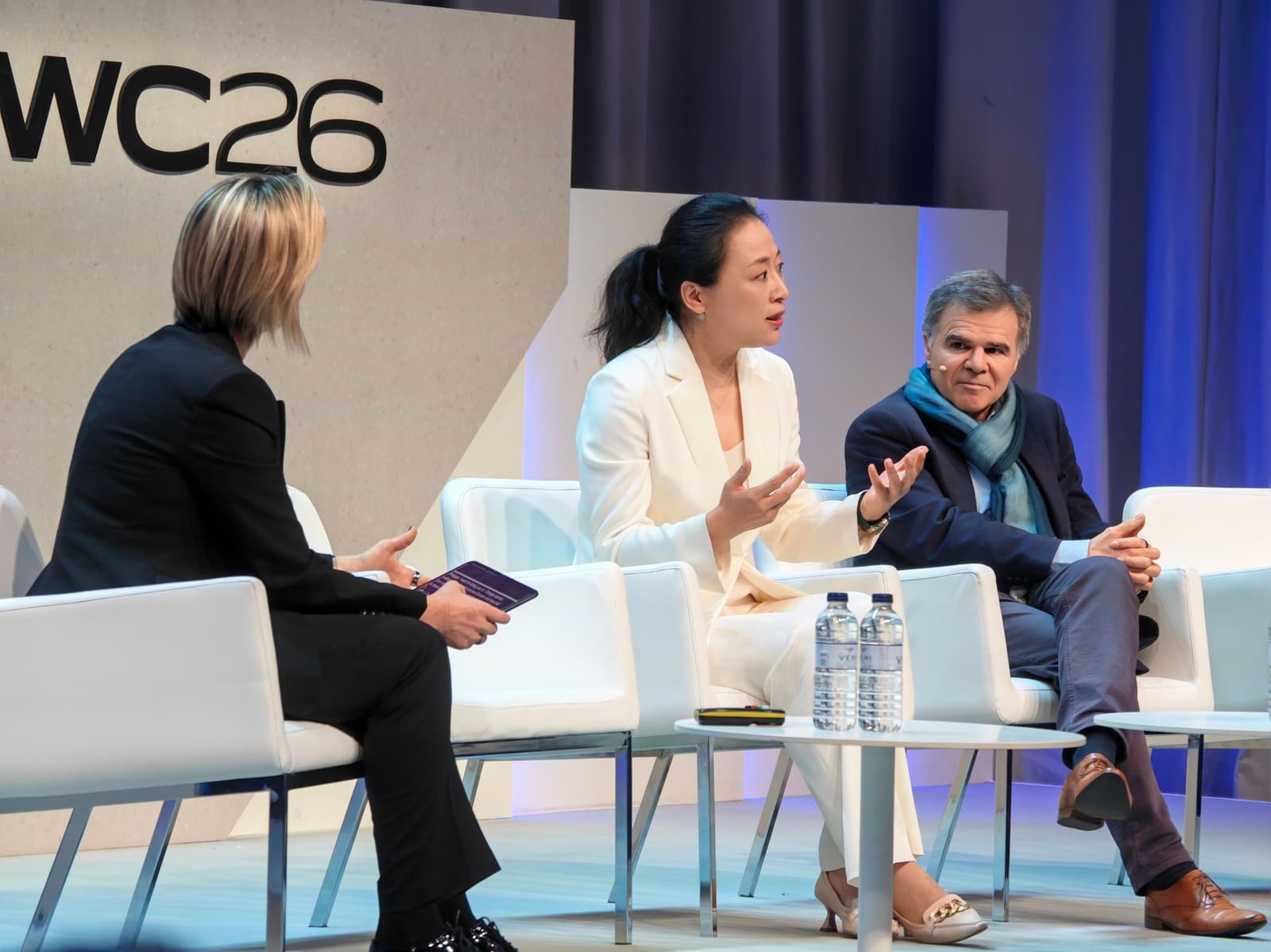
Image context: the cover uses a real Honor press photograph from MWC 2026. It is not a generated AI concept image, a robot illustration, or a diagram. The article is about corporate strategy, product surfaces, and ecosystem negotiation, so a real conference photograph is the right register.[7]
The phone is the first control surface
Honor's 2025 Alpha Plan made the intelligent phone the first step, not a side project. The company described a future device that embeds human-centric AI and showcased a mobile agent able to handle a restaurant reservation while accounting for calendar and traffic context, with Google Cloud and Qualcomm named in the technology demonstration.[1] South China Morning Post separately reported that CEO James Li Jian tied the plan to a US$10 billion five-year investment and to a shift from smartphone maker toward AI-device ecosystem company.[5]
Read narrowly, that is an ambitious vendor keynote. Read operationally, it gives Honor a different job from a model provider. The company has to turn a phone into the place where identity, permission, memory, screen state, app actions, and device-to-device continuity meet. If the user asks for a booking, a file transfer, a summary, a photo edit, or a home-device action, the phone is where the request is grounded. The large model is only one component; the endpoint decides what context can be used, which app or service can be touched, and where the user must confirm.
This is why the word "agent" matters more than the word "chat." A chat assistant can answer from a window. A mobile agent has to act through the operating system and the app graph. It needs semantic understanding, visual recognition, accounts, consent, fallback behavior, and a way to stop before a risky action. Honor's stated lane is to make those pieces native to the device rather than leaving them as disconnected app features.
YOYO is becoming the product interface
The clearest product bridge is YOYO. In China, Honor's MagicOS 9.0 launch on 2024-10-23 said YOYO was upgraded from assistant to agent and described capabilities around semantic understanding, computer vision, user behavior learning, scene awareness, decision-making, and in-app or cross-app operation.[3] The coffee-ordering example from the Chinese launch page is mundane by design: it implies that the agent should interpret a short request, choose a familiar third-party service, execute steps, and ask for settlement confirmation.[3]
The Magic8 Series launch on 2025-10-15 pushed the same idea further. Honor positioned the line as its first "Self-Evolving AI Smartphone," said the newer YOYO Agent could automatically execute across more than 3,000 scenarios, and introduced a dedicated AI Button for quick assistant access.[2] It also described YOYO Memories as a private knowledge base that analyzes personal data such as photos, chat records, and documents, while MagicOS 10 supports cross-platform continuity across Android, HarmonyOS, iOS, and Windows.[2]
Those claims should not be treated as proof that the experience is already seamless. They are company claims, and scenario counts can hide wide variation in reliability. But they reveal the intended architecture. Honor wants the assistant to sit close enough to personal data and system services to be useful, while still being packaged as a consumer phone feature rather than an enterprise workflow product. That is a hard balance: too much privacy isolation makes the agent weak; too much access makes the phone feel unsafe.
The ecosystem pitch is a governance pitch
By MWC 2026, Honor's language had moved from the individual phone toward a partner interface. On 2026-03-02, the company outlined the HONOR AI Connect Platform and said it projected integration with more than 20,000 AI services by the end of 2026.[4] The same announcement framed AI Connect as a way to open Honor's core AI capabilities to ecosystem partners and create a cross-brand device setting, with partner categories extending beyond phones into education, smart home, audio products, pets, and toys.[4]
This is the strategic hinge. A phone agent becomes much more valuable if it can route actions to a large service and device ecosystem. It also becomes much harder to govern. Who owns the user relationship when YOYO calls a partner service? Which party logs the action? What happens when an assistant moves from recommending a smart-home action to actually triggering one? Which services receive priority when multiple partners can satisfy the same intent?
For developers and partners, Honor's open-ecosystem pitch is attractive only if the interface is stable enough to build against. For users, it is attractive only if the assistant can act without becoming unpredictable. For regulators and carriers, it raises the familiar platform question in a new form: the mobile OS is no longer only arranging apps on a screen; it may be selecting and executing actions on behalf of the user.
The model race is upstream of the endpoint race
Honor has model work, including earlier MagicOS on-device model claims, but its current differentiation is less about publishing a single flagship model and more about integrating models into a device operating loop. That loop has at least five layers.
The first layer is local context: photos, documents, messages, screen state, location, calendar, device posture, and user habits. The second is intent interpretation: turning a short request into a sequence of substeps. The third is app and service execution: moving through first-party and third-party surfaces. The fourth is confirmation and accountability: deciding when the user needs to approve payment, deletion, sharing, or a physical-world action. The fifth is ecosystem reach: moving the same intent across phone, PC, car, wearable, home, and partner services.
The AI-China implication is that handset makers can compete without becoming pure model labs. Xiaomi, Huawei, Vivo, Oppo, Honor, and others can use device distribution, OS hooks, app relationships, and local privacy controls as their moat. In that market, the best answer may not be the model with the most impressive standalone benchmark. It may be the phone that can safely complete routine tasks across the mess of real apps and services.
Where the strategy can fail
The first failure mode is brittle execution. A mobile agent that works in a keynote but fails on localized app flows, changed buttons, login states, payment checks, or ambiguous user preferences will be treated as a novelty. Cross-app operation depends on constantly shifting interfaces unless the ecosystem exposes reliable action APIs.
The second failure mode is trust. YOYO Memories and private knowledge features can make the assistant genuinely useful, but they also move the product into sensitive personal territory. Honor will need clear deletion controls, transparent permission boundaries, and predictable handoffs between on-device and cloud processing. Without that, "personal agent" becomes a reason to withhold data rather than share it.
The third failure mode is partner economics. If AI Connect becomes a neutral routing layer, partners may want access. If it becomes a tollgate, ranking layer, or opaque recommendation channel, partners will worry about dependency. TechRadar's account of the Alpha Plan noted the breadth of the company's open-ecosystem ambition and its reliance on partners such as Qualcomm and Google, but also captured the vagueness that still surrounds the industry-wide collaboration pitch.[6]
What to watch next
The first thing to watch is whether Honor converts scenario counts into observable reliability. Claims about thousands of executable scenarios matter only if users can repeatedly complete common tasks without babysitting the agent. Coffee, travel, screenshots, receipts, file transfer, photo editing, and meeting follow-up are better tests than abstract demos.
The second is whether AI Connect produces a developer-facing contract. A credible partner platform should eventually show clear service categories, permissions, ranking rules, auditing, failure handling, and commercial terms. If those remain hidden, AI Connect will be more slogan than ecosystem.
The third is whether Honor's phone strategy travels outside China. Domestic Chinese app integration can move quickly because phone vendors, super-app ecosystems, payment rails, and service providers are accustomed to deep mobile workflows. International markets have different privacy expectations, Google service dependencies, carrier relationships, and app-platform constraints. The same agent promise may need a different operating model abroad.
The narrow conclusion is this: Honor's Alpha Plan is best understood as an endpoint strategy. The company is trying to make the phone into the place where a personal agent can perceive, decide, ask permission, and act across a device ecosystem. If it works, the AI phone will not be defined by a chatbot shortcut. It will be defined by whether the operating system can safely turn intent into action.
Sources
- HONOR, "HONOR Unveils New Corporate Strategy to Transition to an AI Device Ecosystem Company" (March 2, 2025; Alpha Plan, three-step roadmap, GUI-based mobile agent demonstration, MWC booth details).
- HONOR, "HONOR Launches AI-Flagship HONOR Magic8 Series in China" (October 15, 2025; YOYO Agent, 3,000 scenarios, AI Button, YOYO Memories, MagicOS 10 continuity claims).
- HONOR China, "荣耀MagicOS 9.0正式发布,开启手机自动驾驶新时代" (October 23, 2024; MagicOS 9.0, YOYO Agent upgrade, cross-app action examples, Chinese source).
- HONOR, "HONOR Calls for Open Collaboration Under New AI Ecosystem Vision, While New Opportunities are Coming to AI Devices" (March 2, 2026; HONOR AI Connect Platform and 20,000-service projection).
- South China Morning Post, "MWC 2025: Honor unveils US$10 billion investment to drive AI upgrade in smartphones" (March 3, 2025; investment plan and ecosystem-company framing).
- TechRadar, "Honor rebrands as an 'AI device ecosystem company' and commits to developing a 'super intelligent' smartphone" (March 2, 2025; independent account of the Alpha Plan, partner references, and open-ecosystem framing).
- HONOR image asset, real MWC 2026 ConnectAI panel photograph used as this article's cover image.