As of 2026-05-20 UTC, the strongest AI-China signal in healthcare is no longer that Chinese labs and companies can announce medical large models. The sharper shift is that hospitals, health IT vendors, and regulators are turning those models into local deployment problems. The question is moving from "which model scores better?" to "where does the model sit in the hospital, who validates it, what workflow can it touch, and how does responsibility move when a recommendation reaches a clinician?"
DeepSeek-R1 made that shift visible because it spread through hospital pilots as an installable open model rather than only as a remote chat product. A 2025 medRxiv survey described 261 mainland Chinese hospitals reporting local DeepSeek-R1 deployment between 2025-01-01 and 2025-03-08.[1] Nature Medicine later framed the same adoption wave as a regulatory problem and illustrated a real-world DeepSeek outpatient-department architecture at a Beijing hospital.[2] That is the important clue: once a model is near outpatient triage, records, diagnosis support, follow-up, or hospital information systems, the model is no longer the whole product. The deployment envelope is the product.
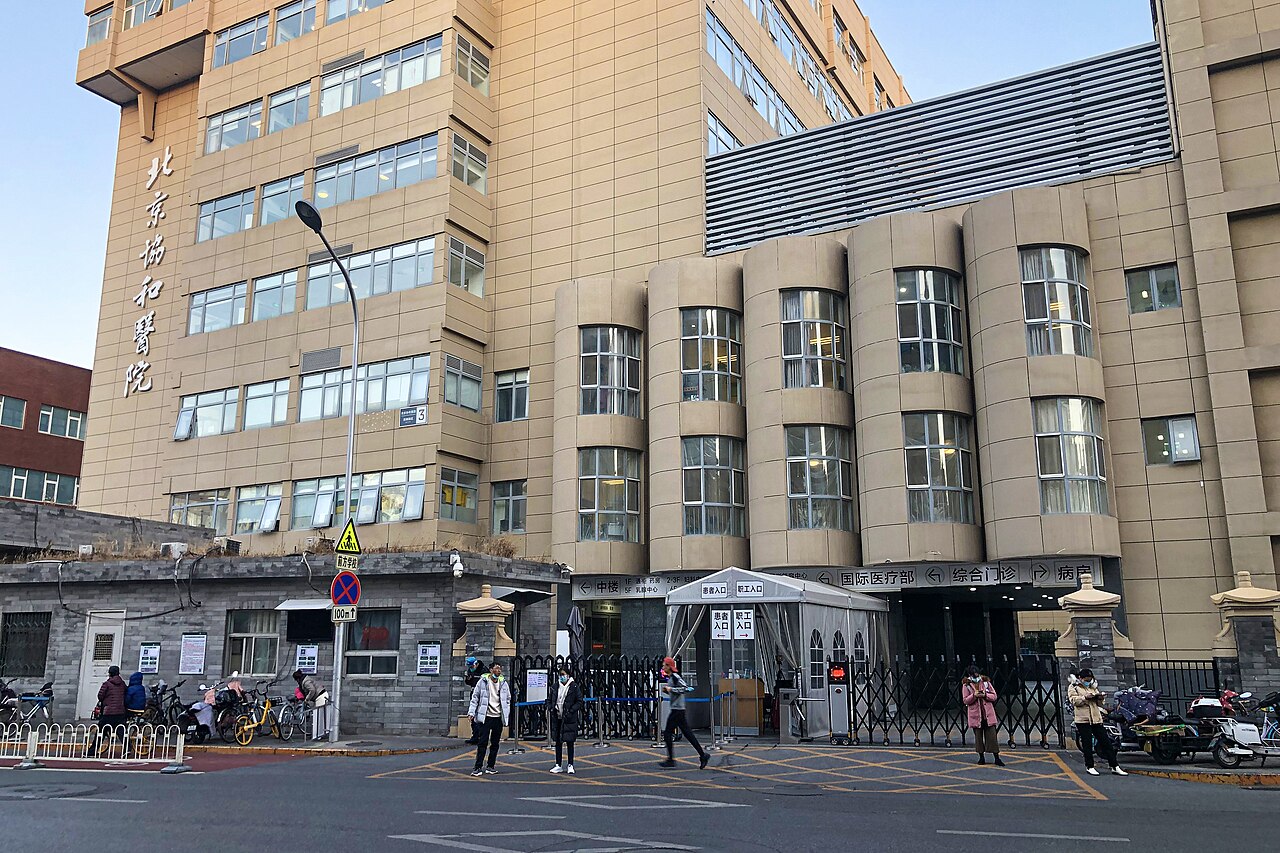
Image context: the cover uses a real Wikimedia Commons photograph of Peking Union Medical College Hospital's Xidan campus. It is not a generated medical concept image or a dashboard diagram. The article is about institutions and clinical deployment surfaces, so a real hospital photograph is the right visual register.[7]
The hospital system is becoming the model boundary
Fosun Health's February 2025 rollout shows why hospital deployment is different from ordinary enterprise AI adoption. Fosun said its Cloud HIS integrated DeepSeek R1 671B on 2025-02-12, launched an AI assistant across four Greater Bay Area hospitals, and tied the system directly to medical-record analysis and doctor-facing diagnostic recommendations.[3] That is not a consumer assistant sitting beside the hospital. It is an assistant inside the hospital information system.
The operational claims are also revealing. Fosun reported time-to-first-token under 0.8 seconds, concurrency rising from 20 users to 200, adoption in more than 80% of departments across the covered hospitals, and over 30,000 outbound follow-up calls reaching more than 20,000 patients for related AI follow-up work.[3] Those numbers should be read cautiously because they come from the vendor, but they point to the actual evaluation surface: latency at the doctor's desk, department coverage, concurrency under hospital load, and whether AI output can be attached to follow-up operations.
That is a different lane from benchmark marketing. A hospital does not adopt "reasoning" in the abstract. It adopts a bundle of local compute, data access, HIS permissions, prompt templates, retrieval, logging, clinician review, and escalation boundaries. A model that is impressive in a web demo can still fail if it cannot return fast enough during clinic flow, respect local medical-record structure, distinguish advice from orders, or leave an audit trail that a hospital risk office can inspect.
Specialist models are narrowing the use case
PUMCH-GENESIS points in the opposite direction from generic deployment: narrower disease domain, deeper institutional grounding. The Chinese Academy of Sciences described it in February 2025 as China's first AI large language model dedicated to rare disease diagnosis, developed by Peking Union Medical College Hospital and the Institute of Automation under CAS.[4] The reported near-term use was not a public chatbot replacing doctors. It was preliminary diagnosis consultation, appointment booking, and planned integration into PUMCH's online multidisciplinary rare-disease clinic, with eventual reach into the national rare-disease collaborative network.[4]
That matters because rare diseases expose the weakness of broad but shallow medical assistants. The problem is fragmented case data, scarce training examples, delayed confirmation, genetic evidence, and specialist routing. CAS described the model as tailored to Chinese demographic characteristics and built around minimal initial data plus clinical expertise.[4] In other words, the value proposition is not "one model answers all medical questions." It is "one institution turns its rare-disease knowledge, patient pathway, and collaborative network into a narrower decision-support surface."
The distinction is important for AI-China tracking. The medical-LLM market will probably split between horizontal hospital assistants, specialist disease models, and administrative agents. DeepSeek-style local deployment is attractive because hospitals can adapt an open model inside their systems. PUMCH-GENESIS is attractive because the clinical domain itself is scarce and institution-specific. Those are different moats.
Validation is becoming infrastructure
Shanghai's January 2025 medical large-model testing center makes the third signal explicit: model release is not enough without a validation layer. Shanghai set up what it called China's first application testing and verification center for medical large models on 2025-01-03, led by Shanghai AI Laboratory, with 12 leading healthcare institutions as first validation units.[5] The center's scope includes qualification verification, model review, safety assessment, medical-scenario evaluation, product ethics review, and application tracking.[5]
That list is the quiet architecture of medical AI deployment. It treats the model as one component inside a lifecycle: before deployment, during scenario-specific testing, and after application tracking begins. The center's stated target areas include disease prediction, diagnostic assistance, personalized treatment, drug discovery, public-health services, medical education, and service management.[5] Those are not interchangeable tasks. Each has a different tolerance for error, different data rights, and different human-in-the-loop expectations.
The practical implication is that Chinese medical AI may not be governed only through model-provider licenses or hospital procurement. It may increasingly be governed through city-level or sector-level validation bodies that decide whether a model is ready for a scenario. That would favor vendors that can document datasets, prompts, failure modes, update cadence, and post-deployment monitoring. It would punish vendors that can only show a leaderboard score and a polished demo.
Policy is widening the deployment mandate
The deployment pressure is not only coming from vendors. In November 2025, China's National Health Commission and four other authorities called for broader AI application across the health sector, with a 2030 goal for intelligent diagnosis and treatment assistance to be basically universal in primary-level medical institutions, including community and village clinics.[6] The same policy direction says hospitals at or above second grade should widely adopt AI technologies such as medical-imaging diagnostic support and clinical decision support.[6]
That creates a two-sided push. On one side, hospitals and vendors are racing to integrate models into HIS, outpatient support, rare-disease routing, and follow-up. On the other, national policy is telling the health system that AI is expected to become part of basic service delivery. The resulting bottleneck is not model availability. It is operational governance.
The riskiest version of the story is easy to imagine: hospitals deploy a capable open model quickly, departments discover useful shortcuts, and clinical staff begin trusting model output without a clear line between suggestion, draft, and decision. The better version is harder but more durable: models sit behind validated workflows, clinicians remain accountable for decisions, logs are inspectable, and specialist tasks are narrowed enough that performance can be measured in the actual clinical pathway.
What to watch next
The first watch item is whether DeepSeek-style local deployment becomes a normal hospital IT pattern or stays concentrated in better-resourced institutions. If smaller hospitals and county-level systems adopt open medical assistants without equivalent validation support, the regulatory burden will move from model companies to local health administrators.
The second watch item is specialist routing. PUMCH-GENESIS suggests that rare-disease models may work best when tied to institutional networks and multidisciplinary clinics rather than released as generic medical chat. If more top hospitals build disease-specific assistants, China's medical-LLM market could become a map of clinical centers of excellence instead of one national general model race.
The third watch item is evaluation procurement. Shanghai's testing center is a sign that hospitals may increasingly ask for scenario validation, ethics review, safety assessment, and tracking before deployment.[5] If those checks become procurement defaults, the winners will be teams that can prove workflow reliability, not only teams that can ship larger models.
The narrow conclusion is this: China's hospital AI race is becoming a deployment-governance race. Models still matter, but the decisive surface is now closer to the clinic: local HIS integration, validated scenarios, specialist pathways, latency, logs, and the human boundary around every recommendation.
Sources
- Tianyi Shen et al., "Large-scale Local Deployment of DeepSeek-R1 in Pilot Hospitals in China: A Nationwide Cross-sectional Survey," medRxiv preprint (2025; survey of reported local hospital deployments between January and March 2025).
- Tianyi Shen et al., "Rapid deployment of large language model DeepSeek in Chinese hospitals demands a regulatory response," Nature Medicine 31 (2025), DOI page and article metadata.
- Fosun, "Fosun Health Cloud HIS Launches DeepSeek AI Assistant, Ushering in a New Era of Medical Services" (2025; DeepSeek R1 671B integration, latency, concurrency, department adoption, and follow-up figures).
- Chinese Academy of Sciences, "China Launches Its First AI Model for Rare Disease Diagnosis" (2025; PUMCH-GENESIS development, trial use, and rare-disease network plans).
- Shanghai Municipal People's Government, "China sets up first medical large model application testing center in Shanghai" (2025; validation units, safety assessment, ethics review, and application-tracking scope).
- The State Council of the People's Republic of China, "Chinese authorities call for broader AI application in health sector" (2025; 2030 goals for primary care, clinical decision support, imaging support, triage, and follow-up).
- Wikimedia Commons, "File:Peking Union Medical College Hospital, Xidan (20211202163223).jpg" (source page for the real hospital photograph used as this article's cover image).