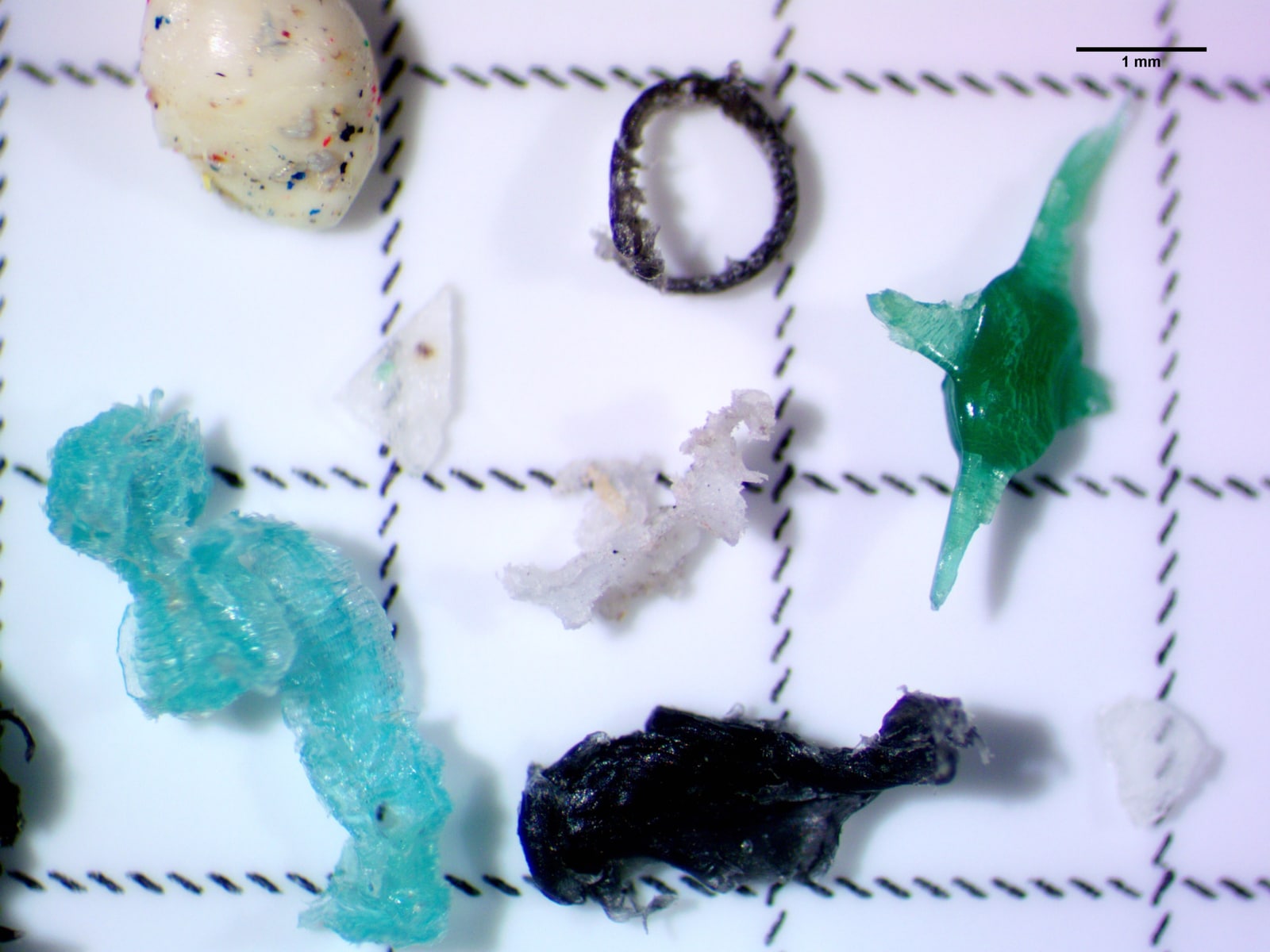
Under a microscope, the fragments look stubbornly unlike one another: a translucent green shard, a curled dark strand, a pale piece with specks trapped inside. The US Geological Survey photograph below preserves those differences at millimetre scale.[5] Naming the material inside each piece is a different task from describing its appearance.
Mixtures complicate identification: their infrared signatures combine different plastics' features, with relative peak heights changing as proportions shift. On September 23, 2025, the Chinese Academy of Sciences' Hefei Institutes of Physical Science announced a neural classifier addressing that problem.[1]
It offers a useful case study in applying AI to an instrument's output, with a clear distinction between reading a sample and measuring pollution.
A mixture changes the reading
The team combined a two-branch convolutional network with CBAM attention, joining the attention-processed outputs. It reports classification accuracy up to 98%, outperforming comparisons including random forests and support-vector machines.[1]
The announcement omits the sample count, training/test split, complete class definitions and independent field-validation results.[1] The percentage therefore offers a directional indication of improvement on the team's task. It does not establish that 98% of particles in an arbitrary water sample would be correctly identified.
The useful question is what the added attention does. In the original 2018 CBAM paper, Sanghyun Woo and colleagues describe a module that successively weights feature channels and positions within a feature map. Those weights multiply the intermediate representation, changing the relative emphasis of different features before processing continues. The module was developed and evaluated for computer-vision networks, including image classification and object detection.[2]
A feature channel here means a learned representation inside the network, not a separate physical sensor. The distinction helps explain the transfer: a component devised for visual recognition can be inserted into another convolutional system to adjust which features receive emphasis. CBAM supplies that mechanism; the Hefei experiment supplies the evidence for this particular spectroscopy application. The original vision results alone cannot validate chemical identification.[2]
Seeing what influenced the answer
The team also used Grad-CAM to inspect features important to its classifications.[1] This has a different job from attention. CBAM participates in producing a prediction; Grad-CAM helps a person examine a prediction already produced.
The Grad-CAM method uses gradients associated with a target class to locate influential regions in a convolutional representation. Its authors present it as a way to investigate model decisions and failure modes.[3] Applied to this use case, the practical question becomes whether the classifier relies on sensible spectral evidence. A compelling explanation would connect an influential region to the chemistry an analyst expects.
Such an inspection is a diagnostic step. A highlighted region does not, by itself, show that a model will handle a different instrument, an unfamiliar mixture or a new collection of samples. Those are separate tests. The distinction matters because an explanation can make an answer easier to examine without making that answer more accurate.
The sample arrives before the model
Consider the physical work that precedes classification. NOAA's 2015 laboratory manual describes procedures involving sieving, removal of organic matter, density separation and microscope examination. Its water-sample method targets material between approximately 0.3 and 5 millimetres. The appendix also documents infrared analysis of environmental samples.[4]
That manual is an example of a defined sampling and preparation workflow, not a description of the Hefei experiment. It makes the practical boundary visible: an analyst must first decide which material enters the measurement. An improved classifier cannot recover a particle that passed through a sieve or disappeared during preparation. Nor does assigning a mixture to a class automatically determine its concentration in the original water.
For a laboratory evaluating the Hefei approach, the next persuasive demonstration would follow identifiable samples through the whole process. It would report which mixtures were confused, test material collected independently of the training set, and retain uncertain cases for chemical review. Those are proposed checks, not results established by the announcement.
The attraction of this Chinese AI application is its precise place in the work. A spectrum reaches the analyst with overlapping evidence; a trained model may help sort it. Whether that improves an environmental survey depends on keeping the model's answer connected to the fragments, preparation steps and measurement that produced it.
Sources
- Hefei Institutes of Physical Science, “Progress in identifying mixed microplastics through infrared spectroscopy” (translated title), September 23, 2025 — Chinese first-hand announcement.
- Sanghyun Woo and colleagues, “CBAM: Convolutional Block Attention Module,” July 18, 2018, version 2; accepted at ECCV 2018 — channel and spatial attention and the original evaluation domains.
- Ramprasaath R. Selvaraju and colleagues, “Grad-CAM: Visual Explanations from Deep Networks via Gradient-based Localization,” December 3, 2019, version 4 — gradient-based localization and model inspection.
- Julie Masura and colleagues, “Laboratory Methods for the Analysis of Microplastics in the Marine Environment,” NOAA Technical Memorandum NOS-OR&R-48, July 2015 — water-sample methods and size range, printed pages 5–11; infrared analysis, page 30.
- US Geological Survey, “Microscope image of microplastic fragments,” approximately 2019, public domain — catalogue record; original photograph in the USGS media archive.