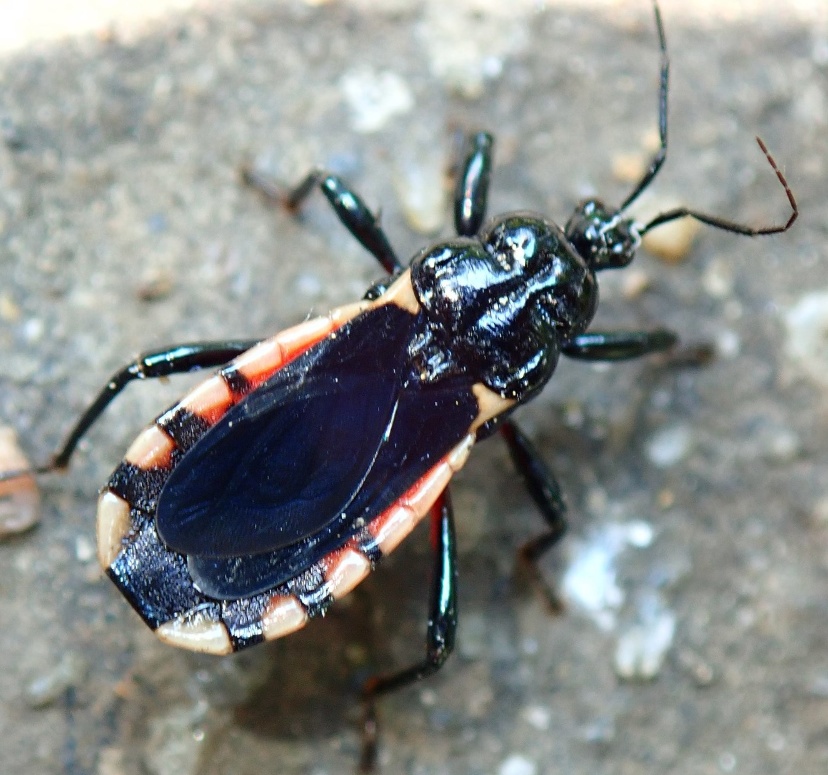
A blue-black assassin bug stands on mottled ground, its abdomen edged in red and pale patches. The photograph supplied with a Chinese research team's classification software is a useful reminder of what an identification system receives: an animal, a viewing angle, and a background, all together.[2]
A China Agricultural University-led study, published on February 11, 2026, asks what happens when the animal's species is unfamiliar to the model. Its answer changes the grading rule: a correct genus can become the useful result.[1]
Familiarity changes the score
The study combined standard specimen photographs, turntable views and ecological images. Its model comparison used ImageNet-initialized networks, cropped images, 100 training epochs and NVIDIA A100 GPUs with PyTorch 1.13.1. The known-species test comprised 729 images of 27 species; the unseen-species test contained 721 images of 28 species from known genera.[1]
The larger-data architecture comparison in Table 2 produced this reversal:[1]
| Model | Known species: correct species | Unseen species: correct genus |
|---|---|---|
| Swin-B | 100% | 89.88% |
| ConvNeXt-B | 99.86% | 92.79% |
These are top-choice accuracies on the authors' curated tests, not estimates for arbitrary field photographs. They also come from the architecture comparison, separate from experiments that held training collections near 1,600 images while changing the mixture of photographic views.[1]
The practical interpretation is straightforward: a ranking based only on familiar species would favor a different model. Choosing a classifier requires deciding which mistakes matter in the work it will actually do.
A useful answer can be less specific
This idea has a longer history in computer vision. In their CVPR 2018 paper, Kibok Lee and colleagues proposed placing an unfamiliar category beneath its nearest known parent in a classification hierarchy. Their aim was to provide more information than a bare judgment that an object was unknown. The distinction is between locating something within a known structure and identifying its exact class.[3]
Imagine a collection with labelled drawers for genera and compartments for species. An assistant encounters an insect whose species has no compartment. Pointing to an appropriate drawer could still save a taxonomist time. Inventing a compartment label would create a different kind of work: someone must first detect the false certainty, then undo it.
That analogy explains the value of genus placement without making a claim about discovering a species. “Unseen” describes the relationship between an example and a training collection. It does not establish that the organism is new to science. A useful evaluation must keep those two meanings separate.
The software still needs a stopping rule
The public repository makes a consequential detail inspectable. At revision cf2d9bf, the ordinary prediction path in inference.py selects the highest-probability label independently for subfamily, genus and species. It can also return confidence values and alternative labels. It does not use a confidence threshold to suppress the species answer when the animal is unfamiliar; its unknown fallback handles errors.[2]
That creates a gap between an evaluation result and a user-facing identification. A model can receive credit for a correct genus in a test while its software still prints a species label alongside it. The presence of a useful broad answer does not tell the reader which narrower answer to disregard.
A field tool would therefore need an additional, tested policy for deciding how specific to be. One possibility would be to send uncertain cases to a human with the photograph and ranked alternatives. That is a proposed workflow, not a capability established by the reported scores. Testing it would require measuring both the errors it prevents and the extra review it creates.
The repository also supplies sample photographs and a DenseNet checkpoint for a demonstration.[2] Running that example would check the software path; it would not reproduce the ConvNeXt-B result above. A working demo and a reproduced experiment answer different questions.
Keep the evidence attached to the name
iNaturalist's identification guidance offers a useful standard for this handoff. It asks contributors to identify an organism at the taxonomic level supported by the evidence. Its example allows a genus-level identification when two possible species cannot be distinguished. It also asks people to be able to explain their identifications and warns against using AI suggestions as the sole basis for them.[4]
Applied here, that would mean preserving the original image, the model's suggestions and the reason for accepting a particular rank. A reviewer could then see whether a broad identification reflects limited photographic evidence, an unfamiliar species, or an unresolved disagreement. Those situations can lead to the same displayed genus while requiring different follow-up work.
The next convincing demonstration would follow independently collected insects through that entire process and measure what reaches the expert correctly. The most valuable output might be a well-supported drawer assignment, with the species compartment deliberately left open.
Sources
- Xinkai Wang and colleagues, “Multi-angle, cross-domain fusion strategy enhances automated insect identification and hierarchical categorization: a case study on assassin bugs (Hemiptera: Reduviidae),” Cladistics, published February 11, 2026 — methods, test populations and Table 2.
- Study authors, assassinbugclassification, revision cf2d9bf8401e50fbcce4638ee5636240cf1f93db — README, inference.py and the sample photograph example/Ectrychotes andreae002.jpg; inspected November 5, 2026.
- Kibok Lee and colleagues, “Hierarchical Novelty Detection for Visual Object Recognition,” CVPR 2018, pages 1034–1042 — placing unfamiliar categories within a known hierarchy.
- iNaturalist, “What is an Identification?” — guidance on evidence, taxonomic specificity and the role of AI suggestions; accessed November 5, 2026.