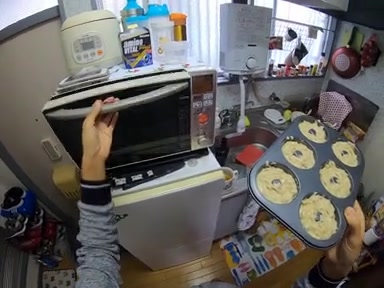
The pastry is in the oven. The oven has been operated, and the stopwatch has been set. What remains? In a published EgoPlan-Bench2 example, the annotated answer is to attach the stopwatch. Loading the tray and setting the timer are also offered as choices, but the recorded action history says those jobs are already done.[1] Knowing a plausible baking routine is insufficient. The model has to locate this particular baker within it.
Developed by researchers at the University of Hong Kong and Tencent PCG’s ARC Lab in Shenzhen, EgoPlan-Bench2 makes that small distinction measurable. This reading uses the journal version published on April 8, 2026; the experiment below belongs to that study.[2]
A useful action can arrive too late
The public baking record includes the task goal, four candidate actions, a correct-answer label, and timestamps for completed steps. Its evaluation prompt asks for the next action using both the earlier footage and the current observation in the final frame. The required response is a single option letter.[1]
That format makes a familiar failure easy to describe. An assistant can recommend something sensible for baking while still recommending the wrong thing for this moment. Repeating a completed step may sound helpful when read as an isolated sentence. Against the actual sequence, it reveals that the assistant has lost its place.
The earlier EgoPlan-Bench repository supplies an equally concrete example: storing cereal. The recorded history has the bag folded, the bag put inside its box, the box closed, and the cupboard opened. The labeled next action is putting the cereal box into the cupboard. Opening the cupboard again is one of the distractors.[3]
These examples give the reader a better diagnostic question than whether an answer sounds intelligent: what evidence makes this action due now? An object name establishes what is in the scene. An action history establishes what has changed. The recommendation must survive both checks.
There is also a limit to the answer label. It records the benchmark’s selected continuation. It cannot, on its own, establish that every other conceivable way of completing the task would be unreasonable. Four offered choices make scoring manageable; they also define the choice the model is being tested on.
Everyday footage becomes a demanding question
The source material matters. Ego4D is an international collection of first-person activity recordings. Its original public overview describes 923 participants across nine countries, using several kinds of head-mounted camera. The consortium deliberately sought varied daily activities and settings.[4] The recordings give the benchmark a base in activities people actually performed across different places.
A camera worn by someone doing a job gives a useful but partial view. Their hands can obscure an object. Looking elsewhere can move the workspace out of sight. The reader can recognize the setting in a still photograph while remaining unable to reconstruct everything that happened there. That is precisely why the article’s image cannot substitute for the benchmark’s temporal evidence.
EgoPlan-Bench2 contains 1,321 questions from 1,113 videos, spanning 24 scenarios. Its construction includes screening for questions answerable from text alone and checking candidate observation frames for clues that reveal the next action without requiring history.[2]
My reading of those choices is that the benchmark tries to make the sequence necessary. A test that gives away its answer through wording or an already-started gesture would reward a shortcut. Removing such shortcuts sharpens the intended question, although screening with particular models cannot prove that every future model will need the same evidence.
The same pictures can produce a different score
One experiment in the 2026 paper makes the evaluation machinery especially consequential. With Qwen2.5-VL-7B, accuracy rose from 24.52% with video input to 38.22% with the sampled frames supplied as separate images. The authors held the sampled visual information fixed and ensured inclusion of the first and last frames. These are next-action multiple-choice results on EgoPlan-Bench2; scoring matches the returned answer to the label.[2]
The difference is 13.70 percentage points, calculated from those reported values. It is evidence that presentation of the visual material can substantially affect this model’s result under these conditions. It does not establish that changing input format will produce the same improvement in every model, or that the higher score measures successful physical work.
For someone evaluating a visual assistant, I would preserve the exact delivered frames alongside the model version, prompt, answer choices, and output. That is a proposed audit practice: it would let a reviewer investigate whether a missed step was absent from the input, overlooked in the image, or misunderstood in the sequence. A score alone leaves those possibilities tangled together.
The final boundary is execution. Selecting a letter from recorded footage does not require opening the oven, attaching anything, or checking whether the attempted action succeeded. My implication for deployment is that a physical assistant needs additional evidence from acting, observing the consequence, and recovering from mistakes. EgoPlan-Bench2 offers an inspectable test of one crucial handoff: whether the next recommendation still makes sense after everything that has already happened.
Sources
- Lu Qiu and collaborators, official EgoPlan-Bench2 repository — baking sample, action-history fields, evaluation prompt, and scoring interface; accessed October 14, 2026.
- Lu Qiu et al., “EgoPlan-Bench2: A Benchmark for Multimodal Large Language Model Planning in Real-World Scenarios,” International Journal of Computer Vision, April 8, 2026 — affiliations, dataset construction, Sections 4.1 and 4.5.1, and Table 3.
- Yi Chen and collaborators, official EgoPlan-Bench repository — validation example for storing cereal, including completed actions and distractor choices; accessed October 14, 2026.
- Ego4D consortium, official project overview — original collection, participants, geographic scope, camera equipment, and daily-activity coverage; accessed October 14, 2026.
- EgoPlan-Bench2 authors, official project page — public “Hobbies – baking” example and provenance of the photographic still; accessed October 14, 2026.