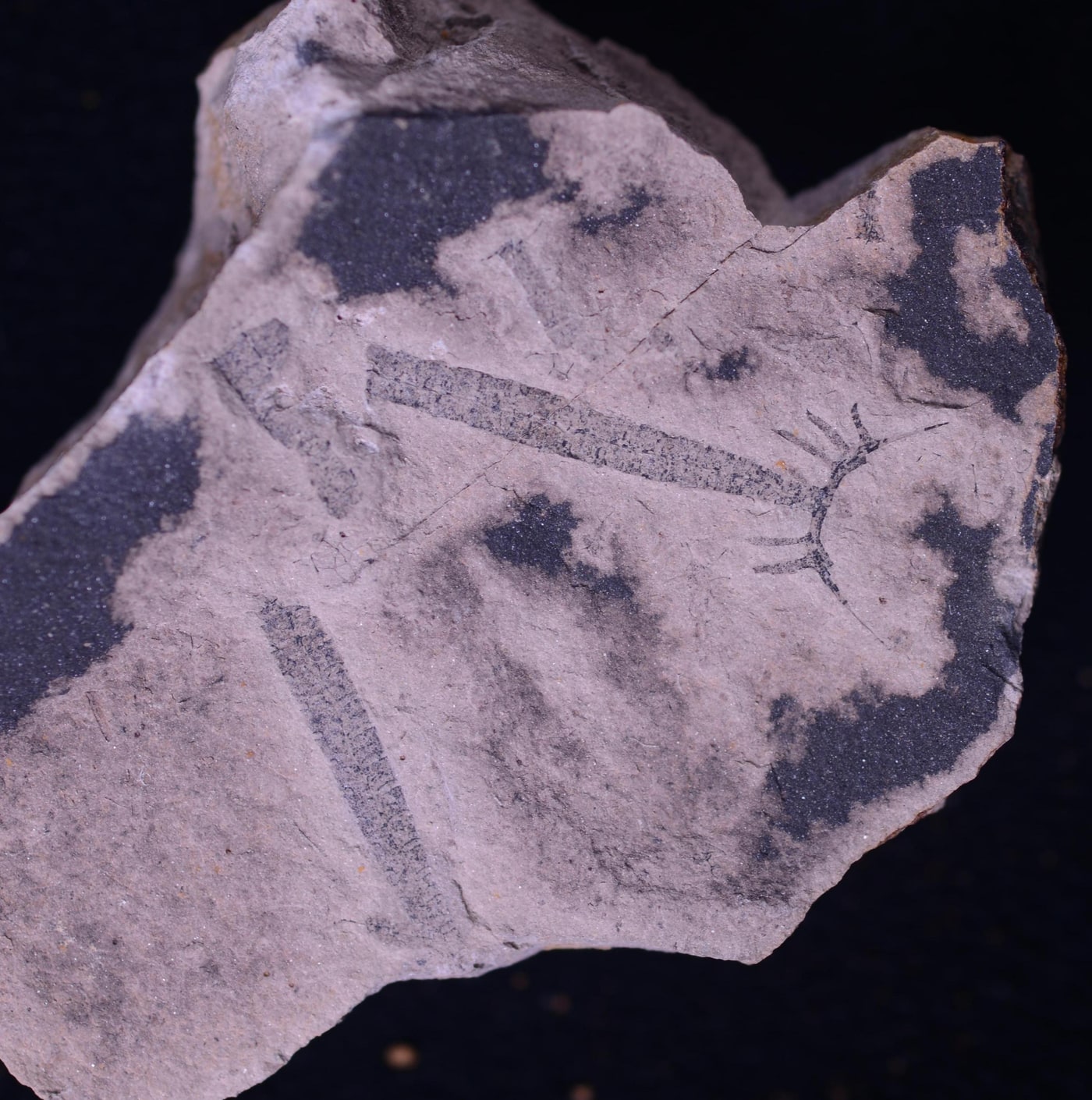
On a small slab from Hubei, two dark fossils lie among cracks and irregular patches. One ends in a delicate spray of spines. The photograph belongs to a public Chinese research collection, and its filename carries a specimen number and a species name: Appendispinograptus venustus, NIGP 136750.[1] Before a computer can learn from this stone, someone has to establish what it contains.
That work sits at the center of a collaboration between Hong-He Xu at the Nanjing Institute of Geology and Palaeontology and Zhi-Bin Niu at Tianjin University. In December 2023, the institute reported an AI system trained to recognize graptolite fossils, with software deployed in its fossil database and applications developed for mobile devices.[2] Looking back at the project reveals how a specialist collection can become a practical resource for machine learning.
Why the name matters
Graptolites often resemble pencil marks on stone. Their branching structures housed colonies of tiny animals in connected tubes. Many planktonic forms evolved rapidly and spread widely, leaving recognizable successions that geologists use to correlate rocks of similar age. Some graptolite-defined intervals span only a few hundred thousand years.[3]
A species identification can therefore help place a rock in a sequence. The Nanjing institute's announcement connects that task to shale-gas exploration: particular graptolite species help distinguish relevant layers within the rock.[2] The useful output is a name that supports geological interpretation. Turning that name into an exploration decision still requires the surrounding geological evidence.
This gives the AI project a concrete purpose. If identification becomes easier to obtain, specialist knowledge can travel farther from the collection that preserves its reference specimens.
Making the drawer searchable
The team's June 2023 dataset paper describes 2,951 high-resolution photographs of 1,550 specimens representing 113 species or subspecies. The specimens had appeared in publications between 1958 and 2020. Camera and microscope photography brought them into a shared digital collection, accompanied by records of names, localities, geological horizons and original references.[4]
The spreadsheet preserves both tagged and revised species names. Its authors explain that some revisions still require further study or peer review.[4] That is a consequential detail for supervised learning: a label records an expert judgment with a history. Keeping the older name makes it possible to trace how that judgment changed.
The public deposit also pairs whole-specimen photographs with closer views. For NIGP 136750, readers can inspect both the slab beside a scale and the fossil detail shown here.[1] The two views invite different questions: where does the fossil sit in the rock, and which small features distinguish it? A useful digital collection preserves the ability to return to the object behind the label.
Preparing what the network sees
The subsequent iScience study used a larger image collection for classification. Its selected network, SE-ResNet50, began with ImageNet pretraining and was fine-tuned on graptolites. Annotators outlined fossil bodies, allowing the system to suppress surrounding visual clutter. The paper explicitly says that users should annotate those contours for more precise classification.[5]
That preparation is part of the recognition task. In the photograph above, cracks and dark patches share the same frame as the fossils. Deciding which pixels belong to the specimen supplies information before the classifier proposes a name.
The authors report 81% species accuracy on a 100-image gold-standard test drawn from 99 specimen pieces, covering 35 species. Their separate three-fold validation across 113 species averaged about 70.5%.[5]
The methods also describe selecting final model parameters through repeated checks on “test images,” leaving the independence of the final test unclear.[5] These are reported experimental scores. Performance on unfamiliar, unprepared field photographs still needs separate evidence.
Expertise that can travel
The institute's December announcement establishes an early deployment milestone; it supplies no measured reduction in fieldwork time or exploration costs.[2] A revealing follow-up would track the whole job: taking a photograph, marking the fossil, reviewing the proposed identification and resolving an uncertain case. Time saved at one step matters most when it survives the others.
My reading of this project is that its durable contribution lies in making expertise reusable. A collection becomes easier to examine, its identifications remain traceable, and a model can help extend access to them. The specimen drawer remains central to that achievement: it holds the physical evidence to which both the human name and the machine's answer must return.
Sources
- Hong-He Xu, “An image dataset of 1550 Ordovician to Silurian graptolite specimens for correlation and shale gas exploration,” Zenodo dataset (June 23, 2022 version) — original photographs and specimen spreadsheet; NIGP 136750.
- Nanjing Institute of Geology and Palaeontology, “Progress in intelligent identification of graptolite fossils” (Chinese original; December 28, 2023) — collaboration, geological application and reported software deployment.
- British Geological Survey, “Graptolites” — colony structure and the use of graptolites in geological correlation.
- Hong-He Xu and colleagues, “A multi-dimensional dataset of Ordovician to Silurian graptolite specimens for virtual examination, global correlation, and shale gas exploration,” Earth System Science Data 15 (June 1, 2023) — collection, photography and taxonomic metadata.
- Zhi-Bin Niu, Si-Yuan Jia and Hong-He Xu, “Automated graptolite identification at high taxonomic resolution using residual networks,” iScience 27, 108549 (online November 23, 2023; January 2024 issue) — model, image preparation, gold-standard test and limitations.