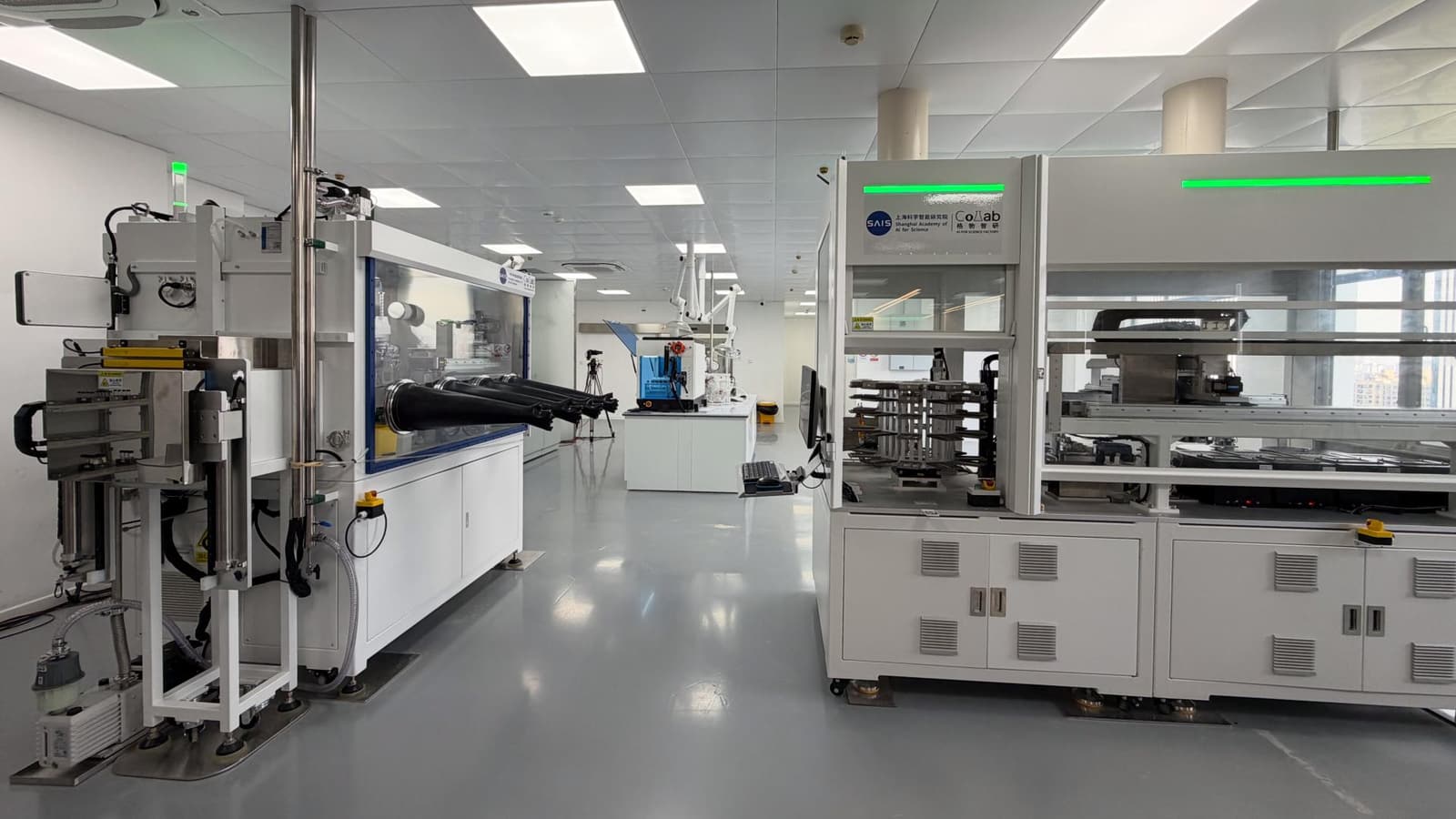
At first glance, Shanghai's new materials-science laboratory offers the cleanest possible AI spectacle: instruments working while the room is empty. During a five-day public run in July, cameras showed mechanical equipment taking samples through reaction, separation, purification, and testing without researchers entering the operating area. By the end, the team behind the facility reported that the system had run 135 research tasks.[3]
But an empty room is not the most consequential part of the demonstration. Laboratory automation can repeat a procedure after people have defined it. The harder achievement is to carry a scientific question from computation into physical chemistry, preserve what happened there, and use the result—including an unhelpful or failed result—to choose what happens next.
That is the useful way to read Golab, the “materials-science intelligent R&D factory” led by the Shanghai Academy of AI for Science and operated by its incubated company, Shanghai GeWu Intelligent Research Technology. Its strongest China-AI signal is not that a robot can hold a vial. It is that the group is trying to make the handoff between a model and a laboratory into a reusable, inspectable system. If that return path works, failure becomes training material. If it does not, “self-evolving” is only a label attached to automation.
The empty room is the least interesting part
Golab's first-phase self-driving laboratory began operating in Shanghai's Caohejing Hi-Tech Park in June 2026. The project was formally presented on July 7, when its organizers began a five-day “100-problem marathon.” The original plan paired roughly 100 computational, or “dry,” tasks with five selected physical, or “wet,” experiments spanning catalysts, polymers, electrolytes, and drug screening.[1][3]
The follow-up account published by Shanghai Observer said the run finished at 9 p.m. on July 11 after processing 135 tasks against a revised plan of 102. It reported a 99 percent overall completion rate, 100 percent correct tool invocation, and tool completion above 95 percent.[3] Those are useful operational claims, but they are supplied by the project team and the article does not provide a task-level result table, error taxonomy, comparison campaign, or independent replication. They show that a long orchestration run occurred; they do not yet establish how broadly the system discovers better molecules or materials.
That distinction matters because the word task can hide very different burdens. Generating a molecule, running a virtual screen, synthesizing a candidate, purifying the product, characterizing it, and deciding whether the evidence supports the original hypothesis are not interchangeable units. A count that mixes them is closer to a workload total than a scientific score.
The documentary cover photograph comes from the July 7 media demonstration and shows the actual facility rather than an imagined AI laboratory.[2] It captures what cameras can prove directly: equipment was installed and operating in a real place. The rest of the claim needs records.
Where software meets chemistry
Golab describes a three-part system. Its SuiRen materials models form the computational layer. A self-driving laboratory performs physical work. Between them, a platform called Huntianling Skills packages algorithms, data, computing resources, and experimental capabilities as composable units, allowing an agent to translate a simulated proposal into laboratory instructions and return measured data to the model.[1]
The interesting engineering boundary is in the middle. The official account says the team focused on automatically connecting synthesis to separation and purification—post-reaction work that often breaks an otherwise impressive laboratory demo.[1] A model can suggest a candidate in seconds; the physical world still produces precipitates, mixed phases, volatile precursors, clogged lines, ambiguous spectra, contaminated samples, and products that are difficult to isolate. Unless the system can handle or explicitly escalate those conditions, it has automated only the tidy part of science.
This is why Golab is better understood as an orchestration use case than as one giant scientific model. The decisive interfaces are mundane: sample identity, instrument state, units, timestamps, calibration, recipe version, environmental conditions, error messages, and the link between a measured artifact and the hypothesis that caused it to be made. Every lost field weakens the return trip.
The same point appears in established self-driving-lab research. These systems combine machine learning, automated equipment, and repeated experimental selection; their value comes from the closed loop, not any component in isolation.[4] Golab's contribution will therefore be clearest where it shows that the physical result—not merely a “success” flag—changes the next proposed experiment.
A failed experiment has to survive the return trip
The project's official description says negative and failed results are retained, structured, and sent back to correct the model.[1] That is exactly the right ambition. Scientific archives are biased toward successful endpoints, while the rejected conditions and unproductive routes that could constrain a search are often poorly recorded. A continuously operating laboratory could create unusually consistent negative data because the same system knows what it attempted, how it attempted it, what the instruments observed, and why the run was judged unsuccessful.
Yet a failed result is not automatically a useful lesson. The system has to distinguish at least three possibilities. The scientific hypothesis may be wrong. The planned procedure may be chemically plausible but badly specified. Or the machinery may have failed to execute a sound plan. Feeding all three back under one label would teach the model a blur.
That is where recovery matters more than bravado. A 2026 assessment framework for autonomous laboratory robotics argues that credible systems should report per-step error rates, variation within and between runs, failure modes and recovery outcomes, and complete data and protocol provenance. It also treats safety, human override, energy use, and material consumption as part of the system boundary.[5] Applied to Golab, the crucial question is not simply whether the agent called the right tool. It is whether a reader can reconstruct what happened after the tool accepted the call.
Consider purification. If a target compound is predicted correctly but lost during separation, the model should not learn that the molecular idea failed. If an instrument drifts out of calibration, a suspicious measurement should trigger a control or re-run rather than steer the search. If a reaction produces an unexpected phase, the raw characterization data and the interpretation both need to remain available, because a later method may read that evidence differently. “Self-evolution” begins with those distinctions.
The scoreboard should compare campaigns, not slogans
Self-driving laboratories need a reference strategy. A recent review of benchmarking work defines acceleration factor as the reduction in experiments required to reach a target performance, and enhancement factor as the improvement achieved after the same experimental budget. Across the surveyed literature, acceleration varied widely and depended on the search space, noise, and chosen baseline; the reported median was six, not a universal constant that can be transferred to a new laboratory.[4]
Golab's next public report would be much more informative if it used that kind of campaign comparison. For a bounded materials problem, the team could give the autonomous system and experienced researchers the same starting data, target property, reagent set, safety constraints, instrument time, and maximum number of wet experiments. The result should show not only the best candidate, but also the path: failed attempts, elapsed instrument time, human interventions, recovery events, material consumption, and the point at which improvement flattened.
The 135-task run is not such a benchmark. It was broad, public, and valuable as an integration test, but breadth makes the denominator hard to interpret. The reported tool metrics describe whether work moved through the system; they do not say how much better the final scientific result was than random search, a fixed design of experiments, or a skilled human-led campaign.[3][4]
Nor should one number cover every domain. A catalyst search, an electrolyte optimization, and a drug-screening workflow have different measurements, hazards, validation depths, and consequences for a false positive. Cross-domain reuse is most credible at the infrastructure layer—identity, scheduling, provenance, instrument control, and recovery—while scientific success must remain specific to the task.
“Unmanned” moves human judgment; it does not erase it
The history of autonomous materials synthesis supplies a useful boundary. In a prominent A-Lab study, an integrated system used computation, literature-derived recipes, machine learning, active learning, robotics, and X-ray diffraction to pursue inorganic materials. After 17 days and 353 experiments, the updated paper reports 36 realized compounds from 57 targets. Human researchers later performed manual refinement to validate the 36 successes; four additional cases remained inconclusive from diffraction alone. The unsuccessful runs exposed slow reaction kinetics, precursor volatility, amorphization, and computational error—different failure classes requiring different remedies.[6]
That is not evidence against autonomous laboratories. It is evidence for a more precise definition of autonomy. Machines can execute, observe, and adapt within a bounded experimental world while people choose objectives, set safety rules, supply and maintain equipment, adjudicate ambiguous characterization, and decide whether a result constitutes discovery. The human role moves from repetitive handling toward system design and scientific judgment.
Golab's organizers make a similar claim: the platform is intended to let researchers concentrate on what question to ask and how to interpret it, rather than on assembling every piece of laboratory infrastructure.[3] The promise is more convincing in that form than in the language of a one-person research company. Shared automation could widen access to expensive instruments and standardize routine work. It does not make expertise optional.
What would make the loop real
The next evidence should be smaller and deeper than another marathon. Publish a handful of complete experimental traces with machine-readable recipes, instrument logs, raw characterization, model versions, rejected branches, recovery decisions, and the human interventions that occurred outside the camera frame. Define completion separately for dry computation, physical execution, purification, measurement, and scientific validation. Then let another laboratory reproduce one campaign.
The proposed second phase—nearly 3,000 square metres and planned for operation in Qingpu in early 2027—will test whether Golab's interfaces survive more instruments, domains, users, and simultaneous work.[1] Scale will amplify whatever the system records well, but it will also amplify mislabeled failures and silent equipment errors.
That is why the failed experiment is the revealing unit. Success can flatter a model and a machine at the same time. Failure forces the system to show whether it knows what happened, whether it can recover, and whether the physical world genuinely changed its next decision. If Golab can preserve that chain, Shanghai has built more than an empty laboratory. It has built a memory for experimental work.
Sources
- Shanghai Municipal Commission of Economy and Informatization / Shanghai Academy of AI for Science, “Golab materials-science intelligent R&D factory lands in Shanghai” (July 10, 2026; first-hand Chinese account of the dry–wet loop, system components, purification handoff, marathon design, and expansion plan).
- CGTN, “China's first fully unmanned AI-driven R&D lab opens in Shanghai” (July 8, 2026; launch timeline and source of the documentary cover photograph).
- Shanghai Observer, “Why this livestream drew attention” (July 13, 2026; reported completion and tool metrics from the five-day run, plus the original dry- and wet-task design).
- Adedire D. Adesiji et al., “Benchmarking Self-Driving Labs,” Digital Discovery 5 (2026), 14–27 (acceleration and enhancement factors, reference campaigns, and cross-study limits).
- Ali A. I. Ali et al., “The ADePT framework for assessing autonomous laboratory robotics,” Communications Chemistry 9 (2026) (error, recovery, provenance, safety, and sustainability reporting requirements).
- Nathan J. Szymanski et al., “An autonomous laboratory for the accelerated synthesis of inorganic materials,” Nature 624 (2023), updated January 2026 (closed-loop A-Lab results, manual validation, and distinct failure modes).