As of 2026-06-25T03:33:19Z UTC, the useful read on GLM-5.2 is not simply that Z.ai has released another high-scoring Chinese model. The sharper signal is that the open-model race is moving toward a harder question: can an open-weight model stay useful when an agent has to hold a whole repository, plan across many steps, call tools repeatedly, and keep the failure surface inspectable by the team running it? Z.ai's public materials frame GLM-5.2 around a 1M-token context, long-horizon work, coding-agent capability, and deployment through common inference frameworks.[1][2]
That makes this a benchmark note with a boundary. Z.ai's repository reports strong GLM-5.2 results on coding benchmarks, including 81.0 vs. 62.0 for GLM-5.2 over GLM-5.1 on Terminal-Bench 2.1 and 62.1 vs. 58.4 on SWE-bench Pro.[2] Those numbers matter, but the repository page does not expose enough harness detail to treat them as fully portable engineering truth. The right posture is directional: GLM-5.2 is claiming a meaningful step up in long-context coding agents, and the claim deserves attention because it is tied to open weights and local serving paths, not only a hosted chat surface.[2]
What Changed
The headline change is context as an operating surface. Z.ai says GLM-5.2 is its latest flagship model for long-horizon tasks and, for the first time in the GLM-5 line, delivers that capability on a solid 1M-token context.[2] The same source lists three practical upgrades: solid 1M context, stronger coding with flexible thinking effort, and an architecture change called IndexShare, described as reducing per-token FLOPs by 2.9x at 1M context while improving speculative decoding acceptance length by up to 20%.[2]
Those details are more important than the leaderboard claim. For agent builders, context length is not just "more prompt." It changes what can be loaded at once: dependency graphs, migration notes, test logs, source files, generated plans, previous failed attempts, and reviewer constraints. A 1M-token window does not guarantee good judgment, but it reduces the amount of retrieval choreography needed before a model can see the shape of a codebase. If the model can also be served locally or through familiar inference runtimes, the choice becomes operational rather than merely evaluative.[2]
The local-serving list is part of the signal. Z.ai's repository points to GLM-5.2 deployment support through SGLang, vLLM, Transformers, KTransformers, Unsloth, and Ascend-oriented inference frameworks.[2] That does not mean every team can casually self-host a 744B-A40B mixture-of-experts model. It does mean the release is positioned for infrastructure people who care about placement, latency, hardware path, and inspection. In China AI terms, GLM-5.2 is trying to make "open" mean runnable and integrable, not just downloadable.
The Comparison Set
The comparison set has shifted too. DeepSeek's V4 Preview, released on 2026-04-24, also puts 1M context at the center: DeepSeek describes V4 Preview as open-sourced, lists V4-Pro at 1.6T total / 49B active parameters, V4-Flash at 284B total / 13B active parameters, and says 1M context is now the default across official DeepSeek services.[3] Its pricing page adds the API contract: both V4-Flash and V4-Pro expose OpenAI-format and Anthropic-format base URLs, support tool calls, and list 1M context with a maximum output of 384K.[3]
Alibaba's Qwen3.7-Max pushes the closed frontier from the agent side. Alibaba says Qwen3.7-Max is built for writing and debugging code, office workflow automation, MCP integrations, multi-agent orchestration, and autonomous execution across hundreds or thousands of steps.[4] Its Qwen3.7 post gives unusually detailed evaluation boundaries for some tests, including Terminal-Bench 2.0 settings, SWE-Bench scaffolding, context windows, and hardware assumptions for kernel work.[4] That disclosure matters because it helps readers separate a real agent harness from a vague "coding benchmark" claim.
Baidu's ERNIE 5.1 is a different pressure point. Baidu says ERNIE 5.1 inherits ERNIE 5.0's pre-training foundation while compressing total parameters to about one-third, active parameters to about one-half, and pre-training cost to about 6% of comparable models, then ties the release to disaggregated asynchronous reinforcement-learning infrastructure for autonomous decision-making agents.[5] That puts cost efficiency beside agent training, not behind it.
Read together, these releases show the Chinese model race becoming less about a single score and more about four contracts: context length, agent scaffolding, serving surface, and migration friction. GLM-5.2's place in that field is specific. It is not trying to win by being the most closed proprietary model. It is testing whether an open-weight coding agent with a large context window can take workloads that would otherwise default to Qwen, DeepSeek, ERNIE, or Western closed models.[2][3][4][5]
Evaluation Boundaries
There are three boundaries worth keeping explicit.
First, GLM-5.2's published coding benchmark deltas should be treated as vendor-reported and directional unless a fuller setup is consulted. The repository gives benchmark names and scores, but not enough end-to-end detail on prompts, tools, timeout rules, sample counts, environment constraints, or model-serving settings to make the numbers fully reproducible from the article alone.[2] That does not make the claim useless. It means the safe inference is "Z.ai is positioning GLM-5.2 as a major long-context coding-agent upgrade," not "every team will see the same ordering in production."
Second, context is not the same as agency. A 1M-token model can still fail if it ignores tests, overfits to stale instructions, loses track of project constraints, or writes broad patches without understanding ownership boundaries. The practical eval for GLM-5.2 should include repository-scale tasks with hidden tests, long-lived branches, dependency updates, and rollback requirements. A model that can read more files but cannot recover from its own mistakes is a bigger autocomplete engine, not a reliable agent.
Third, open weights move risk rather than removing it. They give teams inspection, self-hosting, fine-tuning, and procurement leverage. They also push serving, security, eval, and cost accounting onto the adopter. For a serious engineering organization, GLM-5.2's value will depend on whether the 1M context works inside the actual runtime budget, whether inference frameworks handle the model predictably, and whether code-agent traces are good enough for review and audit.[2]
What To Watch
The first watch item is independent reproduction. The benchmark story gets stronger if third-party evaluators rerun Terminal-Bench, SWE-bench Pro, and agentic coding tasks with published harnesses, fixed timeouts, clear tool permissions, and cost-per-success reporting. Raw pass rates are not enough; long-horizon agents need elapsed time, tool-call count, retry behavior, and failure taxonomy.
The second watch item is local-serving reality. Z.ai lists several inference paths, including vLLM and SGLang, plus Ascend-oriented support.[2] The operational question is whether teams can run GLM-5.2 with stable latency, acceptable memory pressure, predictable context caching, and debuggable failures. If the answer is no, the model remains mostly a hosted or specialist-lab option despite being open.
The third watch item is workflow fit. DeepSeek and Alibaba are already packaging OpenAI- and Anthropic-compatible surfaces, tool calls, MCP-oriented agent use, and long-context defaults into their platforms.[3][4] GLM-5.2's open-weight advantage matters most if it can drop into the same coding-agent tools and enterprise review loops without demanding a bespoke stack.
The narrow conclusion: GLM-5.2 is important because it turns the Chinese open-model story into an engineering test. The claim is no longer just "open models are catching up." It is "an open Chinese model can hold repository-scale context, run through common inference stacks, and compete on long-horizon coding-agent tasks." That is a stronger and more falsifiable claim. The next proof is not another launch post; it is whether outside teams can reproduce useful agent work at a cost and failure rate they would accept in production.[1][2]
Sources
- Z.ai, "GLM-5.2: Built for Long-Horizon Tasks" (official GLM-5.2 release post).
- Z.ai,
zai-org/GLM-5GitHub repository (GLM-5.2 introduction, 1M context, architecture notes, benchmark claims, model download links, and serving frameworks). - DeepSeek API Docs, "DeepSeek V4 Preview Release" and "Models & Pricing" (V4 model sizes, open weights, 1M context, tool calls, OpenAI/Anthropic API surfaces, pricing, and alias deprecation note).
- Alibaba Cloud Community, "Qwen3.7: The Agent Frontier" (May 21, 2026; agent positioning, long-horizon demo, benchmark boundaries, MCP/tool use, and API compatibility examples).
- Baidu ERNIE Blog, "ERNIE 5.1 Officially Released! Topping Multiple Leaderboards" (May 9, 2026; parameter compression, 6% pre-training-cost claim, asynchronous RL infrastructure, and agent benchmark framing).
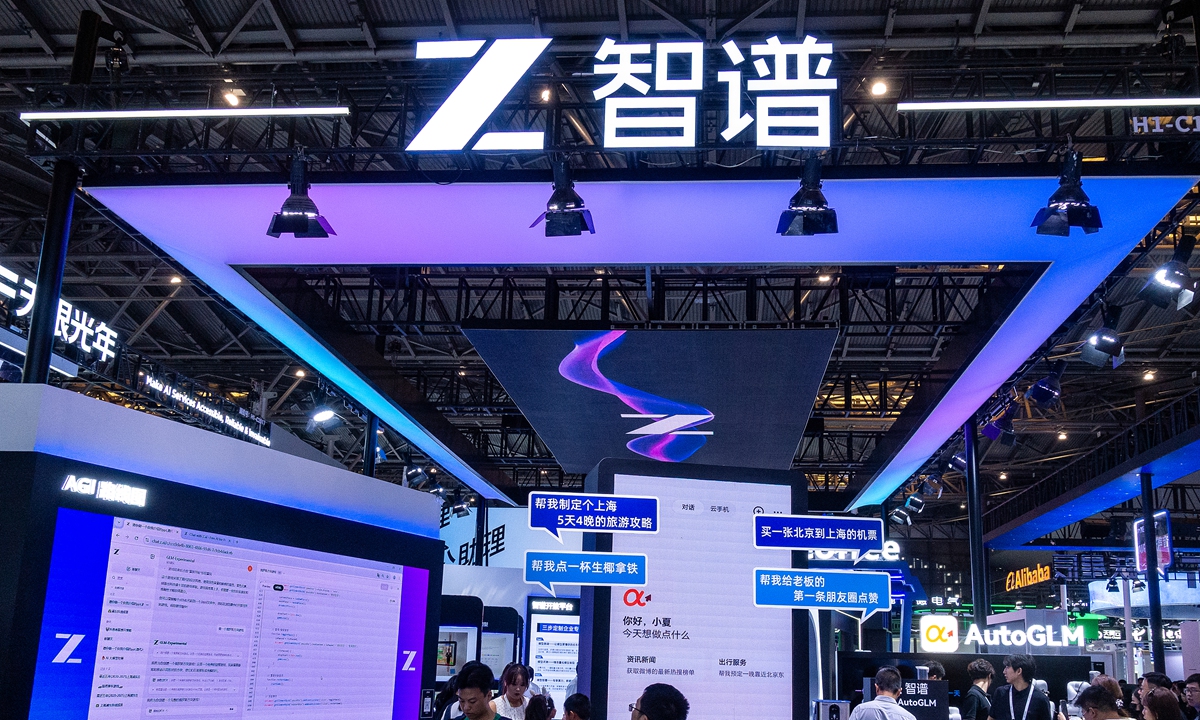
- Global Times, "Global media spotlight China's AI advances as new model shines with open-source release, Zhipu CEO shares backstage stories" (July 29, 2025; source page for the real Zhipu AI booth photograph used as cover image).