The revealing FireRedTTS3 command is not “clone this voice.” It is closer to a word processor’s find-and-replace: take an existing recording, ask for one phrase to be substituted, and receive a newly generated utterance that tries to retain the speaker identity and unedited words. The same release can insert or delete speech, change its pace, pitch, or volume, design a new voice from a written description, and imitate a voice from a reference clip.[1][2]
That combination changes the unit of work. A synthetic voice is no longer only an output generated from a script. A recorded utterance becomes a mutable object: its words and acoustic properties can be revised through one model interface.
Xiaohongshu’s FireRed team staged the release across two weeks. The current model card dates the Base release to August 5, 2026 and the Instruct model plus PyTorch code to August 13; the technical report appeared on arXiv on August 18.[1][2][3] Together, the package includes a continuous-speech tokenizer and an Apache 2.0 license. It is unusually inspectable for a new speech system—and a useful example of why “open model” and “finished voice product” are different claims.
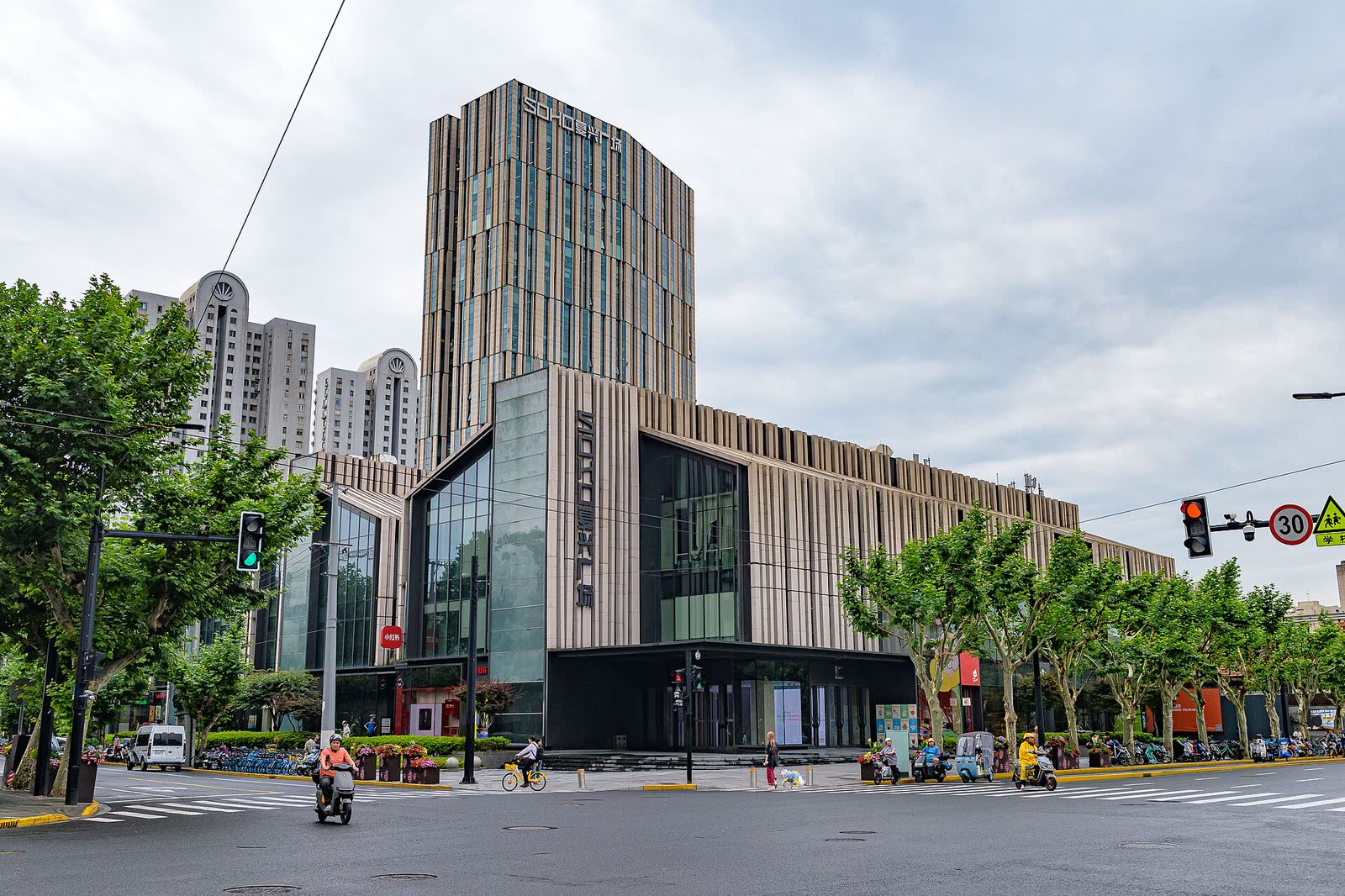
The cover photograph grounds that distinction. It shows SOHO Fuxing Plaza in Shanghai; Commons identifies the complex with Xiaohongshu, and the company’s own contact page gives an address in Plaza C—not a waveform, synthetic portrait, or model diagram.[7][9] FireRedTTS3 is a company research release with real code and weights. The remaining work sits in the product contract around those artifacts.
Two checkpoints, two different promises
The Base model handles zero-shot voice cloning. A user supplies reference audio, its transcript, new text, and a language setting; the system generates the new text in a voice conditioned by that example. The team lists 24 languages, including Chinese and Cantonese. Separately, it lists 21 Chinese dialect labels, including Sichuan, Shanghai, Minnan, Wenzhou, Wu, and others. For the best result, the README recommends that the reference prompt use the target language or dialect.[1][2]
The Instruct model widens the surface. It accepts four task families through one Python class: voice design without reference audio, semantic editing, acoustic editing, and reference-based voice cloning. A voice-design request such as “a gentle young woman, slightly slow, with a playful tone” first produces a textual voice plan, then renders speech from that plan. A semantic-edit request rewrites the transcript and predicts a mask for the region that should change. Acoustic editing operates on the recording’s speed, pitch, or volume.[1][2]
This split matters because the headline capabilities are not interchangeable. The multilingual and multi-dialect claim belongs to the Base checkpoint and its explicit language-tag path. The Instruct checkpoint is the broader editor, initialized from an instruction-tuned text model and trained for voice design and editing. An adopter should test the exact checkpoint and call path that will ship, rather than treating “FireRedTTS3” as one uniform capability score.
The release also publishes the pieces separately. Hugging Face hosts distinct Base, Instruct, and RedAE checkpoint files, while the repository supplies the inference code and text front end.[3] That is good release hygiene: the tokenizer is not hidden behind an API, and the model family can be inspected without reverse-engineering a managed service.
This is a product-surface pivot from FireRedTTS2
FireRedTTS2, released in 2025, emphasized a different set of jobs: long-form generation in seven languages, multi-speaker dialogue, streaming inference, and an author-reported first-packet latency as low as 140 milliseconds on an Nvidia L20. FireRedTTS3 expands the language and dialect surface and adds voice design plus semantic and acoustic editing through the Instruct checkpoint.[1][2][8]
That makes TTS3 a pivot, not evidence of an across-the-board successor. Neither its paper nor README publishes comparable streaming latency, real-time factor, VRAM use, long-form, or multi-speaker results.[1][2] A team evaluating live dialogue may still care about TTS2’s contract; a team building revision tools gets the more relevant new surface in TTS3.
The intermediate plan is the product idea
FireRedTTS3’s technical argument begins with a problem in continuous autoregressive speech generation. Continuous representations can retain fine acoustic detail that discrete speech tokens may lose, which is attractive when an edit should preserve a voice. But small prediction errors can accumulate as the model generates one latent patch after another, eventually shifting timbre or collapsing prosody.[1]
The team’s answer is RedAE, a continuous speech representation trained with guidance from a frozen audio encoder. That teacher has learned speech-understanding tasks such as recognition and speaker verification, so its features push RedAE toward linguistic meaning and speaker cues while the autoencoder still learns to reconstruct sound. The teacher is discarded after tokenizer training. Downstream, a Qwen3-initialized backbone predicts the sequence and a diffusion transformer generates the audio latents.[1]
The useful idea is not simply “more training.” It is that the model converts a vague instruction into a bounded plan before rendering the output. Voice design maps prose into 12 acoustic attributes. Semantic editing expands an instruction into a target transcript plus a text edit mask. That intermediate representation gives a developer something legible between intent and waveform: which words should exist, which transcript span is targeted, and which vocal properties the model believes the user requested.[1]
The training scale is substantial but entirely first-party. The paper reports 500,000 hours of mixed audio for RedAE, 2.6 million hours of Chinese and English speech for the first Base stage, 560,000 hours across the multilingual and dialect stage, and 330,000 hours of voice-design and editing data for Instruct. It also reports training RedAE for 550,000 steps on 32 H800 GPUs.[1] Those numbers establish a serious internal program. They do not disclose corpus composition at the speaker or rights level, nor do they let an outside team reproduce training from public data.
“Free-form” stops at different places in the API
The release page calls the system a free-form speech editor, and that is accurate for one important lane: semantic edits can use ordinary instructions for insertion, deletion, and substitution. The paper evaluates both template-based and open-ended semantic requests.[1][2][5]
Acoustic editing is narrower. The public API says free-form phrasing is not supported for that path. Speed requests must use a trained template and a value from 0.5 to 2.0 in 0.1 steps; pitch uses integer shifts from minus six to plus six, excluding zero; volume uses values from 0.3 to 2.0 in 0.1 steps.[2] “Make this a little warmer and less hurried” may fit voice design, but it is not the documented acoustic-edit command. A production interface would need to translate loose user language into those discrete controls and make the conversion visible enough to correct.
The multilingual front end has a similar seam. FireRedTTS3 can take explicit language tags, or optionally download FastText’s language-identification model. Its default local text normalizer supports Chinese and English. Other languages receive basic cleaning unless the operator enables an LLM-based normalizer through an external OpenAI-compatible endpoint; the example configuration points to DeepSeek.[2]
That is not a flaw in the speech model, but it is an operational boundary. Reading dates, currencies, abbreviations, and numbers aloud is part of a usable text-to-speech system. “Supports 24 languages” therefore does not mean “ships a complete offline text front end for 24 locales.” Teams handling private scripts or air-gapped media would need their own normalization path instead of quietly sending text to another model service.
The scorecard measures components, not the whole listening experience
The paper evaluates four task families, and it states several important setup choices. Seed-TTS-Eval covers English, Chinese, and a harder Chinese split; intelligibility is measured through Whisper or Paraformer transcripts, while WavLM estimates speaker similarity. MiniMax-MLS-Test extends the comparison across 24 languages. On those author-reported tests, FireRedTTS3-Base has the best average error rate and speaker-similarity average among the compared systems.[1]
The averages need context. On the multilingual test, FireRedTTS3 records a 3.75% average WER/CER, only 0.02 percentage points below MiniMax’s 3.77%, while its 84.8% average speaker-similarity score leads the listed systems. Its intelligibility result ranks first or second in 8 of 24 languages, not all 24. The authors also flag a 40.32% Cantonese character error rate and warn that Whisper’s limited Cantonese recognition may be measuring the evaluator as much as the synthesizer.[1] A single mean can conceal both a narrow overall margin and large language-by-language differences.
Voice design uses InstructTTSEval, a 6,000-case Chinese-and-English benchmark covering acoustic parameters, descriptive styles, and role-play.[4] Its official toolkit used a Gemini preview model as an automatic judge; because that version was unavailable, the FireRed team used Gemini 2.5 Pro to rescore every compared system.[1][4] That keeps the paper’s table internally consistent, but it is a modified protocol built on another model’s judgment. It does not replace listening tests with target users, especially for dialect authenticity, emotion, social register, or unwanted identity resemblance.
For editing, the paper uses Ant Group’s Ming-Freeform-Audio-Edit benchmark. The semantic tasks measure whether words were correctly inserted, deleted, or substituted, whether ASR still recovers the non-edited words, and whether speaker similarity survived; the acoustic tasks test rate, pitch, and volume.[1][5] FireRedTTS3 leads the reported averages against Ming-UniAudio-Edit, yet individual rows are mixed: for open-ended insertion, for example, FireRed has higher output word error and higher ASR error on non-edited words even as it improves speaker similarity and edit accuracy in English.[1] “Best editor” is too broad. The supported conclusion is that this release performs strongly on these two benchmark suites under the paper’s recognizers, speaker encoder, automatic judge, and comparison set.
The missing artifact is a provenance record
Voice editing creates an identity problem that ordinary text editing does not. A clean substitution can make a real person appear to have said words they never spoke. A cloned timbre can outlive the context or consent under which the reference clip was recorded.
The FireRed repository acknowledges misuse: its README says the voice-cloning function is intended solely for academic research, warns against illegal activity, and asks users to report fraud. That is disclaimer language rather than an additional restriction in the Apache 2.0 license; the code and checkpoints remain available under that license. The README and model card do not document a speaker-consent workflow, output watermark, identity blocklist, or signed provenance manifest.[2][3] A warning is an important norm; it is not an enforcement or verification layer.
There is already a technical vocabulary for part of the missing layer. The C2PA 2.4 specification supports provenance manifests for audio, distinguishes newly created from derived assets, defines c2pa.changedSpeed, c2pa.edited, and c2pa.dubbed actions, and adds a c2pa.ai-disclosure assertion with fields for model identity and human oversight.[6] C2PA cannot prove that a speaker consented, and metadata can be stripped. But an exporter could at least sign the model and checkpoint identity, the fact that an existing recording was opened, the temporal region targeted, the operation requested, and whether the output was generated or derived.
For a real dubbing, accessibility, podcast, or localization tool, the release contract should add three receipts. The first is authority: who owns the source voice and which transformations were approved. The second is lineage: which clip, transcript, model version, and edit mask produced the output. The third is quality: human listening across the actual language or dialect, plus checks that unedited spans, names, numbers, and emotional intent survived.
FireRedTTS3 is compelling because it makes one difficult abstraction concrete. Speech can now move through an instruction-guided revision loop. The system still decodes a newly generated full waveform; the transcript and edit mask describe what it intended to revise, not which audio samples were guaranteed untouched. The public release exposes enough of that loop to study and build on. Its next meaningful upgrade is not another average score. It is to make the edited voice carry its own history.
Sources
- Feiyu Shen et al., “FireRedTTS3: Unified Speech Generation and Editing with Semantically Enriched Speech Representations,” arXiv:2608.17492v1 (August 18, 2026; architecture, training, evaluation setup, and results).
- FireRed Team / Xiaohongshu,
FireRedTTS3official GitHub repository (August 13, 2026 release; code, APIs, text-front-end behavior, control ranges, disclaimer, and Apache 2.0 license). - FireRed Team,
FireRedTTS3official Hugging Face model repository (model-card timeline dating Base to August 5 and Instruct to August 13; Base, Instruct, and RedAE checkpoint package; model-card metadata). - Kexin Huang et al., “InstructTTSEval: Benchmarking Complex Natural-Language Instruction Following in Text-to-Speech Systems,” arXiv:2506.16381 (June 19, 2025; 6,000-case benchmark design and automatic-judge method).
- inclusionAI,
Ming-Freeform-Audio-Editofficial benchmark repository (semantic and acoustic edit tasks, open and template instruction sets, and evaluation scripts). - Coalition for Content Provenance and Authenticity, C2PA Technical Specification 2.4 (audio support, derived-asset action records, and the AI disclosure assertion).
- Wikimedia Commons, “SOHO Fuxing Plaza (20250610160414).jpg” (N509FZ’s June 10, 2025 photograph of the complex identified as Xiaohongshu’s headquarters, CC BY-SA 4.0).
- FireRed Team,
FireRedTTS2official GitHub repository (2025 predecessor’s seven-language, long-form, multi-speaker, streaming, and latency claims). - Xiaohongshu, official copyright-contact page (Chinese; company address at Fuxing SOHO Plaza C in Shanghai).