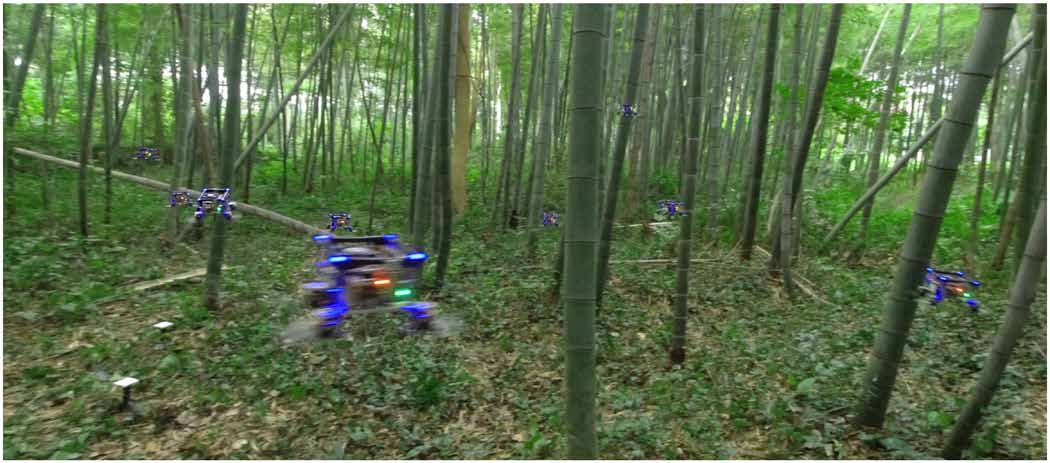
In a bamboo grove in Anji, Zhejiang, the space available to a flying robot changes from one trunk to the next. A tilted stem narrows a passage; a neighboring drone needs the same opening. Zhejiang University's May 2022 account describes small aerial robots finding their way through this setting using onboard vision and computing. The researchers built the hardware, algorithms and software as one system.[1]
The work offers a revealing way into the university's Field Autonomous System and Computing Lab, or FAST Lab. Its stated research interests bring together robot platforms, autonomous navigation and cooperation between robots.[2] Follow its aerial-swarm research from EGO-Swarm to the forest experiments and then Primitive-Swarm, and a consistent question emerges: how can a group act intelligently when every member has limited information and limited time to calculate?
A team begins with a capable individual
The EGO-Swarm preprint appeared in November 2020, ahead of its ICRA 2021 publication. Xin Zhou, Chao Xu, Fei Gao and their coauthors described a decentralized system: drones planned locally, without waiting for a single synchronized planning cycle. They shared trajectories over a network, while observations of other drones helped correct differences in their estimates of position.[3][5]
That distinction matters. Decentralization still involves communication. Each machine needs some account of where its neighbors intend to go, alongside its own view of nearby obstacles. Coordination becomes a continuing exchange between local decisions.
EGO-Swarm expressed collision risk as part of a trajectory-optimization problem. It also included a lightweight way to find alternative routes when local optimization became stuck.[3] In everyday terms, a drone needed both the ability to improve a proposed route and a way to reconsider the route itself. Merely making one calculation faster would leave the second problem intact.
This is the appeal of studying a laboratory through its systems. The research question survives changes in algorithms: what must each robot know, and what can it afford to work out before moving?
The forest makes timing visible
The May 4, 2022 Science Robotics paper put ten drones into a dense bamboo forest, with a goal beyond it. Its planner adjusted both the shape of a trajectory and the timing of movement. When several drones needed one narrow gap, changing their speeds could let them pass in sequence.[4]
A route through space is therefore only part of the answer. Two perfectly reasonable routes can still produce a collision if their users reach the crossing together. Timing gives the system another way to resolve the conflict without forcing an awkward detour.
A separate formation-flight test used less dense obstacles. The forest passage and formation demonstration therefore answered different questions. The authors also prioritized practical performance over rigorous completeness and optimality proofs: successful flights did not establish that the planner would always find a route whenever one existed.[4]
The university's accompanying Chinese report placed the work within a collaboration involving its College of Control Science and Engineering and Huzhou Institute. It presented rescue and surveying as possible applications.[1] Those ambitions explain the appeal of leaving controlled flight spaces, while remaining distinct from a record of routine rescue deployment.
The software reveals the experiment
FAST Lab also makes parts of this research inspectable. The EGO-Planner-v2 repository identifies itself as the codebase for the 2022 paper and provides a Swarm Playground tutorial.[6] That gives other researchers a route from watching the result to examining how a navigation problem is represented.
The earlier EGO-Swarm repository contains an especially useful disclosure. Its default simulator converts commands directly into reported drone motion to reduce computational load. A more realistic quadrotor dynamics model can be enabled separately. Its simulated sensing also has different CPU and GPU modes.[5]
These choices change what a successful run demonstrates. A planner can negotiate traffic in a simplified simulation without that run testing every detail of how a physical aircraft follows commands. The documentation makes the distinction visible, allowing a reader to assess the demonstration on its actual terms.
For a research group, that openness has value beyond distributing code. It exposes the assumptions another team would need to reproduce, replace or challenge. A convincing forest flight establishes capability; an inspectable simulator helps turn that capability into a research program.
A larger swarm changes the calculation
The 2025 Primitive-Swarm work moved more effort out of the flight itself. It prepared a library of feasible motions and collision-checking relationships in advance, letting each drone select among candidates during flight. The organizing idea was to reduce the computation repeated whenever the surroundings changed.[7]
Its largest demonstrations involved 1,000 simulated drones. That experiment used a cloud workstation with 80 virtual CPU cores and 384 GB of memory, simplified sensing to local point clouds, and exchanged trajectories through shared memory. The physical swarm experiment involved eight drones crossing in opposite directions. These are complementary tests of scale and real flight, with substantially different conditions.[7]
The public Primitive-Planner repository makes the preparatory step explicit: generate the motion library before running the planner. It also documents a tested Ubuntu 20.04 and ROS Noetic environment, and advises monitoring memory and CPU usage during simulation.[8] A lightweight planning calculation still sits inside a larger computing system.
What the lab's record makes possible
My reading of this sequence is that FAST Lab's distinctive contribution lies in connecting mathematical planning with the compromises of a flying machine. Its stated scope—platforms, navigation and cooperation—helps explain why the work keeps returning to the entire robot team.[2] Sensors, position estimates, communication and movement have to become one timely action.
The most useful next evidence would connect the existing demonstrations to longer, repeated missions: how often intervention is needed, what happens when sensing deteriorates, and whether useful work gets completed across varied sites. Those are questions for assessing progress beyond the published experiments, rather than claims that these studies already answer them.
The bamboo grove remains a good place to understand the ambition. An intelligent group must keep making room for its individual members, one passage at a time.
Sources
- Zhejiang University, “Aerial robots capable of independent decisions fly out of ZJU in groups” (May 5, 2022; Chinese original) — Anji field setting, research team, integrated development and proposed applications.
- FAST Lab, Zhejiang University, official laboratory homepage — research mission and areas; accessed October 20, 2026.
- Xin Zhou and colleagues, “EGO-Swarm: A Fully Autonomous and Decentralized Quadrotor Swarm System in Cluttered Environments” (preprint, November 9, 2020) — local planning, trajectory exchange and relative localization.
- Xin Zhou and colleagues, “Swarm of micro flying robots in the wild,” Science Robotics 7, eabm5954 (May 4, 2022), author-hosted paper — experiments, discussion and Movie 2 photographic still (page 6).
- ZJU-FAST-Lab, EGO-Swarm repository — ICRA 2021 publication record and README sections on simulated sensing and flight dynamics; accessed October 20, 2026.
- ZJU-FAST-Lab, EGO-Planner-v2 repository — Swarm Playground and tutorial; accessed October 20, 2026.
- Jialiang Hou and colleagues, “Primitive-Swarm: An Ultra-lightweight and Scalable Planner for Large-scale Aerial Swarms” (February 24, 2025 preprint, version 1) — planning method and Sections VIII-F/G on simulation and physical experiments.
- ZJU-FAST-Lab, Primitive-Planner repository — 2025 journal publication details, motion-library generation and documented runtime requirements; accessed October 20, 2026.