
As of 2026-07-07T14:10:20Z UTC, DEEP Robotics' Lynx M20S video is useful because it makes a Chinese embodied-AI argument in the most physical way possible: a robot crosses uneven ground, changes pace, absorbs slopes and steps, and keeps looking less like a consumer gadget than a worksite machine.[1] The tempting read is to treat the clip as a stunt reel. Wheels on legs look spectacular. A quadruped moving quickly over broken surfaces is easy to share. But the stronger AI-China signal is more operational: the company is trying to turn mobility into a deployable agent boundary.
That boundary matters because embodied AI is not just "a model in a body." A robot that enters a substation, tunnel, construction site, logistics yard, emergency zone, or patrol route has to join several contracts at once. It needs locomotion that can survive the floor. It needs sensors that can perceive the room. It needs payload capacity for cameras, gas sensors, lights, radios, or inspection modules. It needs environmental protection, charging routines, operator interfaces, support channels, and partners who can install the machine into a real workflow. The M20S video is short, but it belongs in that longer chain.[1][2][3][6]
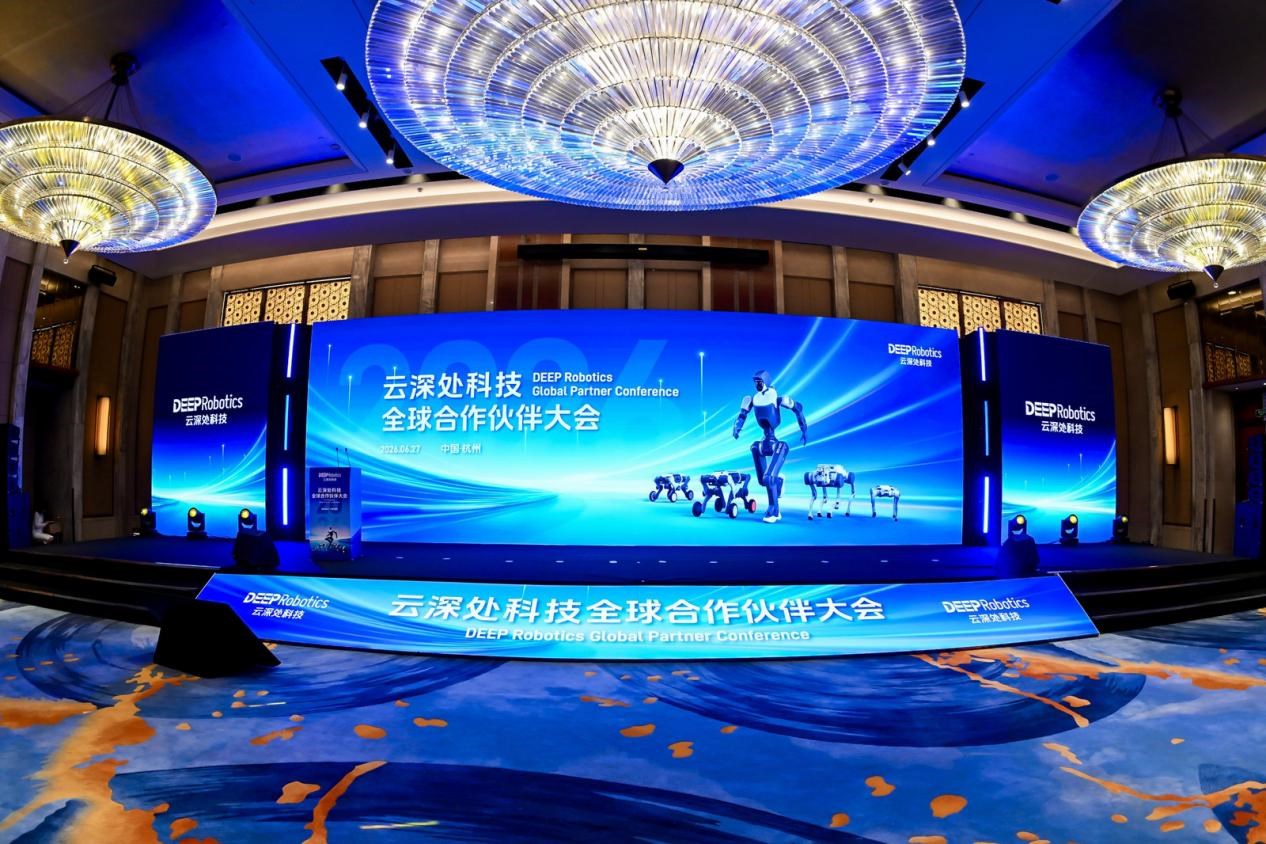
The cover photograph helps set that frame. It comes from DEEP Robotics' 2026 Global Partner Conference in Hangzhou, where the company presented an "1+X+N" strategy: one embodied intelligence base, multiple robot forms, and many industry scenarios.[6] That language can sound like conference architecture until it is placed beside the Lynx video. The clip shows the physical "X": a wheel-legged form that is neither a normal wheeled rover nor a pure walking quadruped. The written sources show the "N": inspection, rescue, security, logistics, energy, manufacturing, and public-service environments where mobility by itself is not enough.[2][3][6]
Around The First Terrain Runs, The Wheel-Leg Choice Explains The Product
The first thing to watch is not speed by itself. It is the compromise behind speed. A conventional wheeled robot is efficient on flat ground but can fail when the terrain becomes discontinuous. A conventional legged robot can step, crouch, and recover, but it spends more energy and usually moves more slowly over long, relatively open stretches. Lynx's wheel-leg format is an attempt to keep both options alive: roll when rolling is cheaper, then use the leg structure when the floor stops being simple.[1][2]
DEEP Robotics' M20 product page makes that compromise concrete. It lists a 15 kg payload, 2.5 hours and 12 km of loaded operation, 80 cm single-step capability, 25 cm continuous stair height, 45-degree slope handling, dual 96-line lidar, wide-angle cameras, and IP66 protection.[2] Those numbers are not decoration. They tell you what kind of robot this is trying to become. A worksite robot must carry useful equipment, move far enough to matter, survive dust and water, climb enough physical discontinuity to avoid constant rescue, and see broadly enough to avoid turning every route into a teleoperation chore.[2]
The video should therefore be read as a product argument, not a magic trick. When the machine crosses rough ground, the point is not that it can do something visually unusual once. The point is that DEEP Robotics wants customers to imagine routes where ordinary inspection equipment would stall: wet ground, debris, stairs, outdoor slopes, partially damaged surfaces, dark corners, and sites where a human visit is possible but expensive, slow, or risky.[1][3][5]
The Middle Of The Clip Is Really About Sensorized Work, Not Animal Imitation
Robot-dog videos often get trapped by animal comparison. Viewers ask whether the machine looks graceful, creepy, cute, or uncanny. That reaction is understandable, but it is a weak way to evaluate this device. The M20S matters only if the body makes sensing and work easier. The wheels, legs, lidar, cameras, lights, processors, and payload rails are more important than the silhouette.[1][2]
That is why the official launch language for the Lynx M20 emphasized industrial tasks and hazardous environments rather than companionship. DEEP Robotics described the platform as suitable for inspection, emergency rescue, logistics, scientific research, and complex-terrain operations, with autonomous navigation and work in low-light or dark settings tied to lidar and perception equipment.[3] The CES Innovation Awards page for Lynx M20 Pro makes the same point from an external event context: the product is framed around complex terrain, hazardous environments, self-developed joints, IP66 protection, speed, stairs, step height, slopes, and loaded range.[5]
The AI-China angle sits in that shift from body to operating loop. A large language model demo can succeed by answering a prompt. A robot agent has to close a loop in physical space: perceive the surface, plan the next motion, avoid obstacles, carry equipment, report useful data, and recover when the environment pushes back. The useful question is not whether Lynx looks impressive for thirty seconds. It is whether the system can make repeated routes boring enough for infrastructure work.[2][3][5]
The Best Annotation Is The Business Context Around The Video
The partner-conference source is important because it prevents the video from floating as a standalone hardware spectacle. DEEP Robotics told partners that future robotics competitiveness would depend on five integrated capabilities: hardware platforms, AI agents, scenario-specific solutions, supply chains, and service networks.[6] That is a vendor claim, but it is the right category of claim. Industrial robots do not scale by looking capable on YouTube. They scale when procurement, maintenance, training, support, spare parts, data flows, and local partners become legible enough for customers to trust.
The financing source points in the same direction. In December 2025, DEEP Robotics announced more than 500 million RMB in Series C financing, explicitly linking the round to core embodied-AI breakthroughs and industry deployment.[4] It also described deployments such as substation inspection under China Southern Power Grid, security patrol uses, and conservation observation in high-altitude Hoh Xil.[4] Some of those details need independent customer-side verification before they become decision-grade evidence, but they clarify the company's market thesis: robot dogs are being sold as field-labor infrastructure, not as lab curiosities.[4]
This is why Lynx's wheel-leg form is strategically more interesting than it first appears. A humanoid robot tries to inherit human spaces and tools. A wheeled rover tries to optimize known routes. A quadruped tries to preserve mobility across awkward terrain. Lynx sits between those categories. It suggests that China's embodied-AI market may not converge quickly on one perfect body. Instead, companies may keep matching forms to scenario economics: humanoids where human-shaped manipulation matters, quadrupeds where access and stability matter, wheel-legged platforms where route speed and obstacle handling both have value.[1][2][6]
What The Video Does Not Prove
The clip does not prove fleet reliability, autonomy quality, unit economics, or safety performance across real customer sites. It does not show how often a robot needs remote assistance, how quickly batteries swap in a full shift, how maintenance behaves after months of dust and impact, or how well perception works in rain, steam, reflective metal, smoke, or radio-poor underground settings. Those questions decide whether a deployment is a productivity tool or a supervised novelty.[2][3]
It also does not resolve the software boundary. DEEP Robotics' public strategy language points toward an embodied "brain" that combines perception, decision-making, and motion control across multiple product forms.[6] That is the right ambition, but the hard proof would be repeatable performance across standardized tasks: inspection route completion, anomaly detection, emergency-scene traversal, map update quality, operator intervention rate, and cost per useful mission. In embodied AI, model intelligence has to be measured through task completion and service reliability, not only through visual fluency.
Still, the video is worth embedding because it compresses the current China robotics story into one legible object. The Lynx M20S is not trying to win the imagination by pretending to be alive. It is trying to make a worksite navigable by machine. If DEEP Robotics can connect that body to sensors, route autonomy, partner delivery, and scenario-specific service packages, then the wheel-legged robot becomes more than a terrain demo. It becomes a practical test of whether embodied AI can leave the stage and keep working after the camera stops.[1][2][4][6]
Sources
- DEEP Robotics, "DEEP Robotics | Introducing Lynx M20S - The Next-Generation All-Terrain Champion," YouTube video.
- DEEP Robotics, "Lynx M20" official product page - payload, endurance, stair, step, slope, lidar, camera, protection, and navigation specifications.
- DEEP Robotics, "DEEP Robotics debuts LYNX M20, sets new standard for industry-grade quadruped robots" - official launch article covering extreme environments, inspection, rescue, logistics, sensors, and low-light operation.
- DEEP Robotics, "DEEP Robotics Completes Over 500 Million RMB Series C Financing to Accelerate Breakthroughs in Core Embodied AI Technologies and Industry Deployment" - financing, investors, and deployment examples.
- CES Innovation Awards, "Lynx M20 Pro" - external product-award page summarizing wheel-leg quadruped use in complex terrain and hazardous environments.
- Newsfile / China Newswire, "DEEP Robotics Hosts Global Partner Conference, Unveiling '1+X+N' Strategy to Accelerate Commercial Embodied AI Worldwide" - partner-conference report and source page for the photographic cover image.