As of 2026-06-10T16:03:44Z UTC, the useful AI-China signal in Alibaba Cloud's Confidential AI materials is not that "security matters" around large models. Everyone already says that. The sharper signal is that model security is being turned into a runtime boundary: encrypted model artifacts, remote attestation, KMS-held decryption keys, TEE-backed CPU and GPU execution, and cloud deployment steps that a platform team can actually follow.[1][2]
That matters because the Chinese model market is no longer short of capable models. It is short of boring trust surfaces. Enterprises can call Qwen, DeepSeek, GLM, Hunyuan, InternLM, and other models through many routes, but the hard deployment question is different: can sensitive prompts, customer data, fine-tuned weights, and proprietary model files move through cloud inference without giving the cloud operator, a compromised host, or an overly broad admin path a clean view into the assets? Confidential AI is Alibaba's answer to that question, and the answer is infrastructure-shaped rather than model-shaped.[1][3][4]
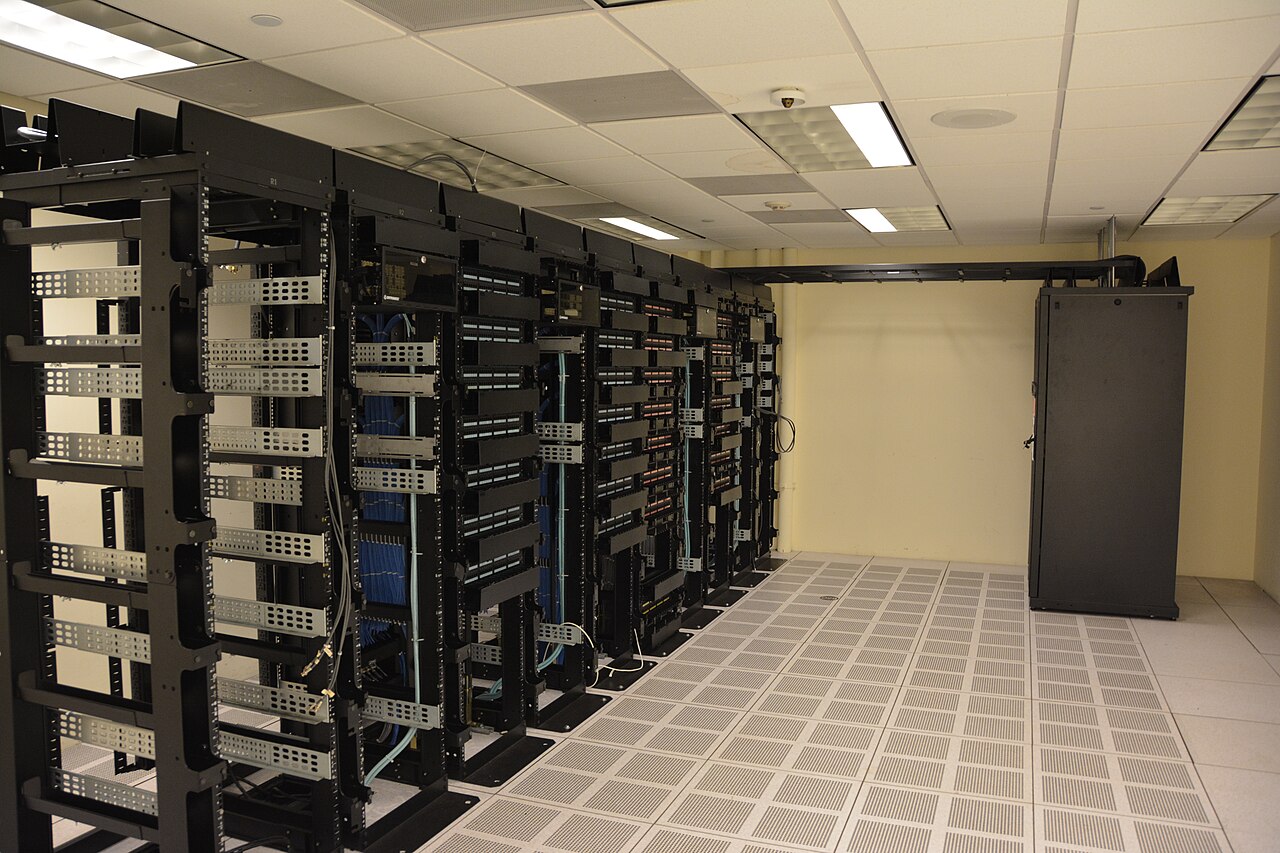
Image context: the cover is a real data-center photograph, not a slide, diagram, chart, screenshot, generated image, or symbolic AI illustration. It matches the article's focus because Confidential AI is a runtime-security story: the relevant action happens where model artifacts, key release, attestation, and CPU/GPU execution become operational infrastructure.[1][2][5]
The key is released only after the environment proves itself
Alibaba's secure-LLM-inference guide gives the clearest operating picture. It describes an Alibaba Cloud heterogeneous confidential computing instance, gn8v-tee, that extends a CPU TDX confidential computing setup by bringing the GPU into the TEE boundary, protecting both CPU-GPU data transfer and GPU-side computation.[1] The guide then couples that environment to KMS and a Trustee remote-attestation service running in ACK. The important sequence is simple: the model is encrypted first, uploaded as ciphertext, and decrypted only when the target inference environment passes verification.[1]
That sequence changes the security object. The model is no longer only a file stored in an access-controlled bucket. It becomes an artifact whose usable form depends on a chain of runtime evidence. Alibaba's guide says the remote-attestation service verifies the model deployment and inference environment, and only after the environment is judged trusted does it inject the model decryption key so the encrypted model can be mounted.[1] For a platform team, that is a much more concrete boundary than "do not expose the model."
The examples also make the stack less abstract. Alibaba lists prepared encrypted trial models including Qwen3-32B and Qwen2.5-3B-Instruct, shows object-storage placement in cn-beijing, and documents two model-encryption paths: Gocryptfs, described as AES256-GCM and compatible with the open-source Gocryptfs standard, and Sam, Alibaba Cloud's trusted AI model-encryption format for protecting model confidentiality and license integrity.[1] Those details matter because they show where implementation risk lives: model packaging, key handling, OSS locality, attestation policy, KMS setup, and inference mounting.
OpenAnolis turns the idea into deployable components
The open-source side points in the same direction. The OpenAnolis confidential-ai project frames itself as a way to run sensitive AI tasks in the cloud without exposing original data or model assets, using trusted hardware and remote attestation to protect user private data, training sets, and generative model assets while still using cloud compute.[2] Its current stable version is listed as v1.1.0, dated 2025-08-01, and the component table is revealing: Trustiflux for resource security management and remote attestation around confidential containers, Trustee for verifying TEE environments and distributing secrets, and TNG as a remote-attestation-based trusted gateway.[2]
That is the real field signal. The security story is not being left as one proprietary cloud checkbox. It is being decomposed into components that map to platform responsibilities. One component verifies the confidential environment. One component controls secrets. One gateway pattern can protect traffic without requiring every existing application to be rewritten. The Docker deployment path is positioned for end-to-end verification and development simulation on a single TDX instance; the RPM path is positioned for production-style deployment with package management and Alibaba Cloud Linux 3 requirements.[2]
This is also where the China-specific angle becomes sharper. China AI coverage often tracks model families, app launches, and price cuts. Confidential AI points to a quieter layer: the software and hardware contract that decides whether enterprises with sensitive data can move from pilots to cloud-hosted inference. The winners here are not necessarily the labs with the biggest benchmark claim. They are the cloud and OS stacks that can make keys, encrypted models, runtime proof, and accelerator access fit together.
Ant shows why financial AI cares about in-use protection
The Ant Group case study with Intel gives the enterprise reason. Ant built a confidential PaaS product matrix on Alibaba Cloud ECS g8i instances using 4th Gen Intel Xeon processors with Intel TDX, which Intel describes as a hardware-based TEE that helps secure customer data and Ant AI models while in use.[3] The same case study says Ant was exploring ways for customers to fine-tune LLMs with their own data, while needing to keep proprietary and customer data confidential during cloud fine-tuning and inference.[3]
That is exactly the adoption bottleneck. A bank, insurer, healthcare operator, or industrial company may accept cloud AI for generic tasks, but becomes much more cautious when the workflow includes customer records, proprietary prompts, fine-tuned weights, fraud logic, claims notes, or internal procedure documents. Encryption at rest and in transit are table stakes. The harder gap is data in use: the moment model inputs and weights have to be processed by CPUs, GPUs, kernels, runtimes, and operators' infrastructure.
The case study also makes a useful performance point without overclaiming. It says Ant used Intel AMX to accelerate matrix-oriented operations in training and inference, and describes migration from general VMs to confidential VMs running an Occlum-based secure operating system with TEE-specific access-control mechanisms.[3] The practical signal is not that confidentiality is free. It is that confidential AI must be sold as an engineering trade: enough isolation and attestability to unlock sensitive workloads, with enough acceleration and VM compatibility that teams will not reject it as a science project.
PAI makes security part of the enterprise AI platform
Alibaba's Apsara Conference PAI article ties the confidential layer to the broader platform strategy. In its enterprise-capability section, Alibaba says more enterprise customers are fine-tuning and using large models in the cloud, making model and data security more salient; it then says PAI provides data compliance and security protection across training, fine-tuning, and inference, and works with Alibaba Cloud base software and the Anolis community on a Confidential AI solution spanning hardware to software.[4]
Read beside the secure-inference guide, that line is not just marketing. PAI is the higher-level product surface, while the confidential-computing guide shows the lower-level mechanism: encrypted model preparation, OSS upload, Trustee remote attestation, KMS-backed key release, ACK deployment, and TEE-backed inference.[1][4] The same PAI article discusses BladeLLM and PAI-EAS inference-service upgrades, including claims of lower first-token latency, lower token-output latency, higher throughput, global region coverage, and large inference-cluster scale.[4] Those claims are about performance, but their placement near enterprise security is instructive: Alibaba wants model serving to be both fast enough and governable enough for production buyers.
The boundary is still important. Confidential AI does not prove model quality. It does not solve prompt injection. It does not decide whether a fine-tuning dataset is lawful, representative, or safe. It does not remove the need for access control, logging, incident response, output filtering, model evaluation, and vendor-risk review. What it can do is narrow a specific but critical exposure: the path by which model files, prompts, training data, and inference data become readable during computation.[1][2][3]
What to watch
The first watch item is GPU coverage. Alibaba's gn8v-tee guide is valuable because it explicitly brings GPU computation into the TEE story, not only CPU-side confidential VMs.[1] For large-model inference, that distinction is decisive. Confidential AI will matter more if teams can see which GPU classes, driver stacks, runtimes, and model-serving frameworks are supported with repeatable deployment examples.
The second watch item is attestation policy clarity. "Trusted" cannot remain a vague word. Buyers need to know which measurements are checked, who operates Trustee, how KMS policies are scoped, how keys rotate, and how a failed attestation blocks model release.[1][2] The more these controls become ordinary platform settings, the more confidential inference can move from special project to default option for sensitive workloads.
The third watch item is integration with PAI and model marketplaces. If Confidential AI remains a separate infrastructure recipe, it will appeal mainly to security-forward platform teams. If it becomes a selectable deployment lane inside PAI, Model Studio, or enterprise inference products, it could become a purchasing differentiator: same model route, stronger runtime boundary.
The narrow conclusion is that Alibaba's Confidential AI signal is not about a new model family. It is about where the trust boundary is moving. In China's AI stack, the model layer is crowded, the inference layer is competitive, and the enterprise layer is risk-sensitive. A cloud provider that can prove when a model should decrypt, where a prompt is processed, and which runtime is allowed to see sensitive data owns a quieter but durable surface of the AI deployment chain.[1][2][3][4][5]
Sources
- Alibaba Cloud Help Center, "基于异构机密计算实例构建安全大语言模型推理环境" (Confidential AI guide for secure LLM inference with
gn8v-tee, encrypted Qwen models, Trustee attestation, KMS-backed keys, ACK deployment, and TEE inference flow). - OpenAnolis,
confidential-aiREADME in Chinese (project scope,v1.1.0stable version, Trustiflux, Trustee, TNG components, Docker deployment, RPM deployment, TDX requirements, and Apache 2.0 license). - Intel, "Ant Group Develops Confidential Computing for SaaS" (customer story on Alibaba Cloud ECS
g8i, Intel TDX, Ant confidential PaaS/SaaS, financial AI scenarios, customer-data fine-tuning, and in-use protection). - Alibaba Cloud Developer Community, "云栖实录 | GenAI 时代 AI Infra 工程技术趋势与平台演进" (September 27, 2024 Apsara Conference writeup on PAI, enterprise security, Confidential AI, and PAI-EAS/BladeLLM).
- Wikimedia Commons, "Datacenter Server Racks" (real data-center rack photograph used as the replacement immersive cover image after QA rejected the slide-dominated conference image).