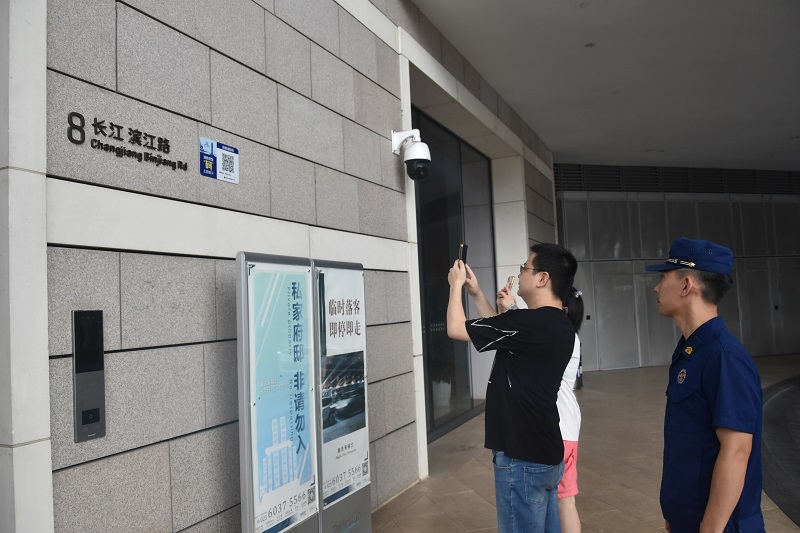
As of 2026-07-11T07:36:27Z UTC, the most useful thing about Chongqing's high-rise fire AI is how little of the working system resembles a chatbot. A roof-tank sensor reports low water pressure. A camera notices a blocked fire lane. A resident scans a building-specific QR code to report a sofa in a corridor. The platform turns each exception into a work order, sends it to a named property or public agency, and waits for someone to fix the physical problem.
That is the use case. The model is only one link in a chain that begins with old buildings and ends with accountable human response. Chongqing's deployment is interesting because it shows what applied urban AI looks like after the stage demo: identity records, sensors, computer vision, risk scoring, digital building models, dispatch rules, local fire stations, property managers, residents, and evidence that a hazard was actually closed.
From a code on every building to a routed response
The baseline was set in March 2023, when Chongqing announced a citywide digital supervision platform for high-rise fire safety. The plan called for a regulatory database, fire-safety internet-of-things devices, and a unique fire code for each high-rise building. It was tied to a very physical backlog: aging or damaged fire equipment, obstructed access lanes, unsafe electrical work, and electric bicycles entering buildings to charge.[1]
By July 2025, Yuzhong District offered a view of the system in use. In just 23 square kilometres, the district had 2,005 high-rise buildings, all under its one-building-one-code scheme. The code exposed building height and floor count, the responsible property manager, maintenance provider, inspection reports, and patrol history. Across the district, officials said they had connected 254,900 sensing resources, including water-pressure monitors, smoke sensors, cameras watching fire-control rooms, and cameras watching access lanes.[2]
The code is not merely a digital plaque. It creates a shared object around which residents, property staff, grid workers, fire services, police, and the district operations centre can coordinate. Chongqing's 2026 Yuzhong government work report describes the larger arrangement as a six-department data integration spanning five applications and seven operational workflows, including hazard patrols and keeping emergency access open.[5] The significance is organizational: a low-pressure alarm has somewhere to go, someone expected to acknowledge it, and a record that can be checked later.
The stack is deliberately uneven
Calling the whole system “AI” hides the useful engineering. It is better understood as four uneven layers.
The first is building identity. The fire code joins a place to its owner, manager, equipment records, inspection history, and escape information. Without this layer, even an accurate alert can become an orphaned notification.
The second is sensing and reporting. Water-pressure terminals, electrical monitors, smoke detectors, access-lane cameras, and resident uploads turn hidden or transient conditions into events. A June 2025 Yuzhong procurement list makes the modularity unusually visible: the district separately scoped fire-control-room absence detection, water-supply alert routing, and an image-recognition agent that classifies a hazard photo uploaded through the fire code.[6] These are small workflow components, not one omniscient city model.
The third is triage and routing. Rules and models decide whether an event should create an alert, which unit receives it, how long it may remain open, and when it should escalate. This is where false alarms matter. A camera that notices every stopped vehicle but cannot distinguish an emergency obstruction from a brief delivery will create alert fatigue; a pressure sensor that drifts silently can create false reassurance.
The fourth is the newer building-twin layer. In December 2025, Chongqing described the Lingji Zhicheng model as extracting building data from engineering drawings and generating component-level 3D models. Officials said the high-rise fire application could combine those models with live fire information to infer safe areas and propose evacuation and rescue paths.[3] That is a meaningful delta from the 2023 platform: the system is moving from “which building and which hazard?” toward “what is happening inside this particular structure, and where can people move?”
One eight-minute incident explains the value
The clearest proof point is not a benchmark. People's Daily reported a small residential fire on Kaixuan Road in Yuzhong: smoke was detected at 11:49, the district operations centre notified fire, police, street-level, grid, and micro-station responders, and local personnel extinguished burning material on a windowsill. Firefighters checked the scene at 11:57. District officials said this kind of coordination moved initial response two to three minutes earlier and that 30 percent of incidents were being handled before a fire engine arrived.[2]
Those are official operational claims, not an independent controlled study. But the sequence reveals the system's real unit of value. It did not “predict a fire” in the abstract. It shortened the interval between a signal, a responsible person seeing it, a nearby responder acting, and a professional confirming the outcome.
The same logic applies before ignition. A resident can flag a blocked hydrant through the code. A water-pressure alert becomes a ticket for the property manager and street office. Camera analysis can flag an occupied fire lane. In July 2025, the local fire service was still visiting sites near Raffles City to check that codes were posted and to teach property staff, owners, and passers-by how to use them.[7] The training is not peripheral to the AI. It is part of the interface.
The numbers are promising—and bounded
By January 2026, Chongqing reported 14,000 high-rise fire-sensing devices citywide, including more than 10,000 water-pressure terminals and more than 2,300 access-lane monitors. The city said the platform had helped rectify 250,000 hazards since its 2023 launch and that the annual number of high-rise fires had fallen by an average of 31.5 percent.[4]
That is encouraging scale evidence, but it does not isolate causality. The same period included inspections, equipment repair, training, enforcement, community fire stations, and changes in resident behaviour. “Helped rectify” also combines very different events, from a moved sofa to a failed water system. A high-quality evaluation would publish the denominator: alerts generated, false-positive rate, median acknowledgement time, median closure time, repeat hazards, sensor uptime, and independently audited missed incidents.
The model claims need the same discipline. Chongqing says Lingji Zhicheng makes 3D building modelling 1,000 times more efficient and 80 percent cheaper than manual work.[3] Those figures describe a vendor-reported production comparison, not the safety accuracy of a route during a fire. The consequential tests are different: whether the source drawing is current, whether doors and corridors match the model, how quickly a route updates as smoke spreads, and whether firefighters can override it when the live scene contradicts the twin.
Where this deployment can fail
The hardest failures sit at the seams. Old buildings may have sparse sensors or outdated drawings. A camera can see a blocked lane but not guarantee that a tow or enforcement team arrives. A resident-facing classifier can lower the effort required to report a problem while also exposing the system to duplicate, ambiguous, or malicious uploads. Cross-department data can improve dispatch while expanding the privacy and access-control surface.
There is also a dangerous presentation risk. “AI navigation” sounds authoritative in an emergency, yet any route is conditional on the freshest available state. A suggested corridor can become unsafe after the last sensor update. The product therefore needs provenance—what data produced this route, how old it is, which hazards are known, and which human authority approved or rejected it—not just a confident arrow on a screen.
Chongqing's own 2026 fire plan points to the next stress test. It targets full high-rise sensor coverage in central districts by the end of November 2026, 80 percent coverage elsewhere, deeper integration with the city's three-level operations centres, and eventual expansion into care homes, hospitals, schools, malls, factories, warehouses, and rail transit.[8] Expansion will test whether the workflow transfers across buildings with different owners, occupants, equipment, staffing, and consequences.
What to watch next
The first signal is whether Chongqing publishes resolution metrics, not only installation totals. More sensors are useful only if verified hazards are found earlier and stay fixed.
The second is whether the building twin becomes a maintained operational record. Automatic model generation is a cost breakthrough only if renovations, locked doors, temporary works, and equipment changes flow back into it.
The third is whether route recommendations are drill-tested under degraded conditions: missing sensors, stale plans, network loss, smoke-obscured cameras, and simultaneous alerts. A resilient system should fail visibly and hand control to responders, not continue to sound certain.
The falsifier is straightforward. If the new AI layers do not reduce verified time-to-response or time-to-remediation after controlling for ordinary inspection and staffing improvements, then they are interface polish on a conventional safety programme. If they do, Chongqing offers a more durable lesson for China's applied-AI push: the valuable product is not a model that names a hazard. It is a response loop that gets the hazard closed.
Sources
- Chongqing Municipal Government, “Chongqing will build a digital intelligent supervision platform for high-rise building fire safety” (March 30, 2023; launch baseline, one-building-one-code plan, IoT scope, and physical risk backlog).
- Jiang Feng, “Yuzhong District, Chongqing promotes intelligent supervision of high-rise building fire safety,” People's Daily (July 29, 2025; district deployment scale, Kaixuan Road response sequence, sensors, camera coverage, and stated response effects).
- Chongqing Municipal Government, “Eleven municipal state-owned-enterprise AI applications selected as typical cases” (December 5, 2025; Lingji Zhicheng building-model claims, digital-twin fire application, safe-space inference, and route generation).
- Chongqing Municipal Government, “Digital Chongqing is becoming deeply integrated into residents' lives” (January 8, 2026; citywide device counts, risk-model indicators, hazard-remediation total, and reported change in high-rise fires).
- Yuzhong District Government, 2026 Government Work Report (January 26, 2026; six-department, five-application, seven-workflow description of high-rise fire governance).
- Yuzhong District Government, “Third batch of 2025 smart-city application scenarios” (June 10, 2025; separately scoped control-room, water-supply, and photo-classification fire-safety modules).
- Yuzhong District Fire Rescue Bureau, “Inspection of High-Rise Fire Code use in the district” (July 9, 2025; field training and source page for the real photograph used as this article's cover).
- Chongqing Municipal Government, 2026 Citywide Fire-Service Work Priorities (February 9, 2026; sensor-coverage targets, operations-centre integration, AI scenario expansion, and extension beyond high-rise buildings).