As of 2026-07-09T06:32:58Z UTC, the useful AI-China signal in Chinese-language coding prompts is not the viral claim that Chinese characters are inherently cheaper than English words. The stronger signal is more operational: prompt language has become an evaluation variable for coding agents, and it only matters if it improves the expected cost per successful task.[1]
That distinction sounds small, but it changes the whole argument. A Chinese prompt can look compact to a human reader and still be expensive after tokenizer fragmentation, multi-turn tool use, reasoning output, failed patches, and retries. An English prompt can look verbose and still be cheaper if the model understands it more reliably. For coding agents, the bill is not paid by the sentence. It is paid by the loop: read the issue, search the repository, inspect files, edit code, run tests, recover from failure, and try again.
The April 2026 paper "Chinese Language Is Not More Efficient Than English in Vibe Coding" is valuable because it moves the debate from character-count intuition to a runnable benchmark boundary.[1] Its result is not "never use Chinese." The result is narrower and more useful: in the tested setup, Chinese prompts did not deliver a systematic cost-efficiency gain, and model choice mattered more than prompt language.
The Evaluation Boundary
The paper tested 50 SWE-bench Lite instances selected by stratified random sampling, with English issue descriptions professionally translated into Chinese by a bilingual software engineer. The task setting was software repair, not generic chat: each model had to work through repository problems and produce patches that could be evaluated by the official SWE-bench harness.[1][2]
The agent boundary matters. The experiment used MiniSWEAgent, a deliberately simple coding-agent scaffold, with a 1,500-step limit and a 2-hour time budget for each run. Three model families were tested through OpenRouter: MiniMax-2.7, GPT-5.4-mini, and GLM-5. Token usage was collected from API logs, split into prompt, completion, and reasoning tokens where available.[1][3]
Those details are the difference between a useful benchmark note and a prompt anecdote. A Chinese issue statement alone is not the workload. The workload is the entire agent run, and the measurable output is not a prettier answer but a patch that resolves the task under the evaluator. That is why SWE-bench remains a relevant substrate here: it asks models to resolve real software issues from repositories rather than only produce snippets that look plausible.[2]
What The Numbers Actually Say
The headline finding is that the "Chinese is cheaper" claim did not survive the tested loop. For MiniMax-2.7, Chinese prompts used 1.28x as many prompt tokens as English prompts. For GPT-5.4-mini, Chinese used 1.09x. For GLM-5, Chinese used slightly fewer prompt tokens, at 0.98x the English level.[1]
That spread is the first important lesson. Chinese-developed models do not behave as one category. MiniMax and GLM moved in opposite directions on prompt-token cost in this experiment, which suggests tokenizer vocabulary, training mix, and reasoning mode matter more than the language label. A buyer cannot infer from "Chinese model" or "Chinese prompt" that the token bill will fall.
The second lesson is more important: success rate moved against Chinese in all three tested model families. The paper reports MiniMax-2.7 at 66.0% resolution for English and 61.5% for Chinese; GPT-5.4-mini at 36.0% versus 26.1%; and GLM-5 at 64.6% versus 55.1%.[1] The authors are careful about the limited sample size, and the number of evaluable Chinese instances varied in some conditions because of API errors and truncated or empty patches.[1] Still, the direction is enough to discipline the claim.
The right economic unit is therefore not input tokens per prompt. It is cost per solved issue. If Chinese saves a small number of tokens but reduces the probability of a passing patch, the retry multiplier can erase the apparent saving. If Chinese increases prompt tokens and also lowers resolution, the trade is worse twice over. The paper's most useful contribution is that it treats failed attempts as part of cost, not as an inconvenience outside the metric.[1]
Why Character Density Is The Wrong Mental Model
The popular shortcut confuses three layers. Chinese can be semantically compact at the character level. Tokenizers may or may not compress Chinese efficiently. Models may reason, call tools, and write code differently depending on prompt language. Those layers do not collapse into one simple rule.
This is why the result matters for AI-China coverage. Chinese AI vendors often advertise broad language support, long-context capability, low token prices, and coding-agent strength. Those claims can all be true in limited ways while still failing the deployment question: does the system resolve more Chinese-language software work at lower total cost? A model card that reports English coding tables, a Chinese MMLU-style score, and a price sheet does not answer that question.
The benchmark also points to a local-product lesson. Chinese-language agent work is not only translation. A Chinese developer may write the bug report in Chinese, but the repository, stack traces, package names, comments, linked issues, test output, and API docs may be mostly English. That mixed environment is closer to real work than a clean one-language prompt. It demands models that can preserve technical intent across language boundaries without over-retrieving, mistranslating identifiers, or losing acceptance criteria.
The Broader Multilingual-Agent Pattern
The Ren et al. result fits a broader pattern in multilingual agent evaluation. The MAPS benchmark extends agentic tasks across eleven languages, including Chinese, and reports that moving from English to other languages can degrade both performance and security behavior depending on task type and input composition.[4] MAPS is not a coding-prompt cost paper, but it supports the same operational point: non-English input is not a cosmetic variation on English input. It can change agent reliability.
There is a second, partly competing idea: use a local preprocessor to translate or rewrite user instructions into a cheaper, more structured English prompt before the cloud agent runs. Cross-Lingual Token Arbitrage proposes that kind of edge-side middleware, using a local model to translate non-English or code-switched prompts into compact structured English with fallback guards.[5] Its setup is different from the Ren et al. SWE-bench Lite test, so the two papers should not be treated as a direct head-to-head. But together they clarify the design space.
One path says: make frontier coding agents genuinely robust in the user's working language. The other says: preserve the user's intent locally, then route the cloud agent through the language and structure it handles most cheaply. Both are more serious than "Chinese characters are dense, therefore Chinese prompts save money."
What To Watch
The first watch item is replication at larger scale. The April paper is explicit that its evidence is preliminary: 50 SWE-bench Lite instances, three model families, and one agent scaffold are not enough to settle Chinese coding-agent economics forever.[1] A stronger follow-up would run more repositories, more harnesses, multiple Chinese prompt styles, native Chinese issue statements rather than translations, and repeated runs with confidence intervals.
The second watch item is model-specific reporting. If MiniMax, GLM, Qwen, DeepSeek, Kimi, ERNIE, and other China-linked model families want to claim coding-agent readiness for Chinese users, the useful table is not only a leaderboard score. It is per-language resolve rate, prompt tokens, reasoning tokens, wall-clock time, retry count, and expected cost per passing patch under a named harness.
The third watch item is mixed-language evaluation. Real Chinese software teams often operate in a hybrid surface: Chinese product requirements, English library docs, English stack traces, Chinese internal comments, and code identifiers that should never be translated. Benchmarks that translate only the visible issue statement are a start. They are not the whole deployment environment.
The falsifier is straightforward. If larger, independently replicated tests show that Chinese prompts produce equal or better resolve rates at lower expected cost across China-developed coding models and realistic mixed-language repositories, then the current skeptical read weakens. Until then, Chinese prompt arbitrage should be treated as a benchmark question, not a shortcut. The agent has to pass the tests.
Sources
- Simiao Ren, Xingyu Shen, Yuchen Zhou, Dennis Ng, and Ankit Raj, "Chinese Language Is Not More Efficient Than English in Vibe Coding: A Preliminary Study on Token Cost and Problem-Solving Rate," arXiv:2604.14210 (submitted April 6, 2026; SWE-bench Lite setup, MiniMax/GPT/GLM results, token accounting, and limitations).
- SWE-bench, official GitHub repository (benchmark framework for real GitHub issue-resolution tasks and evaluation harness context).
- SWE-agent,
mini-swe-agentGitHub repository (minimal coding-agent scaffold relevant to the experiment's agent boundary and SWE-bench-style repair loop). - Omer Hofman et al., "MAPS: A Multilingual Benchmark for Agent Performance and Security," arXiv:2505.15935 (multilingual agent benchmark spanning GAIA, SWE-Bench, MATH, and security tasks, including Chinese-language variants).
- Mehmet Utku Colak, "Cross-Lingual Token Arbitrage: Optimizing Code Agent Context Windows via Local LLM Preprocessing," arXiv:2606.03618 (edge-side translation and structured prompt-rewriting proposal for non-English/code-switched coding-agent prompts).
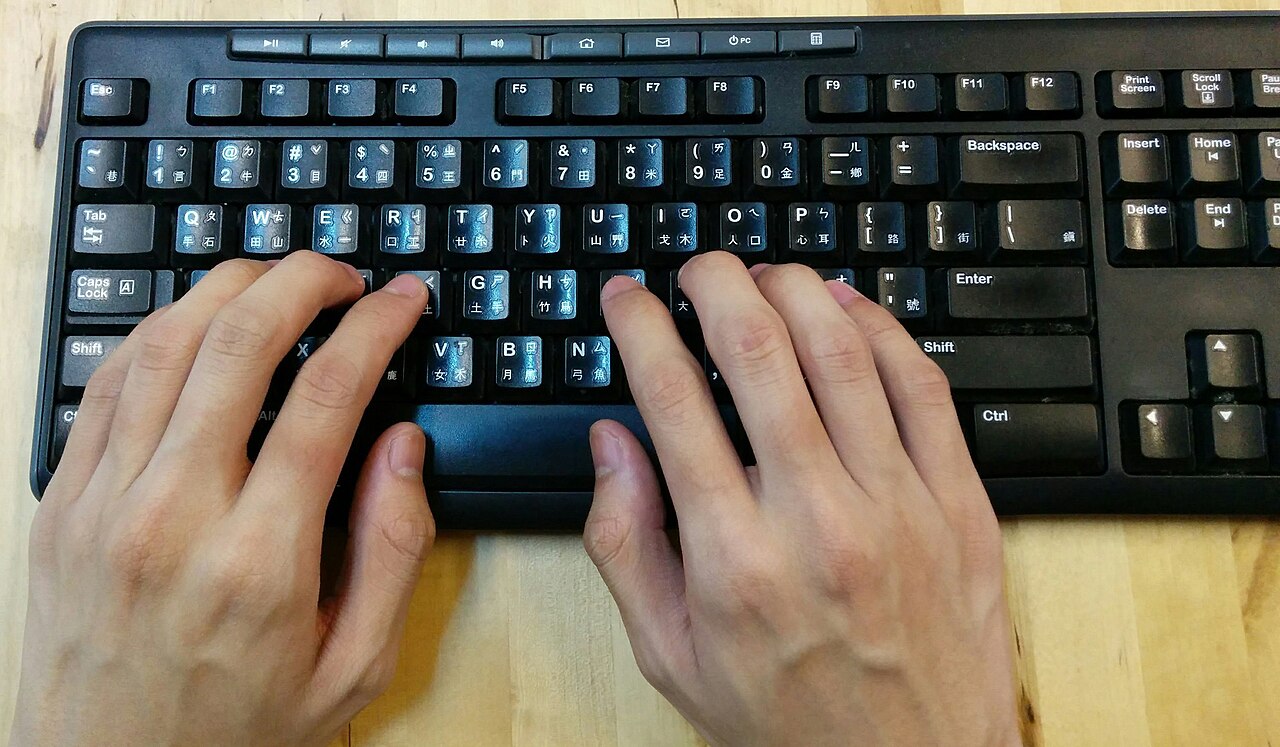
- Wikimedia Commons, "File:Keyboard with fingers.jpg" (source page for the real photograph of hands typing on a Chinese/CJK-labeled keyboard used as this article's cover image).