As of 2026-07-08T10:34:26Z UTC, the useful ai-china signal in Hugging Face's Spring 2026 open-source report is not simply that Chinese models are popular. The sharper read is that Chinese open and open-weight models are becoming dependencies. They are no longer only checkpoints that people download to compare against Western frontier models. They are increasingly base layers for derivatives, quantizations, adapters, local runtimes, agent tools, and national deployment strategies.[1][2]
That distinction matters because download share is easy to misuse. A download is not the same as a paying customer, a daily active user, or a production workload. Hugging Face and the Data Provenance Initiative both warn that raw model downloads need filtering because automated systems and old CI paths can inflate counts.[1][2] Even with that caveat, the direction of travel is hard to ignore: Hugging Face says China surpassed the United States in monthly and overall downloads, and that Chinese models accounted for a plurality, 41 percent, of downloads in the past year.[1] The Data Provenance paper, using a rolling-window filter for more authentic usage, similarly found China at 17.1 percent of downloads for models created from August 2024 to August 2025, just ahead of the United States at 15.8 percent.[2]
The result is a new kind of leverage. If a Chinese model family becomes the base for thousands of downstream artifacts, then influence moves from "who has the highest model card score" to "whose assumptions travel through the ecosystem." Tokenizers, licenses, context lengths, function-call formats, quantization recipes, safety defaults, hardware paths, and tool integrations start to spread with the model. That is what makes the current moment a dependency-surface story rather than a scoreboard story.
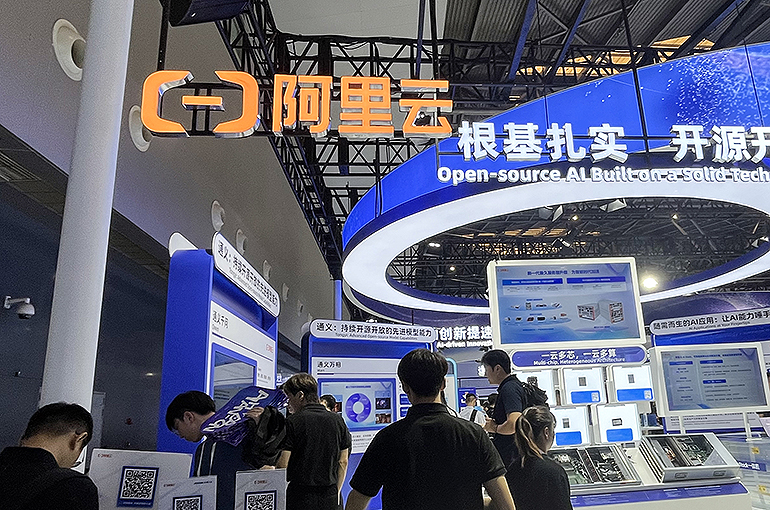
Image context: the cover uses a real Yicai photograph from an Alibaba Cloud exhibition booth, where the visible signage foregrounds open-source AI as infrastructure rather than as an abstract research claim.[5]
The Signal Is In The Derivatives
Hugging Face's Spring 2026 report says the platform had grown to 13 million users, more than 2 million public models, and over 500,000 public datasets in 2025.[1] That scale is important, but concentration is the better clue. The same report says the top 200 most-downloaded models, only 0.01 percent of the model set, represented 49.6 percent of all downloads.[1] In a market like that, the most reused base models shape downstream defaults far beyond their own repositories.
Qwen is the clearest case. Hugging Face reports that Alibaba had more derivative models than Google and Meta combined, with the Qwen family accounting for more than 113,000 derivative models and more than 200,000 repositories when model tags are included.[1] Its "DeepSeek Moment" follow-up puts the same fact in strategic language: Qwen was not shaped as one flagship model, but as a continuously refreshed family across sizes, tasks, modalities, Hugging Face, ModelScope, cloud channels, and application surfaces.[3]
That is why a Qwen or DeepSeek download count should be read as more than attention. It can indicate a dependency choice by a developer who wants a local model, a quantizer who wants a base to compress, an agent tool author who wants a widely recognized backend, or a company that wants an open-weight starting point before deciding whether to pay for managed inference. Each of those downstream decisions can compound without the original model lab controlling every use case.
The Adoption Loop Is Different From The Frontier Race
The U.S.-China frontier race still matters. But open-model diffusion works on a different clock. The USCC's March 2026 paper argues that China's open AI strategy creates a feedback loop: broad adoption drives iteration, which drives further adoption.[4] That loop does not require every Chinese model to beat the best closed U.S. model on every benchmark. It requires the model to be good enough, cheap enough, modifiable enough, and available enough to become an engineering default in many places at once.
DeepSeek-R1 is the template. Hugging Face's retrospective describes R1 as lowering three barriers: technical access to reasoning behavior, adoption through permissive release and downstream adaptation, and the psychological barrier for teams that had previously treated near-frontier models as unreachable.[3] The important change was not only that R1 scored well. It was that teams could download, distill, fine-tune, and integrate its behavior into real systems.[3]
That pattern helps explain why Chinese open-model momentum has lasted beyond one launch. Hugging Face notes that Baidu went from zero Hub releases in 2024 to more than 100 in 2025, while ByteDance and Tencent each increased releases by eight to nine times.[1][3] The platform report also says newly created trending models in 2025 were often either developed in China or derived from Chinese models.[1] That is a release-cadence signal, not just a prestige signal.
Why The Dependency Surface Is Operational
The operational question for adopters is not "Is the model Chinese?" It is "What contracts come with this base layer?" A dependency surface has several parts.
First, there is the runtime contract. If a model family is widely quantized, served through common frameworks, and adapted for domestic or non-Nvidia hardware, it becomes easier to try and harder to dislodge. Hugging Face's open-source report says Chinese open models are increasingly released with explicit support for domestically developed chips, while the broader ecosystem is also pushing quantization, mixture-of-experts architecture, and smaller deployable models.[1][2]
Second, there is the derivative contract. The Data Provenance paper identifies a fast-growing intermediary layer of developers who quantize, fine-tune, repackage, and adapt base models for specific communities.[2] Those intermediaries are not passive mirrors. They decide which base models become convenient, which formats spread, which local hardware paths get recipes, and which models become easy for non-experts to run.
Third, there is the governance contract. Open weights do not automatically mean transparent AI. The Data Provenance paper found that data transparency declined sharply, with downloads for models disclosing training data availability falling from 79.3 percent in 2022 to 39 percent in 2025, and open-weight downloads surpassing truly open-source downloads for the first time in 2025.[2] That creates a tension inside the China open-model story: the ecosystem is more usable, but not necessarily more auditable.
Fourth, there is the sovereignty contract. Hugging Face frames open weights as useful for governments and institutions that want local fine-tuning, domestic deployment, and reduced dependence on foreign-controlled cloud infrastructure.[1] That is especially relevant to China because the country's AI policy aims at broad industrial and public-sector integration, not only consumer chatbot adoption.[4]
What To Watch
The first watch item is whether Chinese model families keep converting downloads into durable downstream tooling. A spike in attention fades quickly; Hugging Face says mean engagement duration for open models is about six weeks.[1] If Qwen, DeepSeek, GLM, Kimi, Hunyuan, and related families keep producing maintained derivatives, runtime support, and agent integrations after that window, the dependency surface strengthens.
The second watch item is whether transparency improves or weakens as adoption grows. If open-weight releases become the norm while training-data disclosure keeps falling, then "open" will remain a deployment advantage but a governance problem.[2]
The third watch item is whether Chinese open models become invisible infrastructure outside China. The strongest sign will not be a viral leaderboard post. It will be a Western or global toolchain quietly defaulting to a Chinese base model, a quantization recipe, a code-agent backend, or a multimodal component because that path is cheaper, faster, or better maintained.
The narrow conclusion is this: China's open-model lead is not just a popularity contest. It is a dependency contest. Once developers build on a base model, inherit its tokenizer, route around its limits, package its weights, and teach tools to expect its behavior, the model family has already shaped the market even if a newer benchmark winner appears next week.[1][2][4]
Sources
- Hugging Face, "State of Open Source on Hugging Face: Spring 2026" (March 17, 2026; platform growth, China download share, derivatives, model concentration, hardware and adoption notes).
- Shayne Longpre et al., Economies of Open Intelligence: Tracing Power and Participation in the Model Ecosystem (Data Provenance Initiative / Hugging Face / MIT; download methodology, country shares, intermediary layer, transparency findings).
- Hugging Face, "One Year Since the DeepSeek Moment" (January 20, 2026; DeepSeek-R1 adoption effects, Chinese repository growth, and model-to-system competition shift).
- U.S.-China Economic and Security Review Commission, Two Loops: How China's Open AI Strategy Reinforces Its Industrial Dominance (March 23, 2026; open-model feedback loops, Qwen derivative ecosystem, industrial deployment thesis).
- Yicai Global, "Alibaba Cloud Cuts Prices for Specific Overseas Markets in Global Expansion Drive" (October 14, 2025; source page for the real Alibaba Cloud exhibition photograph used as the article image).