A protein model can produce a sequence of letters. A drug developer must decide which of those sequences deserves the next experiment. Between those two acts sits the business BioMap is trying to build: models that learn broadly from biology, then become useful inside a partner’s particular research program.
The company’s public record offers two different windows into that ambition. A paper published in April 2025 describes a protein model with inspectable research results. A June 2026 agreement with Harbour BioMed proposes a company that joins AI engineering to antibody platforms and clinical-development expertise.[1][5] Reading them together reveals the strategic question: can access to better experiments become a lasting model advantage?
A company assembled around collaborators
BioMap was founded in 2020 by Robin Li and Wei Liu. Its October 2023 announcement with Sanofi already described a division of labor: BioMap would contribute foundation models and computing expertise; Sanofi would contribute proprietary data and experience developing biological medicines. The companies intended to build AI modules for designing and optimizing those medicines.[3]
The arrangement also separated immediate payment from long-term possibility. BioMap announced a $10 million upfront payment, alongside development payments and contingent milestones that could take the potential deal value above $1 billion. That large headline described possible future achievements. It did not report a billion dollars of earned revenue.[3]
Sanofi’s own partnership page identifies the continuing aim as protein language models and optimization across multiple properties.[4] That wording matters. A research partner needs a candidate to satisfy several requirements together; improving one predicted property is only part of the assignment.
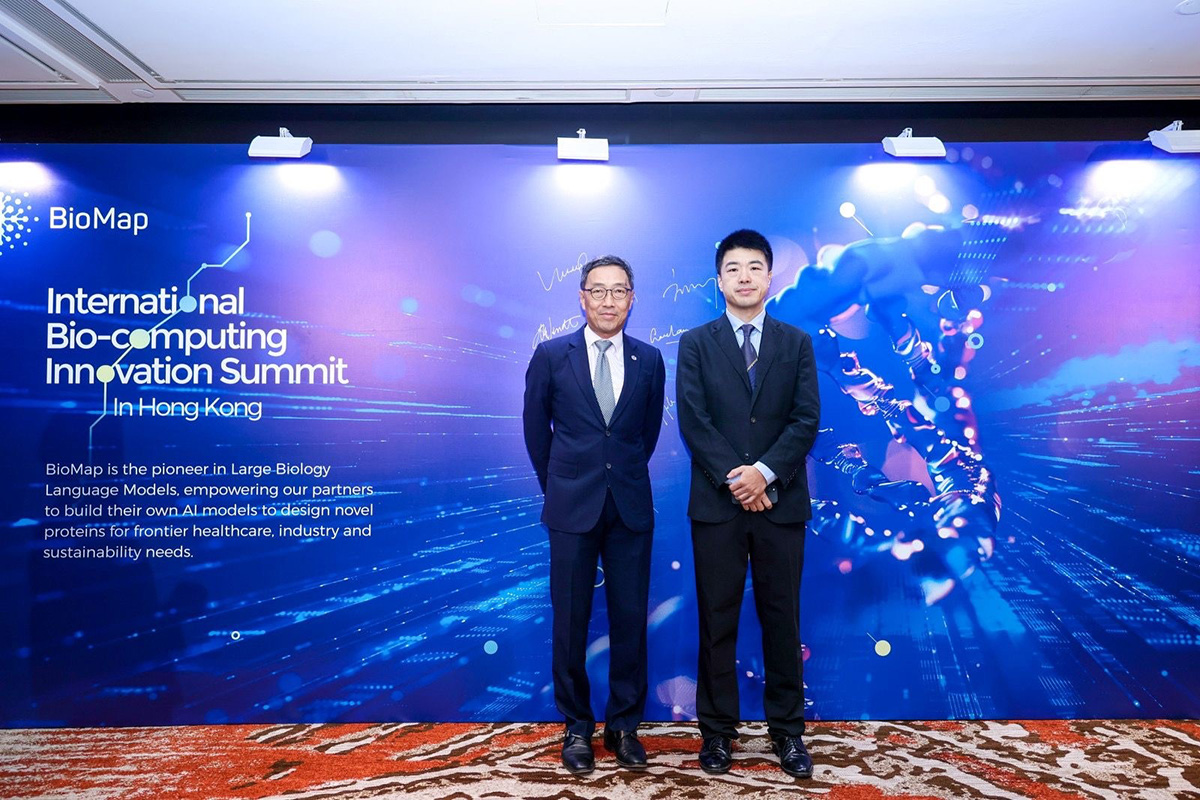
BioMap’s institutional footprint follows the same collaborative pattern. In June 2024, Hong Kong Science and Technology Parks Corporation documented its arrival at Science Park and plans for an international innovation hub. The public research behind xTrimoPGLM connects BioMap with Tsinghua University and MBZUAI.[1][6] This is a company rooted in China’s AI ecosystem whose research and commercial relationships cross borders.
What the published model actually supplies
The April 3, 2025 Nature Methods paper describes xTrimoPGLM, a 100-billion-parameter model trained on one trillion tokens. Its central idea brings together two learning tasks: recovering hidden parts of a protein sequence and generating sequences. In plain language, the same foundation learns both to interpret the protein alphabet and to write in it.[1]
The paper reports evaluations across 18 protein-understanding benchmarks, alongside structure prediction and controlled generation after further training. These are research tasks with specified datasets and methods. Their results support a claim about a reusable computational foundation; they do not supply a general drug-development success rate.[1]
There is a tangible release behind the paper. The BioMap–Tsinghua repository links to a four-bit version of the 100-billion-parameter model and smaller models for understanding or generation. Its instructions say the quantized large model can run inference on an A100/A800 GPU with 80 GB of memory. That is a documented hardware claim for that release, rather than a measured cost for a partner’s entire discovery program.[2]
The repository’s evaluation table illustrates the distinction. It reports perplexity—how surprising held-out sequences are to the model—on two sets separated from training data by different sequence-similarity thresholds. Those tests ask whether the model has learned transferable sequence patterns. They cannot establish whether a generated molecule will become a useful medicine. The repository also identifies a noncommercial license: public availability and unrestricted commercial use are separate questions.[2]
The partner brings the next experiment
Harbour BioMed’s June 15, 2026 Chinese-language exchange filing proposes taking collaboration further through MegaStream TechBio. Harbour would provide its antibody platform, biological expertise and clinical-development capabilities; BioMap would provide AI technology and model engineering. The planned company would combine exclusive data, specialized models and a laboratory process linking computation with physical experiments.[5]
This is the most consequential change in the dossier. The earlier public model offers a broadly trained starting point. The proposed venture adds an organization responsible for choosing experiments and advancing candidates. It could make the model’s outputs answerable to a continuing stream of measured results.
That last sentence is an inference about the strategy. The filing announces a plan, with management appointments under way. It also describes a newer 268-billion-parameter xTrimo system. That description should not inherit the published 100-billion-parameter model’s evidence automatically: the version, training and evaluation would need to be connected explicitly.[5]
The attraction is easy to understand. Imagine a program that records both successful and unsuccessful candidates, together with consistent measurements. A model could learn which proposals are worth testing next. But if measurements change between batches, failed experiments disappear, or data cannot be reused across projects, the apparent learning loop may contain less reusable knowledge than the partnership language suggests. These are conditions for the business thesis, not findings about BioMap’s internal practices.
The evidence that would change the assessment
The next useful disclosure would follow a model-selected group of candidates through a defined experimental process. Readers should be able to see the selection baseline, how many candidates were tested, which requirements they met, and whether incorporating the results improved the next round. Time and experiment counts would make the claimed efficiency legible.
For the company, repeat paid work would answer a different question: whether collaborators find enough value to keep using the system. Neither a model benchmark nor a potential milestone total can answer both questions at once.
BioMap has made a meaningful part of its scientific foundation available for inspection. Its partnerships identify where the next source of differentiation might come from. The decisive advance would be a documented improvement in the next experimental decision—then another improvement after the laboratory results return.
Sources
- Bo Chen and colleagues, “xTrimoPGLM: unified 100-billion-parameter pretrained transformer for deciphering the language of proteins,” Nature Methods, April 3, 2025 — model objectives, training scale, evaluations and affiliations.
- BioMap Research and Tsinghua University, xTrimoPGLM repository — released models, quantized inference requirements, sequence evaluation and license; accessed September 26, 2026.
- BioMap, “BioMap Establishes a Strategic Collaboration with Sanofi to Co-Develop AI Modules to Accelerate Drug Discovery for Biotherapeutics,” October 10, 2023 — founding history, partner contributions and contingent payment structure.
- Sanofi, “Technology Platforms” — Sanofi’s description of the BioMap collaboration and multiparametric optimization; accessed September 26, 2026.
- HBM Holdings, “Jointly Initiate MegaStream TechBio with BioMap,” June 15, 2026 — Chinese-language HKEX filing on the proposed venture, partner roles and newer xTrimo description.
- Hong Kong Science and Technology Parks Corporation, “HKSTP Congratulates BioMap on Signing Strategic Partnership Agreement with HKIC,” June 24, 2024 — Hong Kong expansion, innovation hub and source of the photograph.