As of 2026-05-07 UTC, the useful way to read Hunyuan-Large is to stop at neither the parameter headline nor the open-weight headline. Tencent's late-2024 release matters in ai-china because it makes a specific portability claim: Tencent now has a public MoE model line that can be benchmarked openly, downloaded in standard formats, and then pulled back into Tencent Cloud's own fine-tuning, evaluation, and API-publishing path.[1][2][4] That is more consequential than the slogan that it is merely "big."
The public record is strong enough to take the model seriously. Tencent's repository and technical report describe 389 billion total parameters, 52 billion activated parameters, 256K context for the pre-trained model, 128K for the instruct variant, and training on 7T tokens, including roughly 1.5T of synthetic data.[1][2] The same materials attach a benchmark story that is meaningfully above "China-only curiosity" status: strong Chinese scores, strong math, competitive coding, and overall comparisons that Tencent positions against both similar-scale MoE models and much larger dense baselines.[1][2]
But Tencent's own cloud documentation also makes the boundary unusually explicit. The Hunyuan product page repeats the long-context claim and says the model line reaches 99.9% on needle-in-a-haystack style long-input tests, while the TI-ONE onboarding guide pushes users toward a one-stop fine-tune-and-deploy path on Tencent's platform.[3][4] Then the separate TI evaluation guide says the quiet part out loud: open benchmark results are limited because public datasets invite leaderboard tuning, miss real application noise, and age poorly, so the better test is a custom subjective evaluation set built from your own scenario.[5] In other words, Tencent is publishing benchmark wins and simultaneously warning you not to overread them.
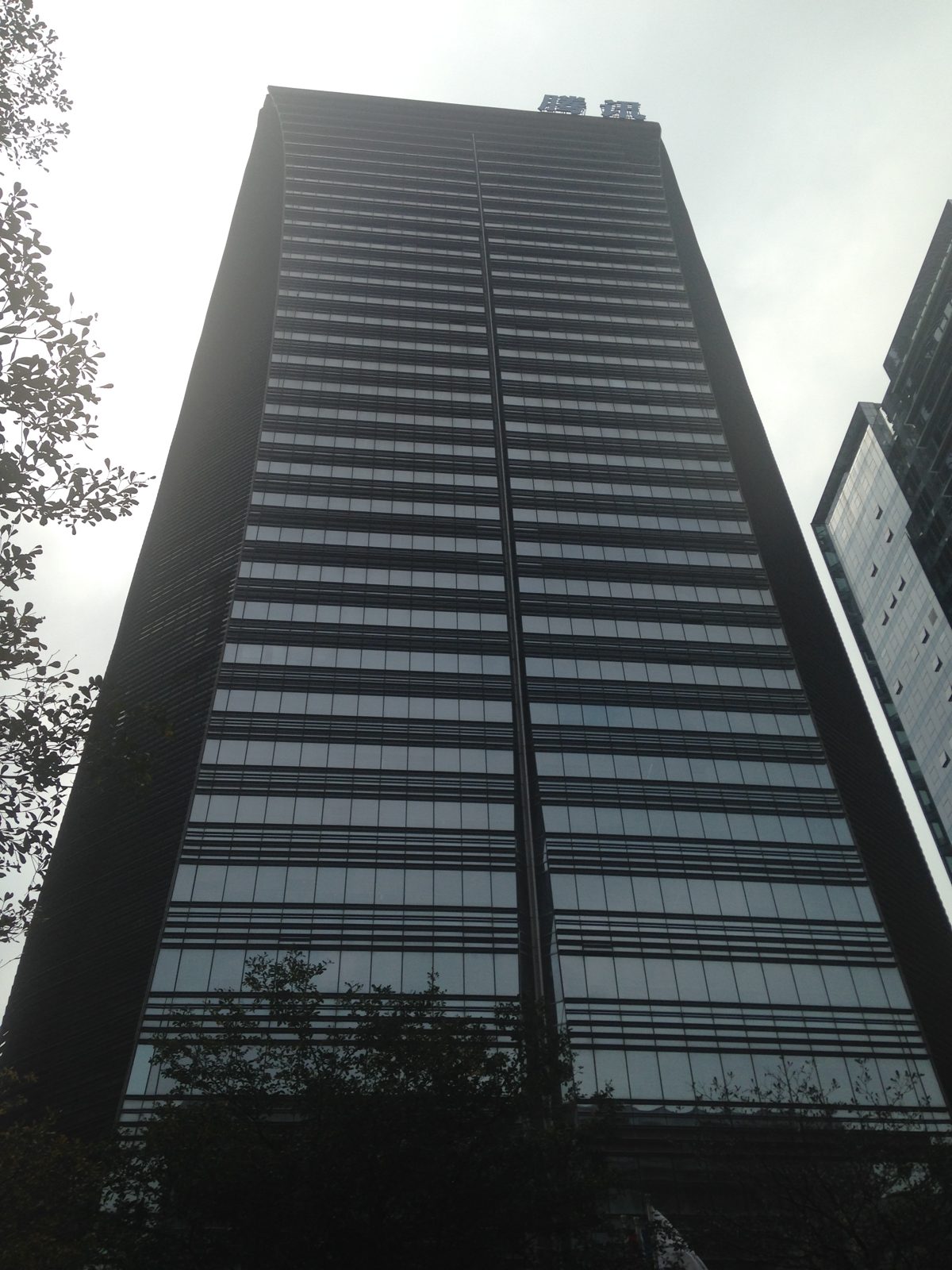
Image context: the cover uses a real Wikimedia Commons photograph of Tencent headquarters in Shenzhen. That is the right frame because the article is about Tencent's open-model posture and cloud operating path. The strategic object is the company trying to turn open weights into a governed enterprise lane.[6]
The benchmark sheet is strong enough to move Hunyuan-Large out of the curiosity bucket
The narrow question for this style mode is not whether Hunyuan-Large wins every imaginable benchmark. The sharper question is whether the public benchmark surface is strong enough that engineers should treat the model as a real open option rather than as a symbolic release.
The answer is yes. Tencent's repository says the pre-trained model leads its comparison set on MMLU 88.4, CMMLU 90.2, C-Eval 91.9, GSM8K 92.8, MATH 69.8, and HumanEval 71.4, among other tasks.[1] The instruct variant then pushes further on instruction-following and post-training measures, with MMLU 89.9, CMMLU 90.4, MATH 77.4, HumanEval 90.0, Arena-Hard 81.8, and AlpacaEval 2.0 51.8 in Tencent's reported table.[1] The technical report states the broader version of the same claim: Hunyuan-Large outperforms Llama 3.1-70B and is competitive with far larger dense models on a range of language, reasoning, mathematics, coding, and long-context evaluations.[2]
That matters because the release gives Tencent something it previously lacked in public form: an open-model evidence trail that can be read without first entering a closed application surface. The benchmarks are not a final verdict, but they are strong enough to change the burden of proof. A reviewer no longer has to ask whether Tencent has a serious open MoE lane at all. The better question is where that lane is strongest and what kind of workload it is actually built to carry.
The more interesting claim is portability, but Tencent means cloud-portable rather than casual-self-hosted
This is where the release gets more precise. Hunyuan-Large is "open" in a way that still points back toward Tencent's own infrastructure.
The repository highlights several portability signals: Hugging Face compatibility, training scripts, a vLLM backend, a promised TensorRT-LLM backend, and engineering tricks such as Grouped Query Attention, Cross-Layer Attention, and FP8 support to lower KV-cache and inference costs.[1] The README says CLA can cut the KV-cache portion of memory by 50%, FP8 can halve memory use against FP16/BF16 while lifting throughput, and LoRA fine-tuning can be done with at least 8 GPUs under Tencent's tested setup.[1] The technical report frames the same idea at a higher level: Hunyuan-Large is not only a research artifact but a model family designed for deployment, scaling-law study, and downstream adaptation.[2]
The Tencent Cloud path makes the operational meaning clearer. The TI-ONE onboarding guide says Hunyuan-Large was integrated into Tencent's training platform immediately, offers a public base-model API if untuned behavior is enough, and routes dedicated fine-tuned API publication through TI once teams adapt the model with their own data.[4] This is not laptop portability. It is platform portability inside a Tencent-shaped enterprise lane.
Tencent's own evaluation guide underscores the cost of taking the model seriously at full size. It recommends HCCPNV6 resources, says subjective evaluation of Hunyuan-Large should use a full node with 8 GPUs, 380 CPU cores, and 2214 GB of memory, and warns that loading the model can take more than one hour.[5] Read beside the benchmark tables, those details clarify the real offer. Hunyuan-Large is open enough to enter standard model workflows, but its center of gravity is still cloud-grade deployment, not everyday hobbyist inference.
Tencent's own eval docs are the best reason to keep the benchmark claims on a short leash
The most revealing source is not the repository or even the paper. It is Tencent Cloud's evaluation guide for comparing Hunyuan-Large against other models on TI-ONE.[5]
That document first acknowledges why open benchmarks are useful. They are the common language by which model releases become legible.[5] Then it lists three reasons they are insufficient: leaderboard-gaming risk because public datasets may already be seen during training, poor fit with real-world noise and scenario complexity, and dataset staleness as fast-moving models outgrow older public tests.[5] Tencent's answer is not rhetorical modesty. It is a concrete workflow: assemble a custom CSV or JSONL question-answer set from your own use case, upload it, and run subjective evaluation against Hunyuan-Large and competitor models inside TI-ONE.[5]
That changes how the public benchmark story should be read. The reported scores are best treated as a strong prior. They tell you Hunyuan-Large is not bluffing its way into the open-model conversation. They do not tell you that the model has already won your workload. Tencent itself is saying that the real test begins when the public sheet is replaced by your own prompts, your own data noise, and your own judgment criteria.[5]
The product page's long-context claim shows the same pattern.[3] "Supports up to 256K context" and a 99.9% needle-in-a-haystack figure are useful directional signals, but without your own retrieval patterns, prompt structure, latency budget, and failure tolerance, they remain directional. The deeper lesson is that Tencent wants the benchmark headline to pull you in, then wants the enterprise evaluation workflow to happen on Tencent infrastructure.
What this release actually proves
The strongest claim this article can support is narrow and useful. Hunyuan-Large proves Tencent can now make a credible public open-MoE case with real Chinese, math, coding, and long-context evidence, while also offering a built-in path from open weights to cloud fine-tuning and API publication.[1][2][4]
The weaker claims should stay weaker. The sources do not prove that Hunyuan-Large is the universally best open model. They do not prove that Tencent's long-context claims will survive every production retrieval pattern. They do not prove cheap or light deployment. And Tencent's own docs directly argue that open benchmark sheets are not enough to answer those questions.[3][5]
That is exactly why the release matters in ai-china. Hunyuan-Large is not just another oversized model announcement. It is Tencent's attempt to define an open lane whose destination is still a governed cloud operating path. The open benchmark story gets attention; the platform-shaped evaluation loop is where Tencent is trying to keep the work.
Sources
- Tencent Hunyuan Team,
Tencent-Hunyuan-LargeGitHub repository and README - model sizes, context limits, synthetic-data note, benchmark tables, inference backends, and hardware guidance. - Tencent Hunyuan Team, Hunyuan-Large: An Open-Source MoE Model with 52 Billion Activated Parameters by Tencent - technical report on architecture, training data, evaluation setup, long-context work, and comparative results.
- Tencent Cloud, "腾讯混元大模型" product page - Hunyuan family overview, 256K-context claim, and 99.9% needle-in-a-haystack long-input claim.
- Tencent Cloud TI-ONE docs, "Hunyuan-Large x TI 上手指南" - one-stop fine-tuning and deployment framing, public API path, dedicated API publication path, and download links.
- Tencent Cloud TI-ONE docs, "对比评测 Hunyuan-Large 和其他模型效果" - Tencent's own warning that open benchmarks have leaderboard, realism, and staleness limits, plus the custom subjective-evaluation workflow and resource requirements.
- Wikimedia Commons, "File:Headquarters of Tencent 20160307.jpg" - source page for the real headquarters photograph used as the article image.