As of 2026-05-07 UTC, the useful way to read Baidu's ERNIE-Image release is to focus on evaluation boundaries rather than on one overall rank line. The April 2026 open release matters because Baidu exposed more of the comparison envelope than image-model launches usually do: the public package distinguishes Prompt Enhancer on versus off, 50-step full generation versus 8-step turbo generation, English and Chinese long-text rendering, and a deployment claim that the model can run on 24G VRAM consumer GPUs.[1][2][3] That makes ERNIE-Image less interesting as a vague "state of the art" slogan and more interesting as a system whose tradeoffs can actually be inspected.
The public package is unusually explicit. Baidu's repository describes ERNIE-Image as an open text-to-image model built on a single-stream Diffusion Transformer with 8B DiT parameters, paired with a lightweight Prompt Enhancer that expands short prompts into richer structured descriptions.[1] The same README distinguishes two released versions: ERNIE-Image, positioned as the stronger instruction-fidelity model at 50 steps, and ERNIE-Image-Turbo, positioned as the faster aesthetic variant at 8 steps.[1] The Hugging Face diffusers documentation sharpens the operational boundary further: Prompt Enhancer is enabled by default because it can improve output quality, yet the docs warn that it may also reduce instruction-following accuracy, and they show separate generation examples for the 50-step full model and the 8-step turbo model.[2]
That combination is the core signal. Baidu is not asking developers to accept one sealed leaderboard claim. It is handing over enough of the system shape that benchmark wins can be read together with the knobs that produced them. In ai-china, where many model comparisons still flatten product surfaces into one vanity chart, that is a meaningful difference.
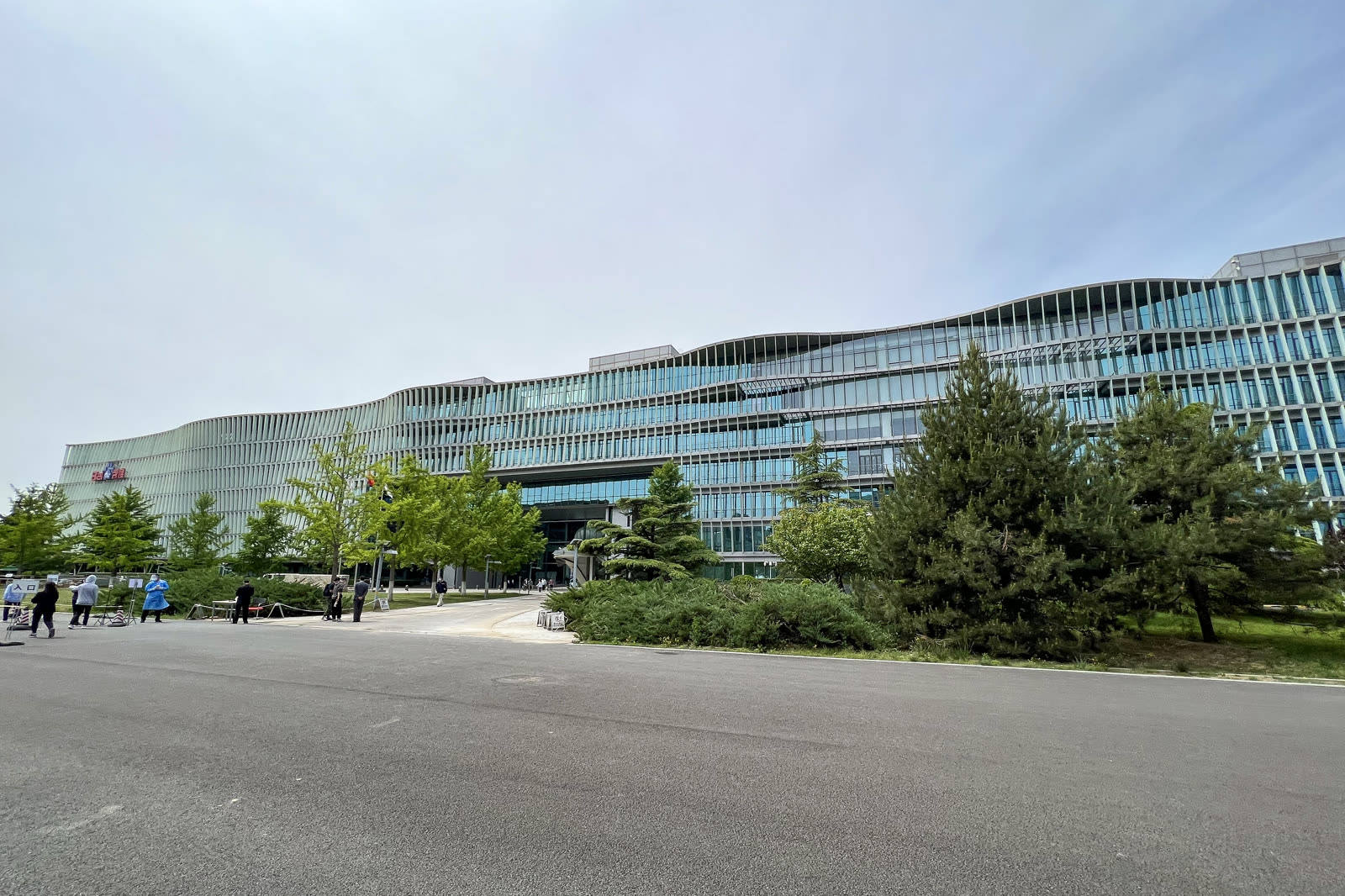
Image context: the cover uses a real Wikimedia Commons photograph of Baidu's Shangdi headquarters in Beijing. That choice fits the article because the important move is institutional. The story is not a generated sample sheet floating free of context; it is Baidu choosing to publish a more inspectable open image stack and its comparison boundary.[5]
The headline score only works if the evaluation envelope stays attached
The first thing to notice is that ERNIE-Image does not tell one single ranking story across all tasks. It tells several narrower ones.[1]
In GenEval, the repository shows ERNIE-Image (w/o PE) at 0.8856 overall, ahead of ERNIE-Image (w/ PE) at 0.8728 and ahead of Qwen-Image at 0.8683.[1] That matters because GenEval rewards compositional instruction following across categories such as object count, color, position, and attribute binding. On that sheet, Prompt Enhancer does not look like a free quality upgrade. It raises some subscores, such as counting, but it also weakens others, especially attribute binding, enough to lower the overall result.[1]
The story shifts on the text-heavier and layout-heavier tests. In OneIG-EN, ERNIE-Image (w/ PE) reaches 0.5750 overall, ahead of ERNIE-Image (w/o PE) at 0.5537, while ERNIE-Image-Turbo (w/ PE) also stays above its no-PE counterpart.[1] In OneIG-ZH, the same pattern holds: ERNIE-Image (w/ PE) posts 0.5543, above ERNIE-Image (w/o PE) at 0.5208.[1] And in LongTextBench, the full model with PE reaches 0.9804 in English and 0.9661 in Chinese, comfortably above the no-PE full model on both languages.[1]
This is why the release is best read as an eval-boundary story. If a team asks, "Is ERNIE-Image better than Qwen-Image?" the only honest answer is "on which workload, with which prompt path, and under which step budget?"[1][2] The repository itself makes that unavoidable. A model can gain when the task values expanded prompt structure and long text, then lose when the task rewards literal instruction retention under a tighter system path. ERNIE-Image's package is valuable precisely because it keeps those differences visible.
Prompt Enhancer is part of the system, not a cosmetic extra
The Prompt Enhancer should be treated as a model-layer choice, not as a harmless post-processing trick.
The diffusers documentation says this directly. Prompt Enhancer is enabled by default to improve output quality, but the same page warns that it may reduce instruction-following accuracy and tells users to set use_pe=False if they want the raw prompt path instead.[2] The docs also disclose that the enhancer itself is a pretrained 3B-parameter PE model, and even mention that larger external language models can improve enhancement further.[2] Once that is true, benchmark claims with PE turned on are no longer describing only the DiT backbone. They are describing a composite generation system.
That does not weaken the release. It clarifies what should be measured. If a product team wants posters, UI-like layouts, or long-form bilingual text rendering, PE-on results may be exactly the right thing to optimize for.[1][2] If a research team wants to know how faithfully the visual generator obeys terse, literal prompts without upstream rewriting, the no-PE path is the cleaner measure.[1][2] The mistake would be to mix those two evaluation objects while talking as if they were the same model behavior.
Baidu's own materials make this tradeoff unusually legible. The repository publishes PE-on and PE-off rows side by side across multiple suites, while the diffusers docs explain why the default is useful and why a user might still disable it.[1][2] That is better evidence hygiene than the more common pattern where prompt rewriting happens silently inside a product demo and the benchmark table never says so.
Step budget changes what is being compared
The second boundary is time and compute.
Baidu's README draws a sharp line between the full model and the turbo path: ERNIE-Image is the stronger general-purpose and instruction-fidelity release at 50 steps, while ERNIE-Image-Turbo is the faster variant at 8 steps, optimized by DMD and RL for speed and aesthetics.[1] The diffusers docs preserve the same split in code examples, with different num_inference_steps and different guidance_scale defaults for the two models.[2]
That means full-model and turbo-model comparisons should be kept separate unless the deployment objective is also the same. An 8-step turbo model that stays close to the full model on long-text or text-understanding tasks is commercially meaningful, because many production image workloads care about iteration speed and queue throughput as much as about maximum fidelity.[1][2] But it would still be sloppy to celebrate a turbo win without acknowledging that the full model is running a different optimization target, with a much larger step budget and a different quality-speed tradeoff.
This matters even more because Baidu also says the model can run on consumer GPUs with 24G VRAM.[1] That is a deployment claim, not only a benchmark claim. Once the public package is read that way, the practical question becomes: what kind of image workload does a 24G-card user actually get at 50 steps, and when is the 8-step turbo route the better operational choice?[1][2] Those are evaluation questions with product consequences, not minor implementation details.
Why this matters in AI-China
The broader AI-China signal is that Baidu is turning image generation into a more inspectable open lane rather than keeping it as a black-box showcase.
The official ERNIE-Image release page frames the model as a leading open-weight text-to-image release built on an 8B single-stream DiT.[3] The repository then adds concrete benchmark tables, PE-on and PE-off splits, step counts, deployment notes, and an Apache 2.0 license.[1] The diffusers docs put the model into a mainstream open-source inference path immediately, which matters because it lowers the friction for outside reruns and tool-chain integration.[2] And the ERNIE 5.0 Technical Report gives the higher-level context: Baidu is pursuing a unified multimodal generation-and-understanding stack rather than treating image generation as an isolated side project.[4]
That combination is more useful than a prettier sample gallery. It lets outside developers reason about what part of the stack is actually being compared, which parts are portable to their own workloads, and which headline numbers depend on prompt expansion or slower generation budgets.[1][2][4]
What to test next
For teams evaluating ERNIE-Image seriously, the first pass should not be "pick the winner." The first pass should be to preserve the boundary conditions the public package already exposed.[1][2]
Test PE on and off for the same prompt set. Split literal prompt obedience from long-text layout quality. Compare 50-step full runs against other quality-first models, and compare 8-step turbo runs against other fast-iteration lanes. Keep English and Chinese typography separate if text rendering matters. And if the deployment thesis matters, validate the claimed 24G VRAM lane under your own runtime and throughput budget rather than treating that line as automatically portable.[1][2]
ERNIE-Image becomes more interesting, not less, once those boundaries are kept visible. The release's strongest contribution is not that it ends the image-model argument. Its strongest contribution is that it gives the argument a cleaner object to measure.
Sources
- Baidu ERNIE-Image team,
baidu/ERNIE-ImageGitHub repository (official README covering the 8B single-stream DiT, Prompt Enhancer, 24G VRAM claim, Apache 2.0 license, 50-step full model, 8-step turbo model, and benchmark tables for GenEval, OneIG, and LongTextBench). - Hugging Face Diffusers docs, "Ernie-Image" (pipeline docs covering the 8B model family, Prompt Enhancer default behavior, the instruction-following caveat, the separate 3B PE model, and 50-step vs 8-step generation examples).
- Baidu ERNIE Blog, "Introducing ERNIE-Image" (official April 15, 2026 release page introducing ERNIE-Image as an open text-to-image model built on a single-stream Diffusion Transformer with 8B DiT parameters).
- Wang, Haifeng, et al., "ERNIE 5.0 Technical Report" (arXiv:2602.04705; unified multimodal understanding-and-generation framing and Baidu's broader generation stack context).
- Wikimedia Commons, "File:Baidu headquarters at Shangdi (20220509111837).jpg" (source page for the real headquarters photograph used as the article image).