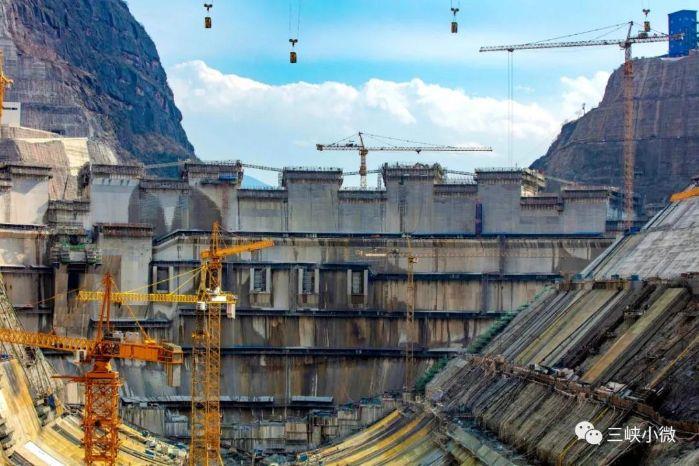
A message sent from the Baihetan dam construction site in February 2019 recorded three temperatures: concrete entering a placement area at 16.3°C, concrete being placed at 17.4°C, and surrounding air at 21.7°C. China Three Gorges Corporation reproduced the notification in a report the following month. On a manager's phone, a vast construction project had become a location, a time and a set of measurements that someone could act on.[1]
That small exchange is a useful entry into China's industrial AI. At Baihetan, the problem was keeping enormous volumes of fresh concrete on a controlled thermal trajectory. The machinery included buried sensors, simulation software and adjustable cooling-water circuits. Tsinghua University's construction team later documented deep learning within the simulation process, alongside the equipment that regulated water flow, temperature and timing.[2][3]
Concrete has its own weather
Concrete releases heat as cement reacts with water. In a massive pour, the resulting temperature changes can create stresses and cracks. The 2021 engineering account of Baihetan therefore describes a deliberately restrained cooling strategy: limit temperature differences, cool gradually, and adjust control to individual concrete blocks. The target is a manageable temperature history through space and time.[2]
The valley complicates that task. In its 2023 account for the International Association for Hydro-Environment Engineering and Research, the project's builder describes hot, dry conditions, frequent strong winds, summer extremes above 42°C and sharp winter temperature drops. A block's surroundings change while the material inside it is still changing too.[4]
Material choice supplied one response. Baihetan used low-heat cement throughout the dam, reducing the heat generated after placement. The same account places that choice alongside monitoring, spraying, circulating water and lifecycle simulations. Lower heat generation and controlled heat removal were complementary parts of the construction method.[4] An intelligent controller starts with the concrete the builders actually chose.
A measurement must reach a valve
Three Gorges' 2019 report describes the physical sequence clearly. Sensors measure concrete temperature, cooling-water temperature and flow. A server calculates water-supply settings against thermal-control requirements. An integrated valve then adjusts the water circuit. Staff monitor the system and handle exceptions.[1]
The 2021 technical paper makes the scale more tangible: the control software was designed to handle 2,000 placement blocks at a time, with time granularity below ten seconds. Those are descriptions of system capacity and timing, rather than a measure of prediction accuracy. The equipment gives a calculation a way to change what happens inside the dam.[2]
This is why the valve matters to the AI story. A better estimate has practical value only if an available intervention can use it soon enough. A temperature notification, a simulation and a flow adjustment occupy different positions in that sequence. Combining them creates an opportunity to learn from the consequences of an action; confusing them makes it difficult to tell what a reported improvement actually improved.
Where learning enters the calculation
Tsinghua's November 2021 account identifies a specific machine-learning role: deep learning helped infer parameters for simulations, supplying more accurate conditions for the model. The team also reconstructed the dam in three dimensions as placement progressed and analysed interacting physical processes. Separately, it describes jointly developed cooling equipment and software that adjusted water flow, temperature and duration.[3]
Parameter inference works backward from observations to the quantities a simulation needs. Learning can therefore contribute by improving the physical model used for engineering judgments, even when it does not command valves directly.
The university also describes field tests of low-heat concrete under windy, hot and dry conditions, including fracture behaviour and bonding between layers.[3] Together, these activities connect measurement, learning and physical modelling. They do not establish that the complete cooling system was a single learned controller.
What the finished concrete can tell us
A paper published in the April 2026 issue of the Journal of Zhejiang University–SCIENCE A brings the construction experience together. Its authors describe a coordinated method covering material quality, construction timing, water-pipe cooling and management. They report that post-construction investigations found no thermal cracking in the cited applications at Xiluodu, Wudongde and Baihetan.[5]
That is a substantial reported engineering outcome, with a specific scope. The result belongs to the combined method. It does not isolate the contribution of deep learning, and an observation about thermal cracking is not a blanket certification against every possible defect. The paper's own emphasis on materials and construction sequence makes that distinction essential.[5]
For future applications, the revealing comparison would hold those other contributions visible: which temperature excursions were avoided, which interventions changed, and how the system performed when measurements or equipment were unreliable. These are questions for evaluating a deployment, rather than results established by the sources here.
Baihetan offers a concrete way to recognise useful industrial AI. Start with the measurement buried in the structure, follow it into a model, and then follow the resulting decision back to the water moving through the concrete. The intelligence earns its place through that complete journey.
Sources
- Du Jianwei and Zhou Mengxia, “Baihetan: a smart dam with a nervous system.” China Three Gorges Corporation, March 26, 2019 — site notification, installed cooling controls and construction photograph; Chinese-language firsthand report.
- Tan Yaosheng et al., “Intelligent construction methods for the Baihetan super high arch dam.” Journal of Tsinghua University (Science and Technology), 61(7), 694–704, 2021 — especially section 4.3 on concrete cooling; Chinese full text.
- Tsinghua University, Department of Hydraulic Engineering, report on its intelligent dam-construction team's contribution to Baihetan, November 22, 2021 — deep-learning parameter inference, simulations, cooling equipment and field testing; Chinese-language firsthand account.
- China Three Gorges Corporation and China Three Gorges Construction Engineering Corporation, “Empower Sustainability: Reveal the Smart Baihetan Dam.” Hydrolink 2/2023, pp. 28–30 — local climate, low-heat cement and integrated construction methods; IAHR library record with downloadable article.
- Qixiang Fan et al., “Thermal anti-cracking safety control for concrete dams.” Journal of Zhejiang University–SCIENCE A, 27(4), 437–452, 2026 — integrated control approach and reported post-construction findings.