A weather forecast has a hidden first task: deciding what the weather is now. A satellite measurement and a report from a ship arrive with different coverage, timing and uncertainty. Turning such observations into a coherent starting atmosphere is a major part of forecasting, before a model ever advances tomorrow's clouds across a screen.[1]
FuXi-Weather brings that first task into China's weather-AI story. In July 2025, a collaboration involving Fudan University, the Shanghai Academy of Artificial Intelligence for Science, the China Meteorological Administration and UCLA presented a system that combines learned data assimilation with learned forecasting. The change is consequential: the AI system constructs successive starting states from observations instead of continually receiving them from a conventional forecasting centre.[2]
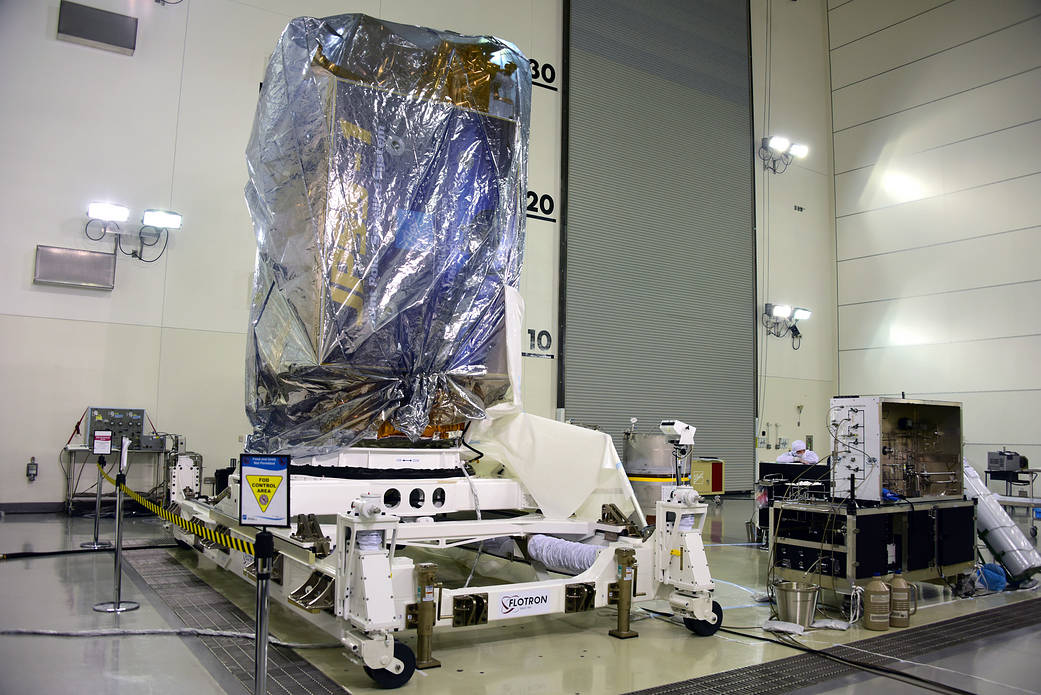
The atmosphere comes with a memory
Meteorologists call the updated estimate of current conditions an analysis. They call the short forecast carried forward from the previous cycle the background. Data assimilation combines that background with incoming measurements, then launches the next forecast. The background preserves information from earlier observations; the analysis gives new evidence a chance to correct it.[1]
This explains why “from observations” should not suggest starting from scratch at every update. Imagine watching a moving storm through intermittent gaps in cloud cover. Remembering where it was helps interpret the next incomplete glimpse. The atmospheric problem is vastly more complicated, but the value of retaining a previous estimate is intuitive. An observation becomes more informative when there is a prediction to compare it with.
The published FuXi-Weather system assimilates measurements from FY-3E, Metop-C and NOAA-20, plus radio-occultation data. It cycles every six hours on a 0.25-degree grid. Removing background forecasts worsened its analyses, especially around missing satellite data.[4] The learned system still benefits from the meteorological habit of carrying yesterday's evidence into today's estimate.
Fudan's Chinese-language announcement describes an ambition to assimilate observations more frequently, potentially with additional small satellites. That is a development direction, separate from the demonstrated experiment. The announcement also situates FuXi-Weather within a family of forecasting models; the operating history of another FuXi model does not establish deployment of this particular system.[2]
The score depends on the atmosphere used to mark it
The paper's main evaluation runs from July 3, 2023, through June 30, 2024, testing ten-day deterministic forecasts with root-mean-square error and anomaly correlation. FuXi is checked against ERA5 reanalysis and, additionally, its own analyses; ECMWF's HRES is checked against HRES analyses. Verification against each system's own analyses favours it at short lead times.[4]
Fudan highlighted a gain for Z500, the geopotential at 500 hectopascals: useful lead time rose from HRES's 9.25 days to 9.5 days, a six-hour extension.[2] The paper defines skill here by an anomaly-correlation threshold of 0.6.[4] Those extra six hours apply to that atmospheric field under the stated test. Local rainfall warnings require a separate evaluation.
An analysis is an estimate, so agreement with it is a carefully defined test rather than direct access to atmospheric truth. That distinction becomes especially important when the innovation changes the analysis itself. A forecast can move farther from the revised reference without becoming less useful in the real world.
ECMWF documented just such a problem in its June 2020 system upgrade. A change that extracted more information from observations made some scores look worse when forecasts were verified against the system's own analyses. Checking against an independent analysis showed a neutral overall effect from that change. The apparent deterioration came from a moving reference.[5]
This is a useful discipline for reading the FuXi comparison. First identify the forecast variable and lead time. Then identify what supplied the verifying field. Only then interpret the gap between models. A single headline ranking compresses all three decisions, precisely where this experiment needs them kept visible.
The rainfall check supplies a particularly revealing limit. Against IMERG satellite precipitation estimates in central Africa and northern South America, FuXi-Weather had lower root-mean-square error than HRES. Yet both systems retained weak anomaly correlations and substantial mean biases.[4] Winning that comparison leaves considerable room for improvement. For someone interested in rain, a smaller average error and a convincing prediction of unusual conditions are different achievements.
A release that invites a narrower reproduction
The paper-linked Zenodo deposit makes the experiment inspectable. Its June 29, 2025 version lists code, model and sample data, and explicitly says that the supplied ONNX model is configured for assimilation during March 2024.[6]
That date matters more than the convenience of a download button. A sensible reproduction begins inside the declared period, checks the input preparation and reconstructs the reported comparison. Applying the artifact to a later observing network is a further experiment. The archive supplies a concrete starting point for investigation; it does not, by itself, demonstrate a continuously maintained forecasting service.
The wider problem remains current. In September 2026, ECMWF described AI opportunities in observation processing, quality control and the conversion between model variables and measured signals. Its account also stresses the continuing value of ground, aircraft and marine observations for calibration, bias detection and local detail.[7] Better use of satellite information therefore belongs within an observing system that still needs independent checks.
For China's weather-AI progress, the implication is a broader standard of evidence. Ask whether a system can keep updating its atmosphere as measurements arrive, whether its advantages survive a change of reference, and whether they persist for the variable a user actually needs. FuXi-Weather makes the first question experimentally concrete. Its evaluation shows why the next two deserve equal attention.
Sources
- ECMWF, “Data assimilation” — definitions of analysis and background, the observation cycle and uncertainty.
- Fudan University, “FuXi-Weather: a global weather cycling assimilation and forecasting system” (July 23, 2025; Chinese-language team announcement, title shortened and translated).
- NASA, “JPSS-1 Prelaunch Processing” (October 13, 2017) — Rodney Speed's photograph taken September 25, 2017.
- Xiuyu Sun and colleagues, “A data-to-forecast machine learning system for global weather,” Nature Communications 16, 6658 (July 19, 2025) — methods, evaluation references and rainfall limitations.
- Michael Sleigh and colleagues, “IFS upgrade greatly improves forecasts in the stratosphere,” ECMWF Newsletter 164 (July 2020) — the effect of changing analyses on verification.
- FuXi Team, “FuXi Weather Model and Data,” Zenodo, version v2 (June 29, 2025) — the paper-linked release and its March 2024 assimilation configuration.
- ECMWF, “From space to forecast: how ECMWF turns satellite data into trusted weather predictions” (September 3, 2026) — observation processing, independent measurements and AI research.
- NASA, “JPSS-2 Begins Launch Processing” (September 20, 2022) — confirms that NOAA-20 was previously known as JPSS-1.