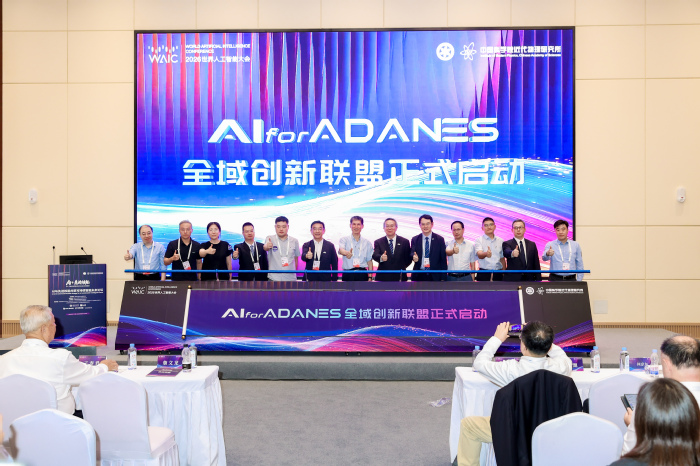
On July 17, 2026, a line of researchers and industry representatives stood beneath a blue conference screen in Shanghai and launched the AI for ADANES innovation alliance. The screen made the project look like one thing. The physical system underneath it is at least four: a high-current proton accelerator, a spallation target, a subcritical reactor, and a used-fuel recycling route.
The accompanying road map puts five AI layers across that chain—a unified data infrastructure, physics-native world models, physical-system control, agent coordination, and continuous evolution—and extends them from design and commissioning into operation and maintenance.[1][2] This is the real update. China's accelerator-driven nuclear program already had a physical architecture. It now has a proposed software architecture for making the parts compute together.
That proposal should not be read as one giant nuclear model. Each machine speaks a different technical language, produces a different kind of evidence, and fails on a different clock. The useful question is where the five layers attach to those physical differences—and how much of the larger loop the still-under-construction CiADS facility can actually exercise first.[1]
Four machines beneath one acronym
ADANES stands for Accelerator-Driven Advanced Nuclear Energy System. The original 2017 concept from the Institute of Modern Physics at the Chinese Academy of Sciences (CAS) divides it into a burner system and a fuel-recycle system.[3]
The burner begins with an accelerator. A high-energy proton beam strikes a target and releases neutrons through spallation. Those external neutrons sustain fission in a subcritical core. The word subcritical is essential: the reactor is designed around an outside neutron source rather than an independently self-sustaining chain reaction. The wider concept then adds a high-temperature dry process intended to remove selected fission products and turn the remaining material back into fuel.[3]
Calling this a four-machine stack is a simplification—the recycler alone contains several processes—but it reveals the coordination burden hidden by the single ADANES name. Beam dynamics, target thermal hydraulics, reactor neutronics, and fuel chemistry do not naturally arrive in one training format.
The latest public engineering numbers make the differences tangible. In an August 10, 2026 conference report, ADANES technical director He Yuan described a 600 MeV, 5 mA superconducting proton linac with beam power above 2.5 MW and a beam-loss target below 10⁻⁶; thermal-hydraulic validation of a 3 MW liquid lead-bismuth spallation target; and completion of the design for a 10 MWt pool-type subcritical reactor.[4] These are presenter-reported component milestones, not a statement that the whole coupled facility is operating. The Institute of Modern Physics still described CiADS as under construction in its July road-map account.[1]
That maturity boundary is useful. It separates a stack of commissioned, validated, designed, and still-to-be-integrated pieces instead of turning them into one launch-stage achievement.
A unified data layer cannot be a flat one
The road map's first layer is a unified data infrastructure. “Unified” should mean that records can be aligned and traced, not that they lose their native structure.
The accelerator produces radio-frequency, magnet, vacuum, timing, and beam-loss signals. The target adds flow, pressure, temperature, vibration, chemistry, and inspection histories. The reactor brings neutron measurements, thermal states, core configuration, control position, and material exposure. The recycler works in batches whose identities depend on composition, process conditions, assay, separation, and fabrication results.
Those records differ in cadence and meaning. A beam transient may unfold before a slow material trend becomes visible. A target temperature belongs to a particular sensor calibration and flow state. A fuel measurement belongs to a physical lot that may later be divided, combined, or fabricated. A common timestamp alone cannot preserve those relationships.
This is where ordinary infrastructure becomes part of the AI product: equipment identities, configuration history, units, uncertainty, calibration, material lineage, simulation version, and the link between a calculated state and the physical item it describes. The International Atomic Energy Agency's 2025 AI deployment report makes the same point at industry level. It treats data integrity, preprocessing, ageing or failed sensors, interrupted streams, and alignment between development data and the intended operating scenario as life-cycle concerns, not cleanup work performed once before training.[6]
For ADANES, the data layer will also need to distinguish at least three kinds of record: simulated states, component-test measurements, and eventually integrated-facility observations. Combining them may be valuable. Blurring their provenance would make a model look better informed than it is.
“Physics-native” implies a federation
The second layer is described as physics-native world models. The plural is revealing.[1] No single representation is likely to replace the specialist codes and experiments already used for accelerator optics, spallation, thermal fluids, neutron transport, materials degradation, and fuel processing.
A more plausible stack is federated. One fast surrogate might screen accelerator settings while retaining a high-fidelity beam model as its reference. Another might estimate target conditions between expensive simulations. A reactor model could combine measured neutron signals with kinetics and thermal constraints. A fuel-cycle model would operate over process steps and material batches rather than millisecond machine states.
The hard work sits where outputs cross domains. Proton-beam conditions become an input to the spallation calculation. Neutron production and target conditions become boundary information for the subcritical core. Core history changes the composition and condition of material entering the recycle route. Each transfer changes units, resolution, uncertainty, and sometimes ownership.
This gives the agent-coordination layer a concrete job. It is less a synthetic scientist floating above the facility than a traffic controller among specialist models, databases, and tools. It must know which physical model is valid for the current configuration, translate without discarding uncertainty, and preserve enough context that the next subsystem can reproduce the input it received.
The 2019 CAS materials review shows why model federation cannot be only a software exercise. It identifies harsh irradiation, corrosion, temperature, stress, and long-service demands around the spallation target and subcritical reactor, and treats materials development as a major constraint on an integrated accelerator-driven system.[5] A target model that ignores changing material condition may be numerically tidy and physically stale.
CiADS tests burner-side coupling at experimental scale
CiADS—the China initiative Accelerator Driven System—is presented as ADANES's engineering-verification platform and remains under construction.[1] Its importance is specific: it brings the accelerator, target, and subcritical reactor into one experimental facility where the boundaries between their models can meet hardware. It does not reproduce the full size or configuration of a future industrial ADANES burner.[3]
That makes CiADS the first serious test of three claims embedded in the AI road map. Can a shared data infrastructure align signals across the coupled machine? Can physics-native models remain useful when the facility differs from simulation? Can orchestration keep the correct model, configuration, and instrument state attached to every calculation?
It cannot, by itself, stand in for the complete ADANES loop. The 2017 concept includes the separate fuel-recycle system as an essential half of the architecture.[3] A successful accelerator–target–core campaign would validate burner-side coupling at CiADS's scale and configuration; it would not automatically validate a full-size burner, batch chemistry, material recovery, regenerated-fuel fabrication, or the return of that material to a future industrial system.
This distinction also clarifies the August milestones. A linac can be commissioned while the integrated facility is unfinished. A target can pass thermal-hydraulic validation without having accumulated the full operating history of a coupled nuclear system. A reactor design can be complete before the reactor supplies operating data. The AI stack must carry those maturity labels with the data, or it will train across design, test, and operation as though they were interchangeable.[1][4]
The alliance is part of the supply chain
The launch account says the AI for ADANES alliance brings together research institutes, nuclear enterprises, AI companies, and financial institutions.[1][2] That is broader than a model-development team because the missing inputs are distributed.
Research institutes hold the accelerator and reactor physics, experimental facilities, and specialist codes. Nuclear enterprises bring industrial quality systems, component histories, operating procedures, maintenance practice, and the constraints of eventual deployment. AI companies can build data plumbing, model infrastructure, orchestration, and observability. Financial institutions may help move a research program toward capital-intensive demonstration, but they do not validate the physics.
The alliance's first useful products should therefore look less like a universal chat interface and more like interface contracts. The accelerator–target boundary needs an agreed description of beam state and uncertainty. The target–core boundary needs a versioned account of neutron source and thermal conditions. Material records need identifiers that survive inspection, irradiation, removal, analysis, and processing. Simulations need machine-readable configuration and code provenance so that a prediction can be rerun after the hardware changes.
The public launch accounts do not yet name the members responsible for those contracts, describe access to facility data, or explain how models and schemas will be governed across organizations.[1][2] Those are not side issues. A five-layer architecture shared by several industries is also an ownership architecture.
What changed—and what would prove the stack
The progression is now visible across three moments. The 2017 ADANES paper defined a burner plus recycler and made the closed fuel loop the system's purpose.[3] The 2019 materials review detailed the physical constraints that make an accelerator-driven facility difficult to build and sustain.[5] The 2026 road map adds unified data, physics-native models, agents, and learning across the life cycle, while current engineering reports describe distinct progress on the linac, target, and reactor design.[1][4]
That is a genuine stack update: AI is being placed inside an existing program of accelerators, heavy liquid metal, reactor physics, and fuel processing rather than attached to “nuclear energy” in the abstract.
The next convincing evidence should stay subsystem-specific. An accelerator task should state its beam regime and beam-loss boundary. A target model should name its fluid, geometry, material state, and thermal-hydraulic validation. A reactor task should identify the core configuration and neutron data on which it depends. A recycler task should retain batch lineage and assay. Only then does an end-to-end demonstration mean more than several good component demos shown side by side.
CiADS can make the first three physical dialects meet at experimental scale. The larger ADANES program still has to connect the fourth and prove how the coupled burner scales. The five-layer AI road map matters if it makes that complicated topology more explicit, reproducible, and governable. Its success will not be one model that claims to understand the whole machine. It will be a system in which every specialist model knows exactly which machine it is speaking for.
Sources
- Institute of Modern Physics, Chinese Academy of Sciences, “AI Road Map Unveiled to Advance Intelligent Nuclear Energy Systems” (July 22, 2026; IMP-hosted report on the five-layer architecture, CiADS construction status, alliance, and ADANES scope).
- ScienceNet, “破解核能AI‘黑箱’难题,AI for ADANES技术路线发布” (July 18, 2026; WAIC forum, alliance composition, CiADS validation role, and source page for the launch photograph).
- Xuesong Yan et al., “Concept of an Accelerator-Driven Advanced Nuclear Energy System,” Energies 10(7), 2017, doi:10.3390/en10070944 — original burner-and-fuel-recycle architecture and the role of the accelerator, target, subcritical core, and dry reprocessing.
- He Yuan, “加速器驱动先进核能进展” (Progress in Accelerator-Driven Advanced Nuclear Energy), 23rd National Conference on Nuclear Electronics and Nuclear Detection Technology, August 10, 2026 — first-hand IMP report of linac, target, and reactor-design milestones.
- Zhiguang Wang et al., “Materials for Components in Accelerator-driven Subcritical System,” Strategic Study of CAE 21(1), 2019 — ADS component architecture, operating environment, and materials constraints around the target and subcritical reactor.
- International Atomic Energy Agency, Considerations for Deploying Artificial Intelligence Applications in the Nuclear Power Industry, Nuclear Energy Series NR-T-1.26, 2025 — data governance, sensor condition, model life cycle, monitoring, and application-specific deployment boundaries.